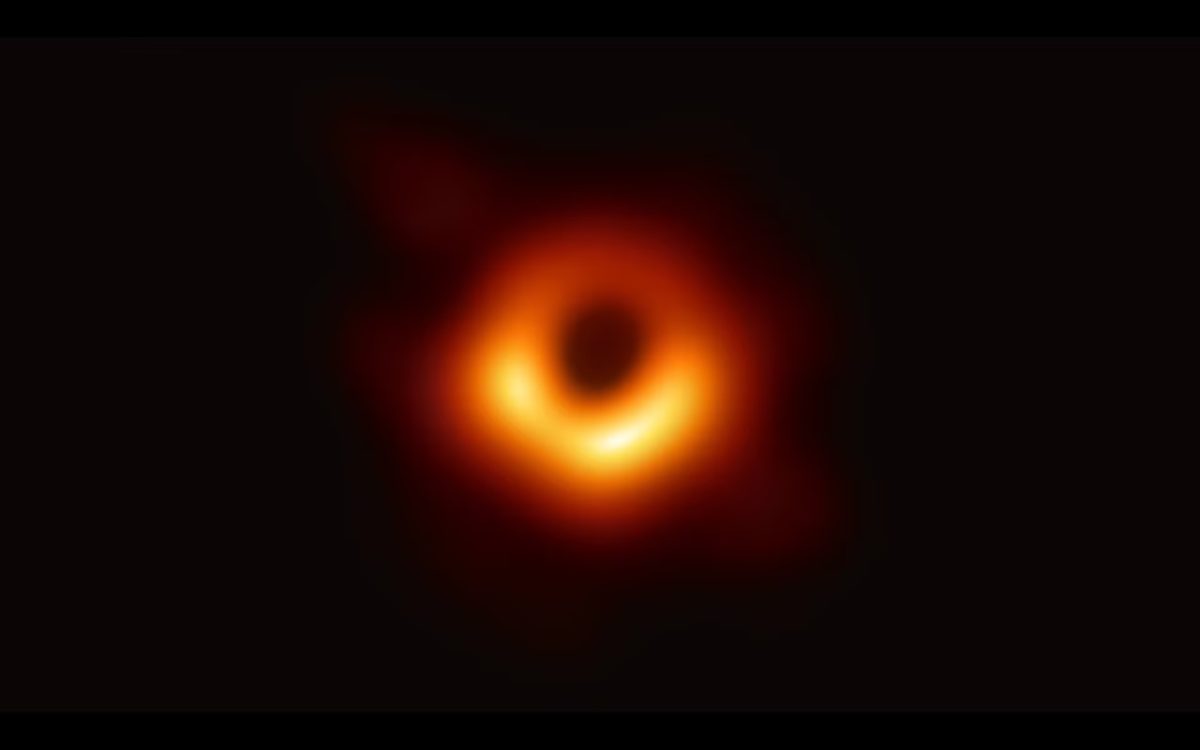
When Interstellar was released five years ago in November 2014, Christopher Nolan’s vision of space travel came under intense scrutiny from Nobel Prize-winning physicist Kip Thorne. The result is a success that balances cinematic spectacle with rigorous astrophysics. Of course, it requires creative freedom. As physicist Jean-Pierre Luminet quickly revealed on his Futura blog, the depiction of the supermassive black hole Gargantua is visually stunning but physically misleading. But under the Hollywood aura, this movie does a lot of things right. Orbital mechanics? Solid. Time dilation close to gravity well? Accurate. The science is still valid, even if the visuals are a little too pretty.
Now that the Event Horizon telescope is starting to take real pictures of these space monsters, a new study out of Japan adds unexpected credibility to Nolan’s fictional world. The researchers, who published their findings in Astrophysical Journal and arXiv, see black holes as more than just graveyards. They believe that planets can actually form around them.
This has nothing to do with the quasar environment, where the radiation levels strip the atmosphere immediately. The new paper focuses on low-luminosity active galactic nuclei (AGN). These are the silent relatives of quasars. In this area, mathematics suggests something strange. Accretion disks around black holes could be viable nurseries for exoplanets.
How do planets form around black holes?
This assumption sounds like science fiction, because it is. For decades, the Standard Model has proposed that extreme tidal forces and radiation near a black hole would tear apart planets before they formed. The environment is considered hostile rather than conducive to structure formation.
However, the Japanese team’s analysis has changed this view. They study the dynamics of the rotating ring of gas and dust that feeds the black hole. conditions can vary wildly. If the central black hole is part of a low-luminosity active galactic nucleus (AGN), certain regions of the disk are cooler and denser. This cooling causes the dust particles to stick together. They unite, grow and eventually form a planetesimals.
Research has shown that under the right conditions, the chaotic environment of the accretion disk can be stable enough to allow planet formation.
This is not just a theoretical hand-waving. This paper discusses the physical mechanisms by which solids withstand such extreme gravitational gradients. The key is the balance between the black hole’s gravity and the disk’s own angular momentum. If the disk is large enough and the black hole is not actively operating at maximum capacity, the outer region could behave more like a protoplanetary disc around a young star than a death spiral entering a singularity.
Why this is important in the search for exoplanets
If true, this would fundamentally change the search for life outside our solar system. We spent years searching the stars for habitable zones. We ignore the center of the galaxy as too violent to support life. But if planets can form around black holes in less active galaxies, we might be looking in the wrong place.
The implications is shocking. Planets orbiting black holes do not receive light from stars. Its main source of heat is
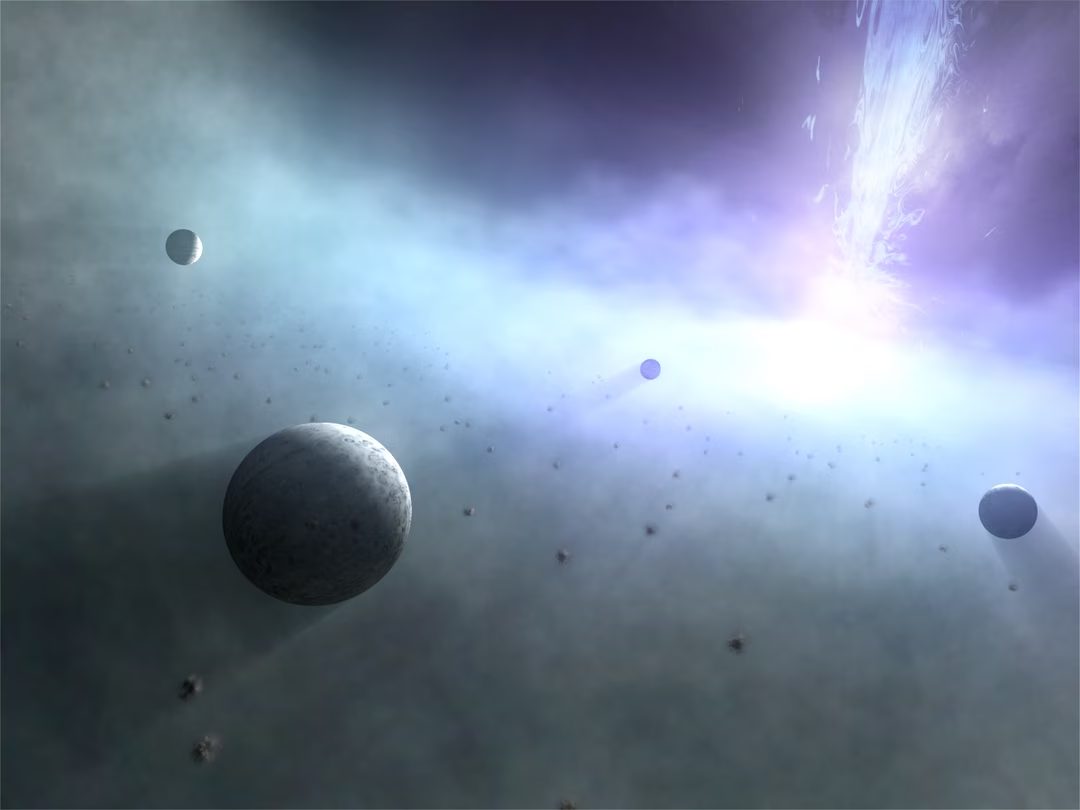

Japanese scientists are destroying places where life might exist. We usually think of black holes as cosmic vacuums, a destructive force that swallows everything nearby. However, a new theoretical model suggests that the material accreting around supermassive black holes actually forms a double structure. It’s not just empty space.
First, there is a accretion disk just beyond the event horizon. This is a ring of superheated material that orbits a black hole, specifically a Kerr black hole. It is incredibly hot. But look further. Past that fiery ring is a dusty torus. This thick dust torus blocks the intense radiation from the center.
This torus extends from about 0.3 to 30 light-years. The temperature drops significantly here. It cools enough for a stratified structure to appear. Basically you get a setup very similar to a protoplanetary disk around a young star.
The Snow Line around a black hole
Astrophysicists have calculated that the same processes that built our solar system must be at work in these disks. Dust grains clump together. they grow. They eventually become planets. The timeline? Several hundred million years.
This is an important detail. Located about three light-years away from the supermassive black hole, the temperature of the dust torus is low enough to trigger something specific. The famous snow line or frost start to form.
Our calculations show that tens of thousands of planets, each with a mass 10 times the mass of Earth, can form within 10 light-years… Around black holes, there could be planetary systems of incredible scale.
— Eiichiro Kokubo, Professor, National Astronomical Observatory of Japan
In our solar system, this line is where water and other volatiles freeze into solid ice particles. Necessary for the formation of giant planets. Now ice particles can form in exactly the same way around black holes.
Strong systems in areas of violence
This is not just one person’s guess. Eiichiro Kokubo, one of the authors of this theoretical discovery, points out the sheer scale. We are not talking about a few rogue rocks. We are looking at tens of thousands of planets. Each can be 10 times the mass of Earth. They could form up to 10 light-years away from the central monster.
The implications are staggering. There may be planetary systems around black holes on a scale we’ve never imagined.
Sean Raymond, an astronomer and planet formation expert at the Bordeaux Observatory, backed this up about a year ago. He theoretically found that there could be a strange and stable exoplanet structure around a supermassive black hole.
Stable. In a place where tidal forces should rip everything apart.
The physics get messy near the event horizon. Radiation should strip atmospheres. Gravity should tear orbits apart. However, math suggests otherwise. The dust torus acts as a shield. The cooling allows for condensation. The ice grows. Planet formation.
Why is this important? It changes the definition of habitable area. We’ve been searching for Earth-like planets around a quiet yellow star for decades. Scan the Goldilocks area. But if planets can form and stay in the shadow of a supermassive black hole, we’re looking in the wrong place. or


The noise of the digital age is deafening. Science and technology updates often get lost in the scrolling. Sometimes we miss milestones. Because they get lost in the noise. Or worse, you might only see content that the algorithm deems “viral.” This limits your understanding. You can only react and not know.
There’s a better way to stay up-to-date without drowning in data.
The Shift to Direct Feeds
Platforms like WhatsApp and Google News offer different possibilities. They prioritize delivery over discovery. This is changing the way we consume information. No need to look for the next big story. It will come to you.
This approach reduces friction for those interested in science and technology news updates. You will receive an alert. Just look at the title. You decide what you read. It is inactive until you decide to participate.
Why WhatsApp is good for science
WhatsApp is usually for friends and family. But groups and channels have evolved. Official science channels now broadcast directly.
- Instant alerts: Get the latest news first on your phone. No need to update.
- Curated Trust: When you join a reputable channel, the filter is built-in. No clickbait.
- Privacy: Unlike social media feeds, your data stays in the app ecosystem. Less tracking.
The key is curation. Follow sources like Futura Sciences and other trusted tech media. Avoid random groups. Quality is important. One reliable source is better than 100 noisy sources.
Google News: The Algorithmic Edge
Google News uses artificial intelligence to clean up the mess. Learn what you are. Tailored to meet the latest technical discoveries.
- Personalization: Tell it you care about AI or space. Filter the rest.
- Aggregation: The information comes from dozens of sources. You get one view.
- Depth: Usually links directly to the full text. No paywall friction (in some cases).
This has nothing to do with laziness. It’s all about efficiency. You spend less time searching. You have more time to read.
Convenience costs
There is a risk. Algorithms create echo chambers. If you only focus on specific topics, you miss the big picture. Science is interconnected. Discoveries in biology affect technology. Changes in climate science change energy policy.
Don’t be blinded by convenience. Check multiple sources. Verify before you share.
Staying Ahead Without the Stress
The purpose is to get information. Not overloaded. Tools like WhatsApp and Google News can help you stay up to date. You can see the trends. You understand the shifts.
However, you must actively configure these filters. Define your interests. Stick to trusted sources. Ignore the rest.
The world of science is developing rapidly. Your attention span is a limited resource. Allocate it wisely.