
They’re everywhere during the season. That groovy dancing skeleton in the window display. The inflatable snowman that spins when you walk by. The “Hip-swinging monster” gag gift that looks ridiculous until it starts shaking at 3 AM because a cat jumped on the stairs. You’ve seen them at the mall. Flea markets. Those sketchy TV infomercials.
The magic isn’t in the battery compartment. It’s in how you trick them into moving.
Most of these holiday novelties rely on one of three specific triggers to get the party started. Ignore the button for a second and look at the tech.
Most motion-activated holiday figures use sound or infrared sensors to detect presence.
If you yell at it, it moves. If you wave your hand, it dances. If you press the little switch on the bottom, it starts. That’s it. Three methods. Three ways to waste electricity and scare your neighbors.
But why do some models only respond to noise while others are blind to your voice but sensitive to movement? The answer lies in the sensor type. Sound-activated figures use a microphone circuit. Motion-sensing ones use passive infrared (PIR) or simple proximity switches. Knowing which type you bought saves you from standing in the living room screaming at a plastic reindeer.
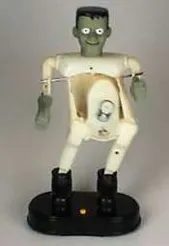
The Mechanics of the Groove
The magic starts the moment you flip the switch. The figure doesn’t just stand there. It moves. In rhythm. To a track blasting from its own base. But not all of them come pre-loaded. Some versions are smarter. They wait for your playlist. They sync up to the CD player in the next room or the radio on the counter. It’s a wireless link. A shared beat.
We’re cracking the shell now. Lifting the lid. Peering into the belly of the beast. What’s actually driving the show? The speakers? The motors? The lights?
Inside the Body
“Some versions actually dance to the music from your own CD player or radio.”
It’s not just magic. It’s engineering. We need to see the gears. The circuits. The wiring. How does sound become motion? How do eyes glow in the dark? Let’s pull back the curtain.
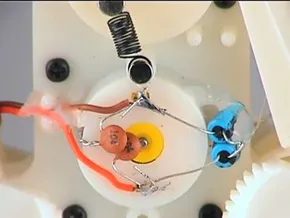
The Mechanics Behind the Dance
Forget the flashy exterior for a moment. The so-called “dancing monster” isn’t magic. It’s pure, unadulterated mechanical elegance. Strip away the plastic shell and the fabric skin, and you’re left with a surprisingly sophisticated skeleton. It doesn’t need a microcontroller. It doesn’t need a chip. Just one motor. And some gears.
Synchronization with the Beat
Press the button on the base. The song “Monster Mash” kicks in immediately. You get a beat or two of audio before the motor engages (Figure 2 ). Here’s the trick. The motor doesn’t just spin continuously. It reverses direction. Every time the beat drops, it flips. It spins forward, then backward, locking perfectly into the rhythm of the track.
Gearing Down for Timing
How does a tiny motor keep up with a pop song? It doesn’t try. It slows down. The motor shaft connects to a larger wheel via a simple rubber belt. This setup acts as a gear reduction. By using a larger wheel, the system takes the high-speed, low-torque output of the motor and converts it into the slow, powerful rotation needed to mimic the dance moves. The timing isn’t digital. It’s physical. The gear ratio does all the work.
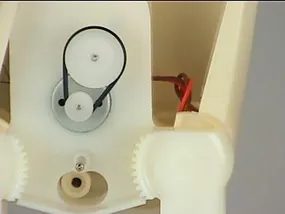
The mechanism relies on a simple but effective transfer of energy. A metal shaft bridges the gap between the large belt-driven wheel (Figure 3 ) and a secondary wheel. When the motor spins the primary wheel back and forth, that oscillating motion travels directly to the second wheel.
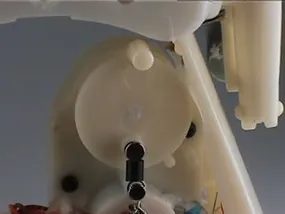
Mounted on this second wheel is a plastic knob (Figure 4 ). It sits inside a long slot on the interior of the monster’s back panel. This setup functions essentially as a cam. The front and back body panels are bolted together and secured to the main frame by two metal pins (Figure 5 ). These pins aren’t just for structural integrity; they allow the entire body assembly to slide.
As the plastic knob moves side to side within its slot, it pushes against the body. This lateral force translates into the sideways sway you see. The monster doesn’t just walk in place. It shimmies. The pins guide the motion, keeping the panels aligned while allowing the necessary drift.
The movement isn’t random. It’s a direct translation of rotary motion into linear sway.
This design ensures the monster looks alive without complex electronics. The back-and-forth of the motor becomes a side-to-side dance. It’s mechanical theater. The body pivots on those pins. The knob drives the action. The result is a creature that doesn’t just exist in one spot. It moves.
There’s a rhythm to it. The motor sets the pace. The shaft carries the energy. The knob converts it. The pins restrict the path. The result is a specific kind of animation. You can see the physics in it. It’s not magic. It’s just gears and pins working in sequence.
The monster doesn’t need to turn to look dangerous. It just needs to sway. The lateral motion creates tension. It implies weight. It suggests something heavy is shifting. The plastic knob in the slot is the heart of that illusion. Without it, the body would stay static. With it, the whole structure responds.
It’s a clever use of simple parts. No servos. No complex coding. Just a slot and a pin. The monster breathes by moving sideways. The belt-driven wheel keeps the time. The metal shaft ensures nothing gets lost in translation. The body follows.
What happens when the motor slows down? The sway becomes sluggish. The monster seems to hesitate. The motion doesn’t stop abruptly. It lingers. The pins keep the panels connected. The knob stays engaged. The illusion holds.
The design is efficient. It uses the existing motion of the belt-driven wheel. It doesn’t waste energy. It redirects it. The plastic knob is durable. The metal pins are strong. The body panels are rigid. The whole thing works together.
You can trace the path of movement. Start at the motor. Follow the belt. Watch the wheel spin. See the shaft connect. Find the knob. Trace the slot. Follow the pins. See the body move. It’s a loop. A cycle. A mechanical heartbeat.
The monster doesn’t need to roar to be impressive. The movement speaks for itself. It’s subtle. It’s consistent. It’s driven by physics. The design is elegant in its simplicity. It doesn’t overcomplicate the animation. It focuses on one thing. Lateral motion.
And that’s enough. The side-to-side


How the Arms Actually Move
It’s not magic. It’s a vertical plastic tab tucked right below the elbow joint. A metal pin, angled slightly into the side of the body frame, punches through a hole at the top of that tab. When the monster’s torso sways, the tab slides up and down the pin. Simple physics. That sliding motion forces the forearm to jerk upward or drop down. No wires. No servos. Just leverage.
The Gear System Driving the Legs
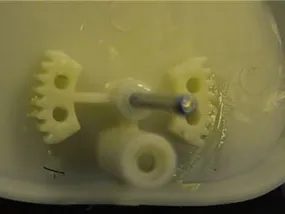
Look inside the bottom of the front and back body panels. You’ll find molded plastic gear teeth. They mesh with identical gears sitting at the top of each leg. This connection is rigid.
Each leg also features a metal pin running through it, right where the leg enters the boot. That pin allows the leg to pivot from side to side. The magic happens in the interaction between the body’s movement and these gears. As the body shifts left or right, the gears engage. The legs move in the opposite direction. It’s a counter-movement. You push one way, the legs swing the other. That’s how the walk cycle works.

The Blinking Eyes and the Brain of the Beast
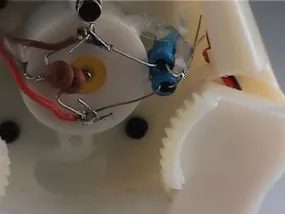
It’s not just the movement that sells the effect. You have two green LEDs doing the heavy lifting for the monster’s gaze. (Figure 9 ) These lights aren’t static. They are wired directly into the circuit board buried in the base, which acts as the central hub for all power distribution.
The trick is in the timing. Pulses of electricity shoot to those diodes, turning them on for split seconds. The result is a flicker that matches the beat. If the music speeds up, the eyes dart. If it drags, the glow lingers. It creates that uncanny valley feeling of something alive staring back at you.
The Circuit Board and Motor Control
Look closer at the base (Figure 10 ) and you’ll find the circuit board (Figure 11 ) holding it all together. This isn’t just a power strip. It houses a tiny integrated chip (IC) that serves as the actual brain of the toy.
This chip has a specific job: it stores the song data. But it doesn’t just play audio. It synchronizes the motor’s spin to the track. It works by alternating the current flow. One moment, the current pushes the motor clockwise. The next, it flips and spins it counter-clockwise. This back-and-forth rotation is what creates the chaotic, dancing motion.
The integrated chip doesn’t just play music; it physically dictates the monster’s dance moves by reversing the motor’s direction in time with the beat.
Without this chip, you’d just have a buzzing motor and a light bulb. The IC is what turns a noisy box into a rhythmic performer. It’s a simple mechanism, really. Just electricity flipping directions. But when paired with the flickering eyes, it’s enough to make you jump.
You can almost see the gears turning. The chip calculates the beat. The motor obeys. The eyes flash. It’s a closed loop of logic and light. And it works every time.
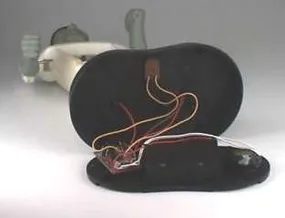
Five distinct wire pairs bridge the gap between the main circuit board and the external components. It’s a straightforward harness, but each pair has a specific job.
The Power Line
First, you’ve got the power supply. A simple red and black pair runs up to the battery compartment. Inside there, you’ll find four AA batteries. This is where the juice comes from.
The Trigger Mechanism
Next is the start sequence. Two yellow wires connect a small push button on the base’s top surface to the board. Press it down, and you complete the circuit. It’s the signal for the board to kick off the sequence.
Moving the Parts
The motor pair is also red and black. It’s purely functional: it sends current to keep the motor running. No fancy signals here, just raw power.
Lighting the Head
For the visual effect, look at the LEDs pair. One orange and one red wire are dedicated to sending power to the LEDs hidden in the monster’s head. That’s how it glows.
The Audio Output
Finally, the sound component. A pair of white wires carries the signal to the speaker. It’s the last link in the chain.
(Figure 12 )
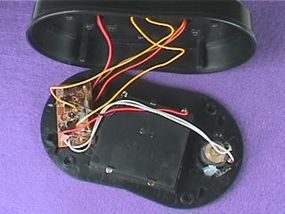

That tiny speaker nestled in the base is where the magic actually happens. It takes the audio signal from the internal chip and turns it into sound. Without it, the dancing monster is just a silent plastic figure.
If you want to dig deeper into the mechanics of these animated toys, the next page holds the technical breakdown.