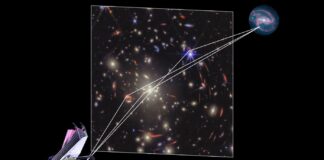
For over 100 years, the foundation of modern cosmology has rested on a single, elegant assumption: that the universe is smooth and uniform on its largest scales. However, new research suggests this long-held belief may be incorrect. Emerging evidence indicates that the universe might be much “lumpier” than previously assumed, a revelation that could fundamentally reshape our understanding of space, time, and cosmic evolution.
The Flawed Foundation: The FLRW Model
To understand why this matters, one must look at the FLRW model (named after Friedmann, Lemaître, Robertson, and Walker). Because it is impossible to map every individual galaxy, cosmologists have traditionally used this model to simplify the universe. It assumes two key properties:
- Homogeneity: The universe looks roughly the same regardless of your location.
- Isotropy: The universe looks the same in every direction.
By treating the universe as a smooth, even “fluid,” scientists have been able to interpret almost all cosmological observations through this lens. But if the universe is actually characterized by large-scale irregularities—or “lumps”—then the mathematical tools used to measure it for the last century may be providing a distorted view of reality.
A New Way to Test Reality
In a series of recent preprint papers, researchers have proposed and tested a novel method to determine if the FLRW model still holds water.
- The Methodology: Timothy Clifton (Queen Mary University of London) and Asta Heinesen (University of Copenhagen) developed a test using combinations of cosmic distance formulas. These formulas are derived from supernova observations and matter density fluctuations.
- The “Zero” Benchmark: The test is designed so that if the FLRW model is correct, the result must be exactly zero. Any non-zero result serves as a “smoking gun,” indicating that the model is failing to describe the actual universe.
- The Role of AI: Applying this test to existing data is notoriously difficult because most past datasets were already processed using the assumption that FLRW was true. To bypass this bias, Heinesen and Sofie Marie Koksbang (University of Southern Denmark) used symbolic regression —an AI-based method—to extract distance measurements without relying on the old model.
The results were striking: the researchers obtained a clear non-zero result, suggesting that the standard model is indeed flawed.
Why This Matters: Solving Cosmological Mysteries
If these findings are confirmed, they could provide the “missing link” for several major headaches in physics. Currently, cosmologists are struggling with several unexplained phenomena, including:
- The Expansion Discrepancy: A mismatch between how fast the universe expanded in its early history versus how fast it is expanding now.
- The Dark Energy Puzzle: Recent measurements suggest that dark energy—the mysterious force driving cosmic expansion—might be changing over time, which contradicts standard theories.
Clifton suggests that these mysteries might not be caused by “new physics” like strange dark energy, but rather by flawed math. If the universe is lumpy rather than smooth, our current measurements are merely “averages” that fail to account for local irregularities. A lumpy universe would naturally create the discrepancies we see in expansion rates and energy measurements.
The Road Ahead
While the results are provocative, the scientific community remains cautious. The findings have not yet reached the rigorous statistical threshold required to claim a formal “discovery.” The research team must now wait for more precise astronomical data from upcoming missions to see if the signal holds.
As Subodh Patil of the University of Leiden noted, while caution is necessary to avoid overinterpreting the data, the approach itself is “fantastic” because it tackles the most fundamental questions in the field.
“It suggests that the universe may not be as simple as it appears,” says Timothy Clifton.
Conclusion
If the universe is indeed more irregular than our models allow, we may be on the verge of a paradigm shift that resolves the deepest contradictions in modern physics.