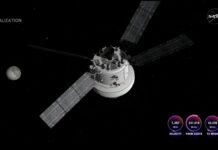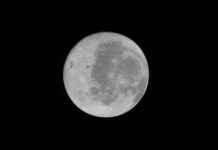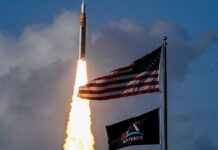
The crew of NASA’s Artemis II mission has officially entered the Moon’s “sphere of influence.” This critical milestone means the Moon’s gravitational pull has become the dominant force acting on the Orion spacecraft, overtaking the pull of Earth.
After four days and six hours of travel, the spacecraft is currently positioned approximately 39,000 miles (62,800 km) from the Moon and 232,000 miles (373,400 km) from Earth. This transition sets the stage for the mission’s most ambitious phase: a journey to the lunar far side.
A New Perspective on the Lunar Surface
While the Apollo missions of the 1960s and 70s sent humans to fly just 70 miles above the lunar surface, Artemis II is taking a different approach. The crew will maintain a much higher altitude, passing at roughly 4,000 miles from the Moon at their closest point.
This higher orbit serves a specific scientific purpose: it allows the crew to observe the Moon as a complete, spherical body, including the polar regions. More importantly, it provides a vantage point to witness the lunar far side—a region that was largely inaccessible or difficult to observe during the Apollo era.
Key Mission Milestones:
- Visual Observations: During a six-hour flyby, astronauts will use both onboard cameras and their own eyes to document the lunar landscape.
- The Communications Blackout: As Orion passes behind the Moon, the lunar mass will block radio signals, resulting in a planned 40-minute communications blackout with Earth’s Deep Space Network.
- Record-Breaking Distance: If the flyby proceeds as planned, the crew—Americans Christina Koch, Reid Wiseman, and Victor Glover, alongside Canadian Jeremy Hansen—will set a new record for the farthest distance humans have ever traveled from Earth.
Testing the Limits of Spaceflight Technology
Beyond the astronomical views, Artemis II is a vital “proving ground” for NASA. Unlike previous missions that used proven Apollo-era hardware, this mission is testing the Orion spacecraft and its life-support systems for the first time with a human crew.
“This is the first time astronauts have ever flown on this spacecraft before. That’s what we’re most interested in getting data from,” explained NASA Chief Jared Isaacman.
The mission is not just about exploration, but about validation. Data gathered regarding the spacecraft’s ecosystem and life-support stability is essential for the success of future missions, specifically the planned Artemis III lunar landing in 2027 and Artemis IV in 2028.
Bridging the Gap Between Apollo and Artemis
The mission carries a deep symbolic weight, acting as a bridge between the legacy of the 20th century and the ambitions of the 21st. This connection was highlighted by 90-year-old former astronaut Charlie Duke, who walked on the Moon during Apollo 16, providing a ceremonial wake-up call to the crew.
As the crew prepares for the far-side transit, they have already begun contributing to lunar science. NASA recently released an image captured by the crew showing the Orientale basin —often called the Moon’s “Grand Canyon.” While orbiting satellites have photographed this bullseye-shaped crater before, this marks the first time the entire basin has been viewed by human eyes.
Conclusion
Artemis II serves as a critical technical rehearsal for deep-space habitation. By testing the Orion spacecraft and navigating the lunar far side, NASA is gathering the essential data required to return humans to the lunar surface and, eventually, beyond.