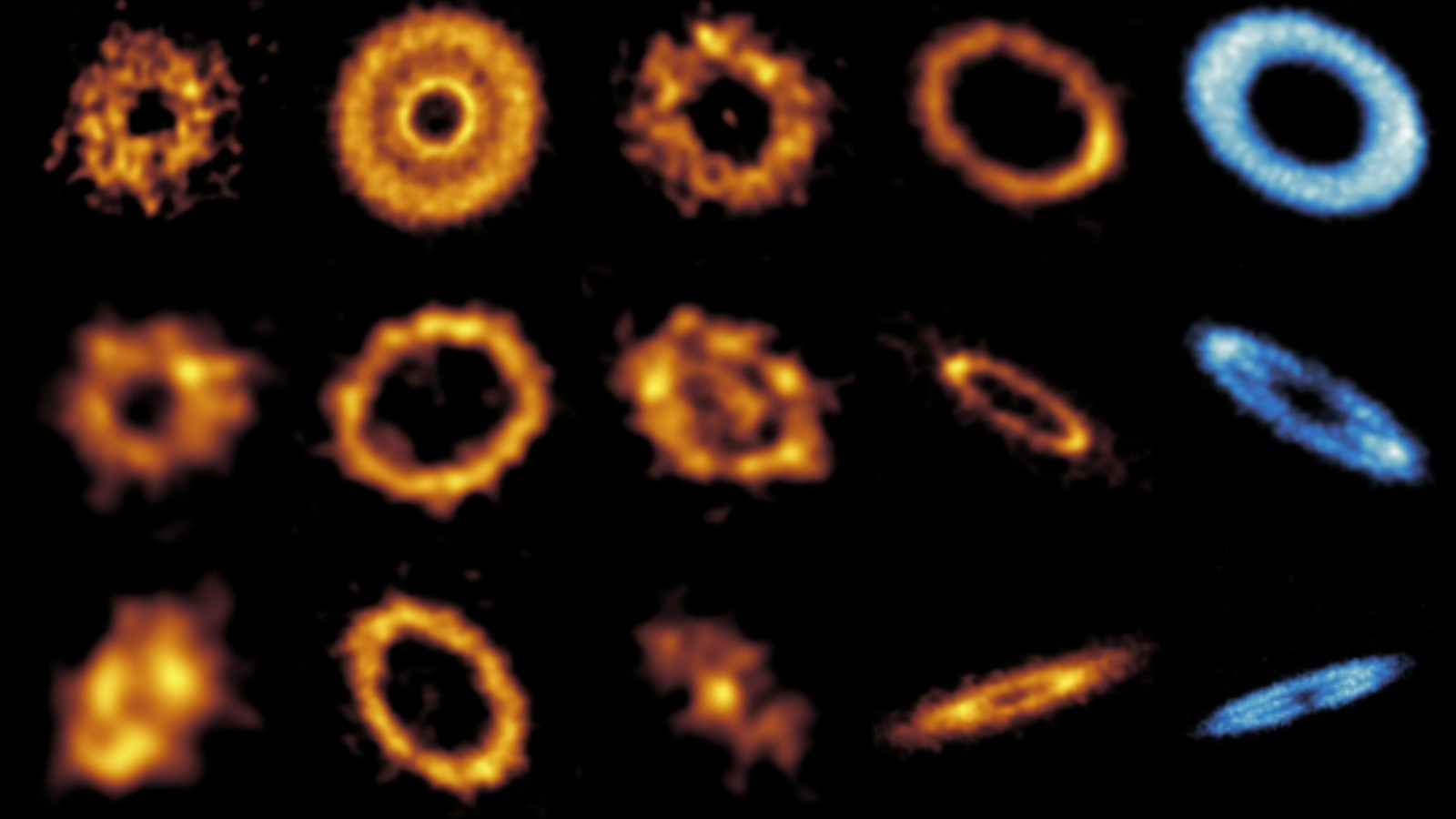
Astronomers have captured unprecedented views of planetary systems in their turbulent adolescence, a period marked by violent collisions and rapid evolution. Using the Atacama Large Millimeter/submillimeter Array (ALMA), researchers have observed the debris disks around young stars, shedding light on the chaotic processes that shape planetary growth – including events like the moon-forming impact on Earth.
The Missing Link in Planetary Evolution
For years, scientists have studied the early stages of planet formation (the “baby pictures”) and the relatively stable mature systems. However, the intermediate “teenage” phase, where planets collide, migrate, and reshape their orbits, remained largely unobserved. This new research fills that gap, providing crucial insights into how planetary systems transition from chaotic nurseries to stable configurations.
The ALMA observations focused on 24 debris disks – remnants of the planet-forming process – around infant stars. These disks are thousands of times fainter than their younger counterparts, making them exceptionally difficult to study until now.
Collisions and Chaos: The Hallmark of Teenage Systems
The data reveals a surprising degree of complexity. Instead of simple, uniform rings, the disks exhibit multiple rings, wide halos, and unexpected clumps —evidence of ongoing collisions and orbital disruptions. This confirms that the teenage phase is a period of extreme upheaval, where planets are not yet settled into stable orbits.
As team member Sebastián Marino explained, “We’re seeing real diversity… revealing a dynamic and violent chapter in planetary histories.”
Echoes of Our Own Solar System’s Past
The findings aren’t just about distant exoplanets. The same violent processes observed in these young systems likely shaped our own solar system billions of years ago. The Kuiper Belt, a region beyond Neptune filled with icy remnants, is a testament to these ancient collisions and planetary migrations. Even the formation of Earth’s moon may have been a result of this same chaotic teenage phase.
Why This Matters: Understanding Planetary Origins
This research is significant because it provides direct evidence of the physical mechanisms driving planetary evolution. By studying these exoplanetary systems, we can refine our models of how planets form and migrate, and gain a deeper understanding of the conditions that led to the formation of our own solar system. The ALMA’s ability to combine data from 66 radio telescopes allows for unprecedented detail, confirming that the teenage phase of planetary systems is a time of great upheaval.
“These discs record a period when planetary orbits were being scrambled and huge impacts… were shaping young solar systems,” notes team member Luca Matrà.
In conclusion, these observations mark a turning point in exoplanetary research. By revealing the chaotic dynamics of planetary adolescence, scientists are gaining invaluable insights into the violent yet essential processes that sculpt planetary systems, including our own.