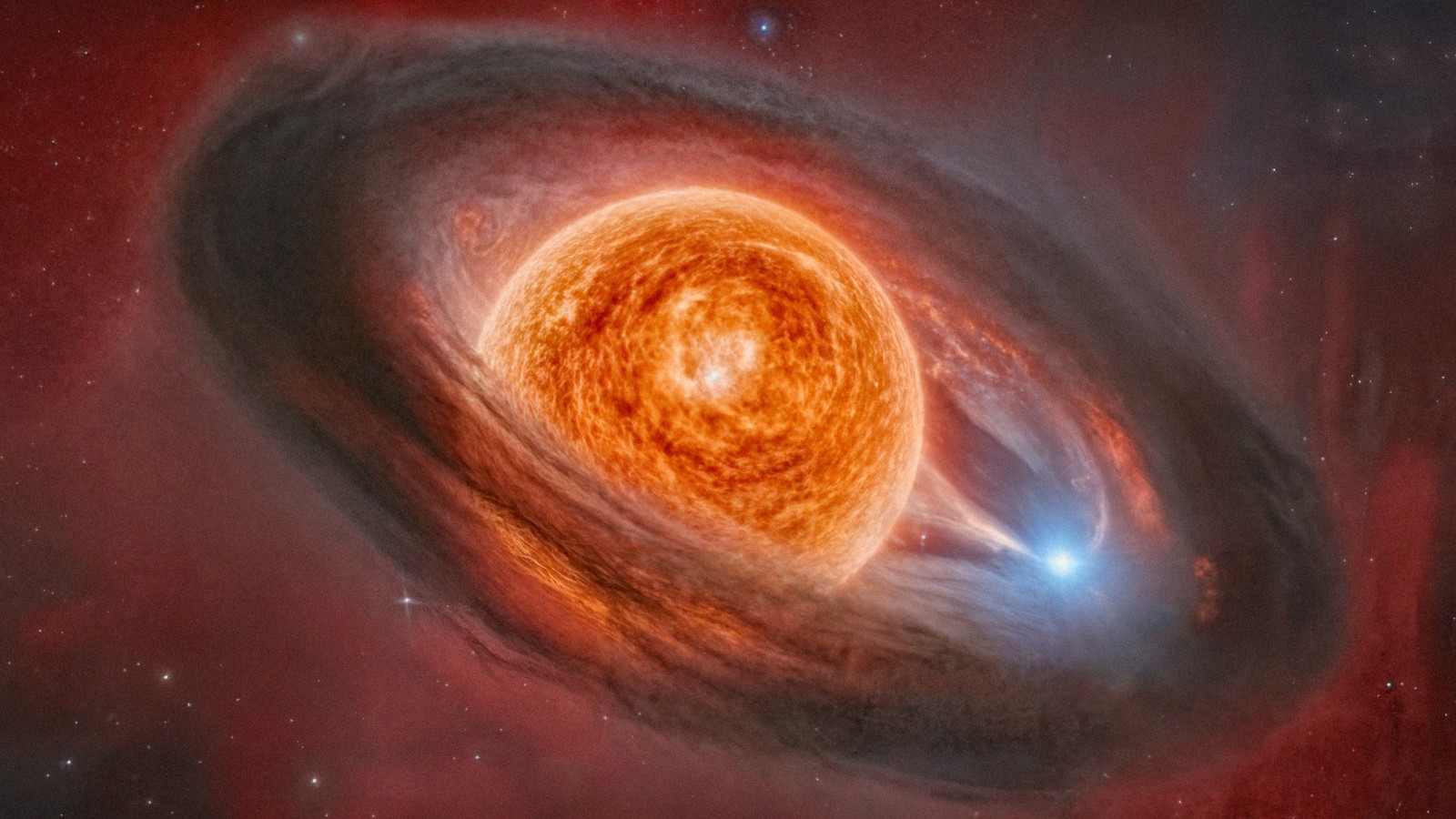
Astronomers have documented a rare transformation in a massive star, WOH G64, located 163,000 light-years away in the Large Magellanic Cloud. This star, 1,540 times larger than our sun, has shifted from a red supergiant to a yellow hypergiant—a change that may precede its violent death as a supernova or even a direct collapse into a black hole. The study provides an unprecedented look at the final stages of a star’s life and helps resolve long-standing questions about how massive stars die.
The Unusual Evolution of WOH G64
WOH G64 was first identified in the 1970s as a red supergiant surrounded by dense dust. However, observations in 2014 revealed a significant change: the star’s color shifted, and its surface temperature increased. This indicated a transition into a yellow hypergiant, a stage that is both rare and short-lived. The transformation happened smoothly over a year, defying the expectation that such changes are typically violent.
“The fate of stars with initial masses between 23 and 30 solar masses after evolving into red supergiants is still uncertain,” explained Gonzalo Muñoz-Sanchez of the National Observatory of Athens. “WOH G64 might be the solution to this question.”
Why This Matters: The Fate of Massive Stars
The death of massive stars is a critical process in the universe. These events seed space with heavy elements necessary for new star and planet formation. However, not all massive stars follow the same path: some explode as supernovae, while others collapse directly into black holes. Understanding these differences is crucial for predicting future events and interpreting observations of distant galaxies.
Yellow hypergiants are extremely rare because they represent a brief transitional phase. For this transformation to occur, a star must expel its outer layers through a powerful stellar wind, raising its temperature. Only the brightest red supergiants can drive outflows strong enough to trigger this shift.
Complicating Factors: A Binary System
Adding another layer of complexity, WOH G64 is part of a binary system, meaning it orbits a companion star. This introduces the possibility that interactions with its partner may be influencing its evolution. The star could be stealing mass from its companion, driving the changes observed.
The team has not yet determined whether the evolution is a consequence of interactions between WOH G64 and its binary stellar companion or if the metamorphosis is intrinsic to the star itself.
What Happens Next?
Astronomers estimate that WOH G64 is relatively young, at just 5 million years old, compared to our 4.6-billion-year-old sun. Massive stars burn through their fuel quickly, so its end is imminent on a cosmic timescale—likely within the next hundred to a few thousand years.
The star’s fate is uncertain. It could explode in a supernova, merge with its companion, or collapse directly into a black hole. Regardless of the outcome, the observations of WOH G64 provide valuable insights into the death throes of massive stars.
“Such an event would be extraordinary, it remains highly unlikely that it will occur within our lifetime. Although, of course, we are not even sure that this star will explode as a supernova.”
The continued monitoring of WOH G64 will be critical for understanding the final stages of stellar evolution and confirming the specific mechanisms that drive these dramatic transformations.