NASA’s XRISM spacecraft has measured winds erupting from the starburst galaxy Messier 82 (M82) at an astonishing 2 million miles per hour (3.21 million kilometers per hour). This discovery confirms long-held theories about how star formation drives powerful galactic outflows, yet also highlights key discrepancies that astronomers are now scrambling to explain.
The “Cigar Galaxy” and its Extreme Outflows
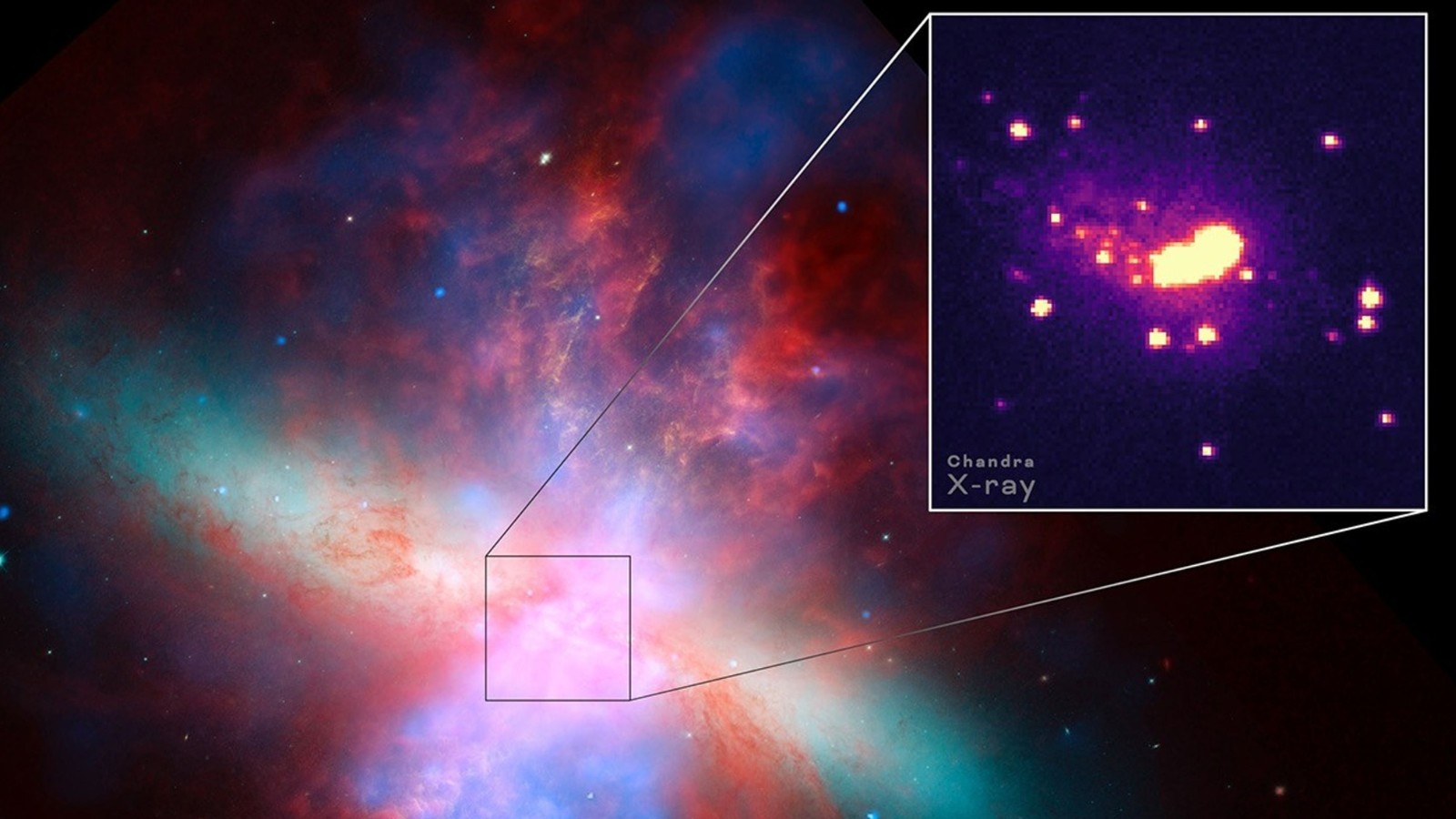
M82, located 12 million light-years away in the constellation Ursa Major, is a “starburst galaxy”—meaning it produces stars at ten times the rate of our own Milky Way. This intense star formation fuels extreme activity at the galaxy’s core, ejecting superheated gas and dust in colossal winds that stretch over 40,000 light-years. These winds have been observed by multiple telescopes, including Hubble, James Webb, Chandra, and Spitzer.
The primary question driving this latest research was whether these outflows are directly linked to the rapid star formation and supernova activity at the galaxy’s center. The answer appears to be yes, but with surprising complexity.
XRISM’s Breakthrough Measurements
Using its Resolve instrument, XRISM detected X-ray radiation emitted by superheated iron at M82’s core. This revealed temperatures reaching 45 million degrees Fahrenheit (25 million degrees Celsius) – heat that generates tremendous outward pressure. These measurements confirm that shock waves from star formation and supernovae are indeed driving the winds, but the observed velocities exceed predictions from some existing models.
“We didn’t have the ability to measure the velocities needed to test the hypothesis… Now we see the gas moving even faster than some models predict.” – Erin Boettcher, University of Maryland and NASA Goddard Space Flight Center.
A Missing Mass Puzzle
The team found that M82 expels the equivalent of seven suns’ worth of material per year. However, XRISM’s data suggests that only four of those solar masses are accounted for in the observed wind. Where do the remaining three solar masses go?
Researchers theorize that these could be escaping as hot gas through other mechanisms, or that current models underestimate the total outflow rate. The discrepancy is significant, as it challenges the completeness of our understanding of starburst galaxies.
Implications for Galactic Evolution
The findings from XRISM are forcing scientists to refine their understanding of how starburst galaxies function. Some existing models date back to the 1980s, and this new data provides a much-needed opportunity to validate or revise them.
The research also sheds light on the connection between galactic winds and cosmic rays. The same forces that drive these outflows likely also accelerate high-energy particles, suggesting that starburst galaxies may be major cosmic ray sources.
The ongoing observations from XRISM will be crucial in resolving the missing mass puzzle and building more accurate models of starburst galaxies, potentially revealing new insights into galactic evolution.