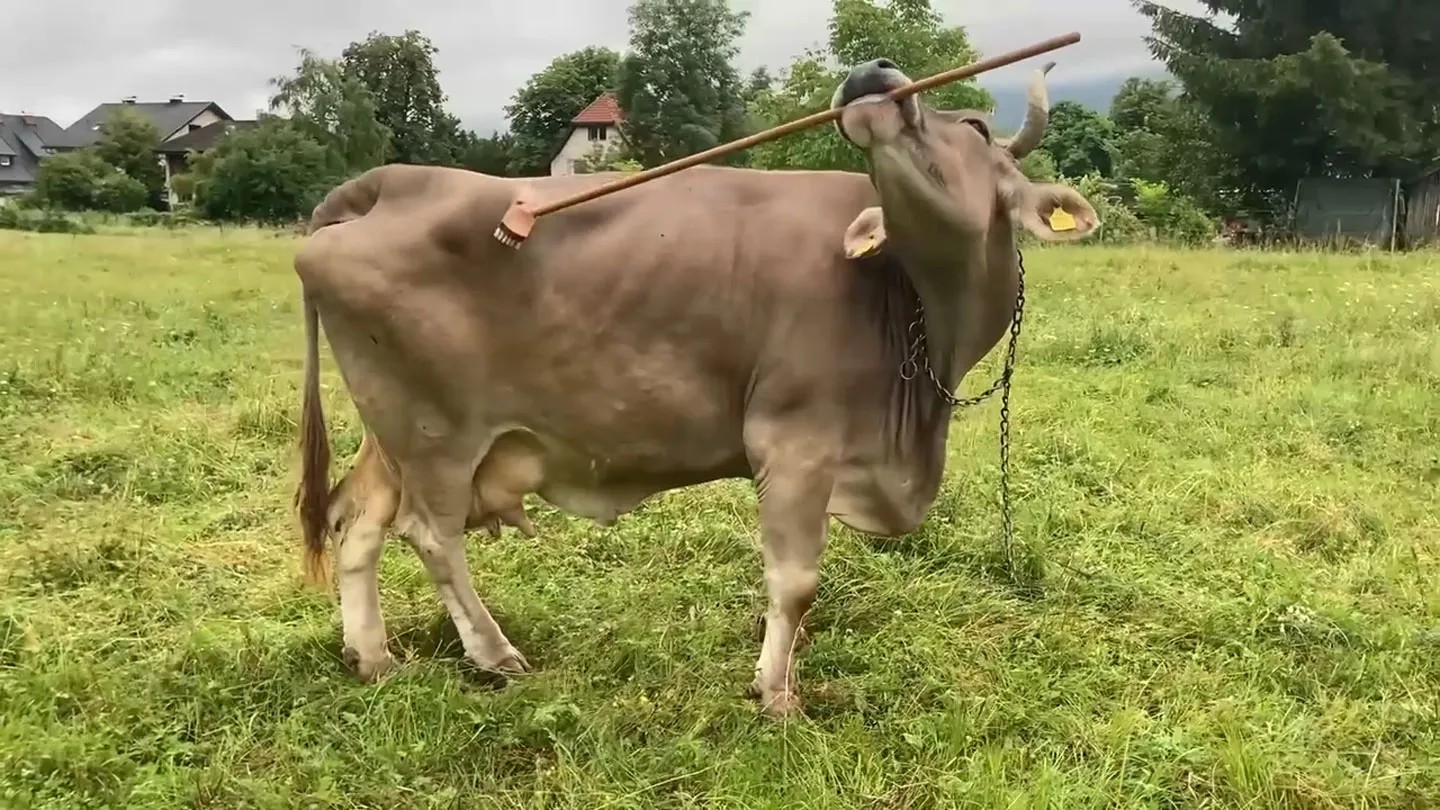
A Brown Swiss cow named Veronika has become the first of her species documented using tools, overturning long-held beliefs about cattle cognition. Researchers reported in Current Biology on January 19th that Veronika strategically employs a deck brush to scratch parts of her body inaccessible by natural means—a behavior previously unseen in cows.
The Discovery and Method
Veronika, who lives on a small Austrian farm, picks up the brush with her tongue and manipulates it to reach various areas of her body. She uses the bristled end for thick skin on her back and the handle for softer areas like her udder and belly button. The cow’s method is not random; she adjusts the brush’s orientation to maximize its effectiveness, demonstrating an understanding of the tool’s different functions.
“At first, I thought it was a mistake,” said Antonio Osuna-Mascaró, a cognitive biologist at the Messerli Research Institute. “But after observing Veronika for a while, it was so obvious that she was using both ends in different ways to target different body areas.”
Why This Matters
Tool use is a hallmark of higher intelligence in the animal kingdom. Traditionally, this behavior was considered exclusive to primates, corvids (crows and ravens), and some marine mammals. That a cow—a species often underestimated in cognitive terms—has independently discovered this behavior suggests that intelligence may be more widespread across the animal world than previously thought.
Veronika’s case is particularly notable because she uses the same tool for multiple purposes. This level of flexible problem-solving was previously observed only in chimpanzees, suggesting a surprising degree of cognitive overlap.
Beyond the Farm: Rethinking Animal Intelligence
Experts believe this discovery highlights the importance of studying animal intelligence in diverse species. “People are happy to acknowledge that dolphins and so on are extremely clever,” says Lindsay Matthews, an animal behaviorist at the University of Auckland, “But I believe most animals are extremely clever if they’re given the right task to do.”
Matthews points out that cows can be trained in surprising ways, such as potty training. He suggests testing Veronika with different implements to see how she adapts, potentially revealing further cognitive capabilities.
The key takeaway is that intelligence is not limited to traditionally “smart” species. Animals may be far more capable than we assume if given the opportunity to demonstrate their abilities.
This case serves as a reminder that intelligence exists on a spectrum and that our understanding of animal cognition remains incomplete.