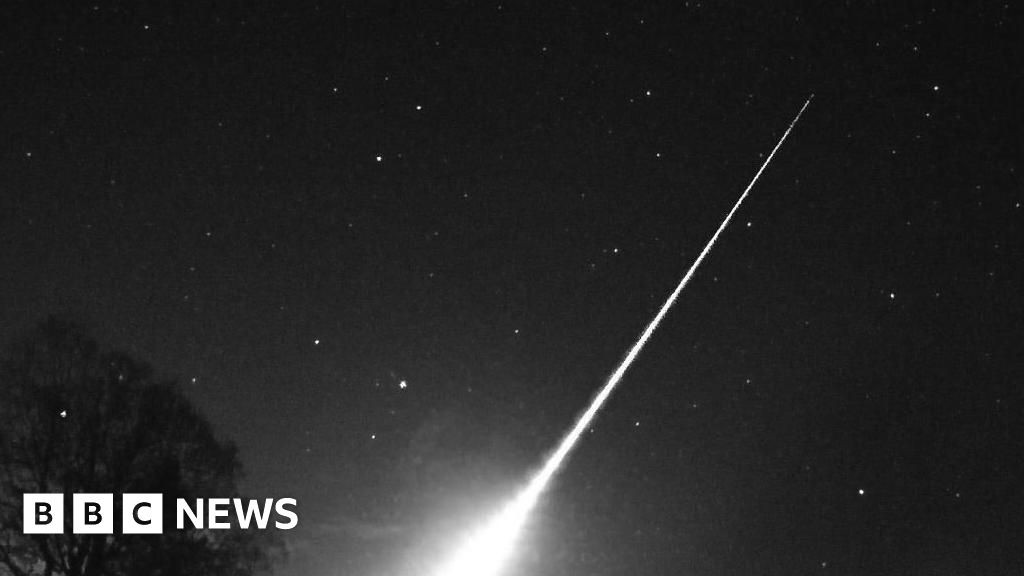
A brilliant “fireball” illuminated the night skies over East Yorkshire and Lincolnshire early Monday morning, leaving residents and stargazers in awe. Experts have since confirmed that the phenomenon was a meteor —a piece of space debris entering Earth’s atmosphere at high velocity.
The Event and Its Trajectory
The fireball was observed at approximately 00:24 BST on Monday, with footage captured in several locations, including Hornsea, Billingborough, and Moulton Seas End.
While the visual display was striking, experts suggest that finding physical remnants of the object will be nearly impossible. According to Charlotte Bays, secretary of the UK Fireball Alliance, the meteor’s trajectory took it directly over the North Sea.
“Based on the fireball trajectory, the event occurred over the North Sea, so, sadly, we do not expect any recoverable meteorites,” Bays noted.
Why Was It So Bright?
The intense brightness of the event was not necessarily a sign of a massive object, but rather a result of its chemical composition. The presence of elements like magnesium can cause a meteor to burn with exceptional brilliance as it interacts with the atmosphere.
John Maclean from the UK Meteor Network provided further technical context:
– Origin: The meteor was likely a fragment from a larger asteroid rather than part of a broader astronomical event.
– Size: Despite its bright appearance, the object was relatively small, estimated to weigh only about 12 grams (0.5 oz).
– Speed: The object entered the atmosphere at approximately 20,000 mph (32,000 km/h), a speed sufficient to cause it to burn up completely before reaching the ground.
Looking Ahead: The Lyrids Meteor Shower
While this specific fireball was a “one-off” event, it serves as a timely reminder for astronomy enthusiasts. The UK Fireball Alliance encourages stargazers to remain vigilant in the coming weeks, as the Lyrid meteor shower is expected to begin soon, reaching its peak on April 22.
Conclusion
Though this particular meteor left no physical trace on land due to its North Sea trajectory, its bright magnesium-fueled flash provided a rare celestial spectacle for residents across northern England.