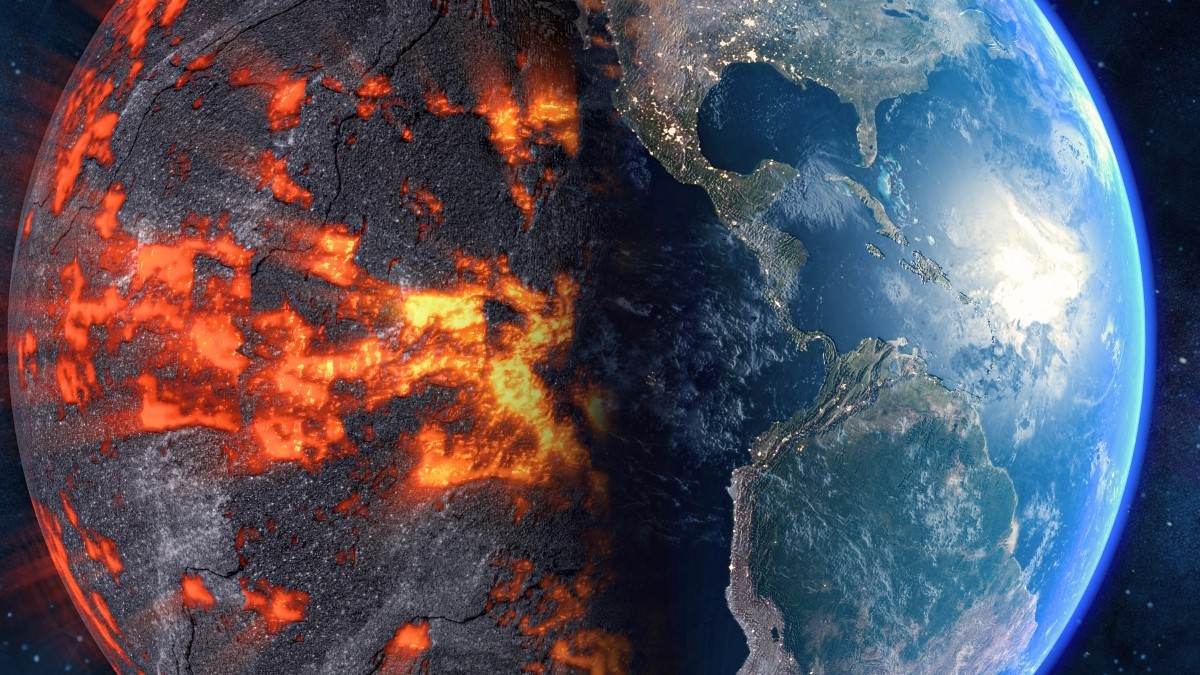
Geoscientists have finally explained why some oceanic islands contain unexpected traces of continental material, despite being far from any landmass. The answer lies in a previously underestimated process: continents aren’t just drifting on Earth’s surface – they’re being slowly peeled away from below by massive, slow-moving “mantle waves.” This discovery reshapes how we understand plate tectonics and volcanic activity.
The Mystery of Continental Material in the Oceans
For decades, scientists puzzled over why the oceanic mantle – the layer beneath the seafloor – appeared contaminated with ancient continental rocks. Two leading theories failed to fully explain this phenomenon. One suggested that recycled crust from subduction zones (where one plate slides under another) was the source. The other proposed that mantle plumes, columns of hot rock rising from deep within the Earth, carried this material upwards.
However, neither explained why some regions showed little evidence of either process and why the enrichment varied so much in age. The new research suggests the explanation is far more fundamental: continents themselves are being eroded at their roots.
How “Mantle Waves” Strip Continents
When continents break apart through rifting, the resulting instabilities create slow-moving waves in the upper mantle. These waves sweep along the base of the continents at depths of 90–125 miles (150–200 kilometers), scraping away material from their roots. This stripped material is then carried vast distances – over 620 miles (1,000 kilometers) – and enriches the oceanic mantle.
This isn’t a sudden event; it’s a geological creep. The process is so slow that continental slivers move at a pace a million times slower than a snail. Yet, these timescales mean continents leave a lingering chemical fingerprint long after they’ve fractured.
“We found that the mantle is still feeling the effects of continental breakup long after the continents themselves have separated,” explains geodynamicist Sascha Brune from the University of Potsdam. “The system doesn’t switch off when a new ocean basin forms – the mantle keeps moving, reorganizing, and transporting enriched material far from where it originated.”
Evidence from the Indian Ocean
The chain of submarine volcanoes and mountains in the Indian Ocean – including Christmas Island – provides strong evidence for this theory. Formed over 150 million years ago as the supercontinent Gondwana broke apart, this region shows enriched volcanism that occurred within 50 million years of the split. Critically, it lacks the characteristics of mantle plume activity, aligning with the “mantle wave” model. The enrichment declined over time, as predicted by the researchers.
Beyond Volcanism: Other Implications
This research has broader implications beyond explaining oceanic volcanism. The same mantle waves may also trigger eruptions of diamond-rich magmas from deep within the Earth. Furthermore, they can cause continental uplift, forcing seemingly stable parts of continents to rise over half a mile (1 kilometer), shaping some of the planet’s most dramatic landforms.
In conclusion, Earth’s continents aren’t just breaking apart; they are slowly dissolving from below. This process, driven by the relentless movement of the mantle, fundamentally changes our understanding of plate tectonics and the long-term evolution of our planet’s surface. The discovery highlights how interconnected Earth’s internal processes are, with effects rippling through geological time.