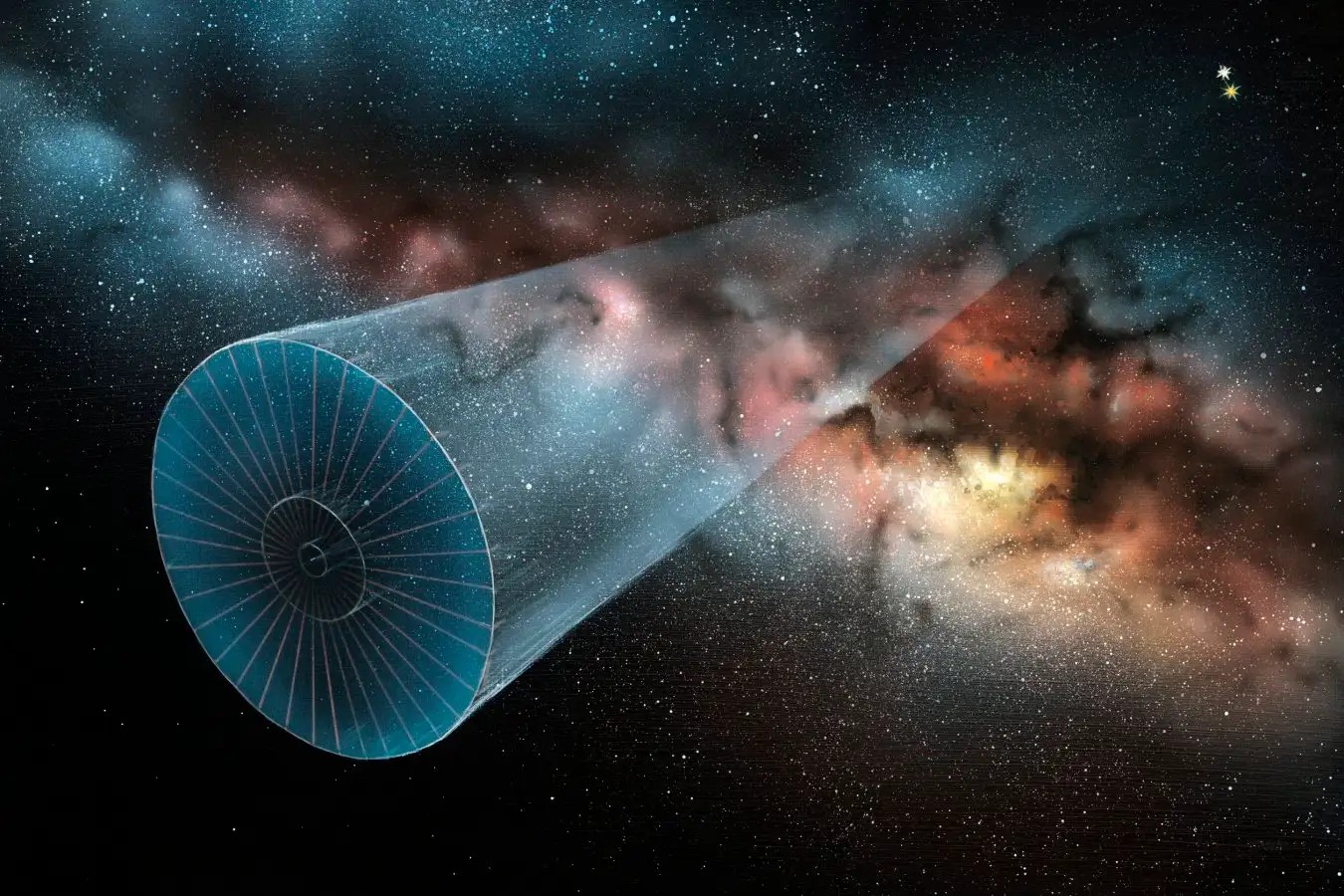
Interstellar travel has long relied on the concept of light sails—vast, ultra-thin sheets propelled by the momentum of photons bouncing off them. While the physics of using light for propulsion is well-established, a critical engineering challenge has remained: how do you steer a sail that has no moving parts?
A new breakthrough from Texas A&M University offers a potential solution. Researchers have developed a microscopic device called a “metajet” that uses the refraction of light, rather than just reflection, to generate directional thrust. This innovation could allow future spacecraft to navigate the vast distances between stars with precision.
How Metajets Work
Traditional light sails rely on reflection: photons hit the surface and bounce off, transferring momentum in a single direction. The new device, however, utilizes a metasurface —an extremely thin sheet of material textured with microscopic pillars.
According to Kaushik Kudtarkar, a researcher at Texas A&M University, the key difference lies in how the light interacts with the material. Instead of simply bouncing off, the light passes through the tiny pillars on the metasurface. The size and pattern of these pillars are engineered to bend (refract) the light in specific ways. This refraction allows the device to control the direction of the momentum transfer, effectively creating thrust in multiple directions simultaneously.
The prototype metajet is incredibly small, measuring only about 0.01 millimeters across. Despite its size, the principle remains the same: by altering the design of the metasurface, engineers can dictate exactly how the light pushes the material.
From Theory to Motion
To validate the concept, the team conducted experiments using silicon metajets submerged in water. By shining a laser on the devices and observing them under a microscope, they tracked the resulting motion.
The results confirmed that the metajets could generate complex movement patterns:
* Levitation: The devices rose against gravity.
* Horizontal Propulsion: They moved sideways across the fluid.
* Speed: The maximum speed recorded was approximately 0.07 millimeters per second.
While slow in a fluid environment, this demonstration proved that the directional control of momentum via refraction is physically viable. As Kudtarkar noted, “We knew already that any light or laser can impart momentum transfer, but now we can control the direction as well.”
Beyond Space Travel: Biomedical Applications
While the ultimate goal is interstellar navigation, the technology has immediate implications for other fields, particularly biomedicine. Current methods for using lasers to move drugs or particles within the body often involve direct exposure to high-energy beams, which can generate heat and damage sensitive biological molecules.
Metajets offer a safer alternative. Because the device itself interacts with the light, the target payload (such as a drug capsule) could be attached to the metajet without being directly exposed to the laser’s heat. This could allow for precise, non-invasive delivery of medications to specific locations in the body, minimizing collateral damage to surrounding tissues.
The Road Ahead
The current prototype operates with lasers in controlled environments, but practical space travel requires compatibility with the sun’s natural output. The researchers are now working to adapt the metajet design to work with broad-spectrum sunlight, rather than single-wavelength lasers.
If successful, this could enable the creation of light sails that are not only propelled by the sun but also actively steered by it. Such sails could potentially change shape over time or adjust their metasurface patterns to navigate complex trajectories through the solar system and beyond.
“It’s all a bit sci-fi,” admits Kudtarkar, but the underlying physics is grounded in reality. By mastering the manipulation of light at a microscopic scale, scientists are turning the dream of directed interstellar travel into an engineering problem with a tangible solution.
Conclusion
The development of metajets marks a significant shift from passive light sails to active, steerable photonic propulsion systems. By leveraging refraction through metasurfaces, this technology not only solves a major hurdle in interstellar navigation but also opens new doors for precise biomedical applications. As research progresses toward sunlight compatibility, these tiny devices may soon play a pivotal role in both exploring the cosmos and treating diseases on Earth.