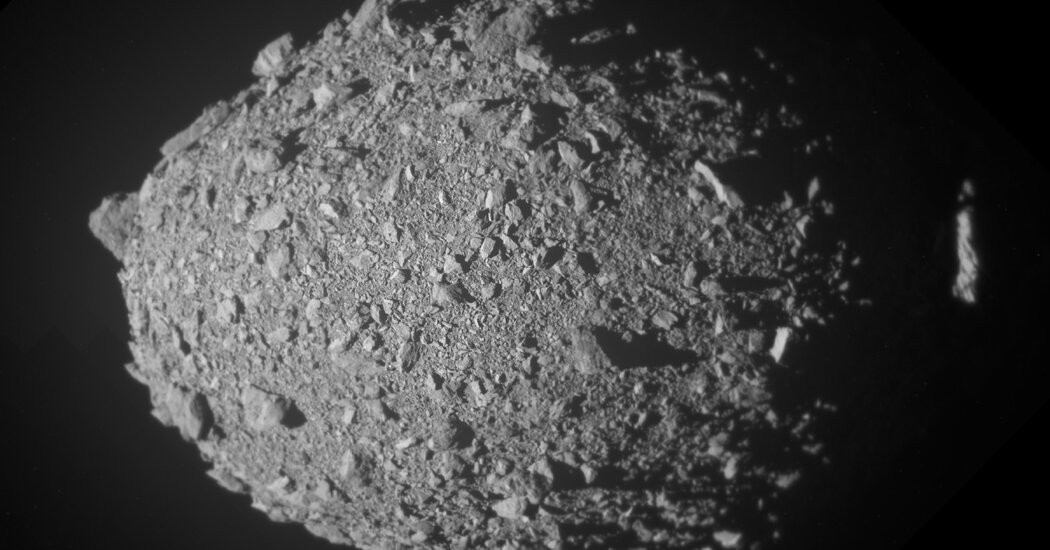
In 2022, NASA made history by intentionally colliding a spacecraft, the Double Asteroid Redirection Test (DART), with the asteroid Dimorphos. The mission wasn’t about destruction; it was a controlled experiment to test humanity’s ability to alter the trajectory of a potentially dangerous space rock. The results, now confirmed by new research, go beyond simply shortening Dimorphos’s orbit around its larger companion, Didymos—it actually changed the asteroid pair’s path around the Sun.
Initial Impact: A Successful Test of Planetary Defense
The initial impact of DART shortened Dimorphos’s orbit by a measurable 32 minutes. This seemingly small change proved that kinetic impact—essentially, hitting an asteroid hard enough—can nudge it off course. The collision also created a spectacular debris cloud, offering scientists valuable data on the mechanics of asteroid deflection.
However, the latest study reveals a more significant outcome. Researchers, led by Dr. Rahil Makadia of the University of Illinois Urbana-Champaign, analyzed the data and found that DART’s impact didn’t just affect the orbit around Didymos, but also altered the entire system’s movement through space.
Why Changing Solar Trajectories Matters
The key takeaway is this: shifting an asteroid’s path around the Sun is possible. This is critical because if a large asteroid were ever on a collision course with Earth, simply altering its orbit around another asteroid wouldn’t be enough. The real threat lies in its overall trajectory toward our planet—and DART has demonstrated that we can influence that.
“If we ever find an asteroid that is headed toward the Earth, what we need to do is change its motion around the sun,” Dr. Makadia explains.
This discovery underscores the viability of kinetic impact as a method for planetary defense. The study, published in Science Advances, confirms that the technique isn’t just theoretical; it can be executed and measured in real time.
The DART mission represents a pivotal step in our ability to protect Earth from cosmic threats. The findings are a clear signal that with planning and precision, humanity can actively intervene to alter the paths of dangerous asteroids, safeguarding our planet for future generations.