


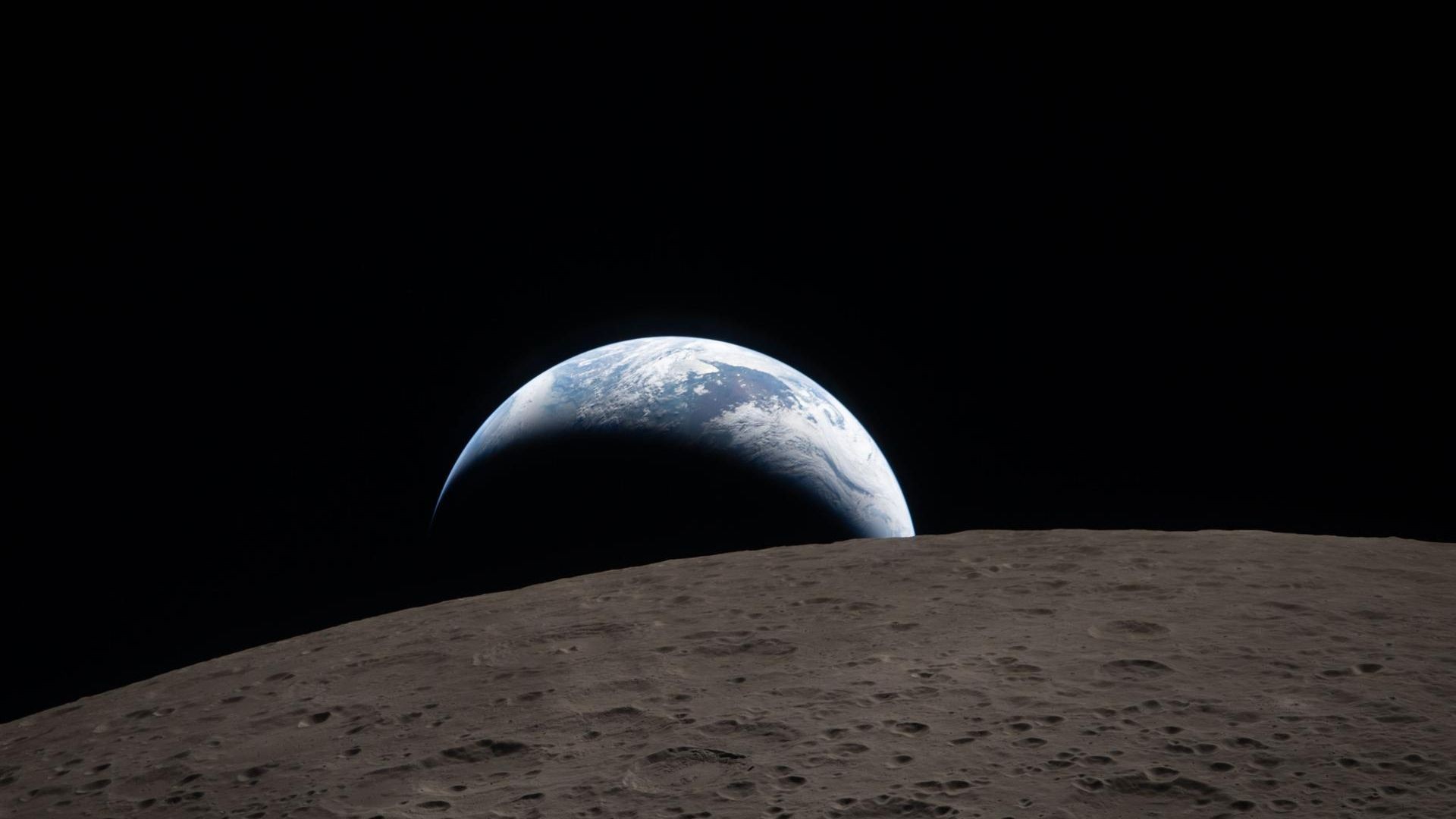
The Artemis 2 mission has achieved a milestone that has eluded humanity for over half a century. On Monday, April 6, a crew of four astronauts successfully completed a flyby of the moon’s far side—the first time humans have traversed this region since the Apollo 17 mission concluded in 1972.
The crew—comprising NASA’s Reid Wiseman, Victor Glover, and Christina Koch, alongside Canadian astronaut Jeremy Hansen —did more than just navigate deep space; they acted as celestial chroniclers. Through high-resolution photography, they have provided scientists with invaluable geological data and the public with breathtaking perspectives of our solar system.
Perspectives from the Lunar Far Side
One of the most striking images captured by the crew offers a perspective rarely seen from Earth: a tiny, crescent-shaped Earth “setting” behind the massive, dominant curve of the moon. This “Earthset” occurred halfway through the flyby, highlighting the profound isolation and scale of deep-space travel.
Beyond the view of Earth, the mission focused on several key lunar landmarks:
- The Orientale Basin: Often called the “Grand Canyon of the moon,” this 600-mile-wide feature was a primary target for the crew. Commander Reid Wiseman noted its striking circularity, describing the basin’s annular ring as looking like “a pair of lips” from orbit.
- The Lunar Terminator: This is the moving line that separates the moon’s day side from its night side. Astronaut Victor Glover described the terminator as “visually captivating,” noting how the interplay of light and shadow creates “islands of light” and valleys that appear like bottomless black holes.
- The South Pole-Aitken Basin: This massive impact crater, spanning over 1,550 miles, is a focal point for future space exploration.
Why this matters: The South Pole region is not just a geological marvel; it is a strategic resource. Scientists believe the permanently shadowed craters there contain vast amounts of water ice. In the 2030s, NASA intends to use this ice to sustain lunar bases and to manufacture rocket fuel (hydrogen and oxygen), making long-term lunar habitation possible.
A Celestial Spectacle: The Lunar Eclipse
As the mission neared its conclusion, the crew witnessed a rare phenomenon: a total solar eclipse viewed from beyond the moon.
Because of the specific trajectory of the Artemis 2 spacecraft, the moon passed directly between the crew and the sun. This eclipse differed significantly from those experienced on Earth:
– Duration: While a typical Earth-based total eclipse lasts a maximum of about 7.5 minutes, the Artemis 2 crew experienced totality for approximately 54 minutes due to the moon’s massive presence in their field of view.
– Visibility: The crew even captured images of Venus appearing near the eclipsed sun.
Despite the awe-inspiring nature of the event, the astronauts adhered to strict safety protocols, using specialized eclipse glasses to protect their vision.
The Journey Home
The lunar flyby served a dual purpose: scientific discovery and orbital mechanics. The gravity of the moon acted as a “slingshot,” helping propel the spacecraft back toward Earth.
The crew is currently scheduled to conclude their 10-day mission with a splashdown in the Pacific Ocean off the coast of San Diego this Friday, April 10. While their physical journey is ending, the data and images they have gathered will provide a foundation for the next era of lunar exploration.
Conclusion: The Artemis 2 flyby has successfully bridged the gap between the Apollo era and the future of lunar habitation, proving that the moon remains a vital frontier for both scientific discovery and human inspiration.


