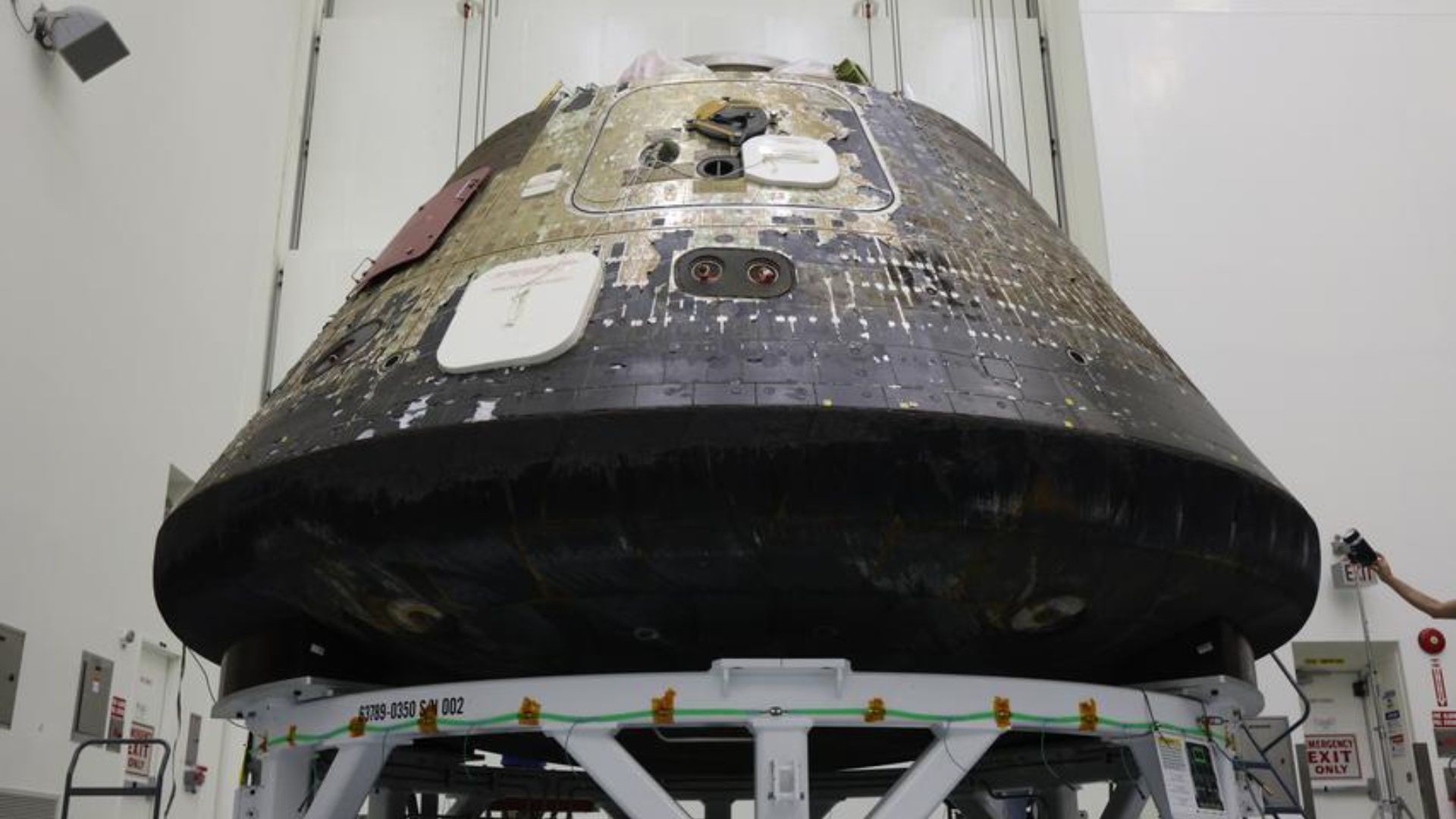
The blackened, scorched hull of NASA’s Orion spacecraft stands as a stark visual testament to the extreme violence of re-entering Earth’s atmosphere. Resting at the Kennedy Space Center in Florida, the capsule—named “Integrity” by its crew—bears the physical scars of a journey that marked the first time humans traveled to the Moon in over half a century.
This image, captured on May 8, 2026, offers more than just a glimpse of hardware; it illustrates the critical engineering challenge that defines human spaceflight: getting back alive.
The Journey Home
The Artemis 2 mission launched on April 1, 2026, carrying a four-person crew into deep space. The team included NASA astronauts Reid Wiseman (Commander), Victor Glover (Pilot), and Christina Koch (Mission Specialist), alongside Canadian Space Agency astronaut Jeremy Hansen. Their 10-day voyage culminated in a splashdown in the Pacific Ocean on April 10, ending a historic circumlunar flight.
While the launch and lunar flyby were spectacles of precision, the return trip was a battle against physics. As Orion hurtled back toward Earth, it had to shed immense orbital velocity. This deceleration generated friction with the atmosphere, creating a plasma sheath around the capsule.
Key Fact: During descent, temperatures surrounding the Orion capsule reached approximately 5,000°F (2,760°C).
The charred appearance of the spacecraft is not damage in the traditional sense, but rather the successful execution of its heat shield’s primary function. The ablative material on the capsule’s exterior was designed to burn away, carrying extreme heat with it and protecting the crew inside. The dark tiles and burnt undersides visible in the photo are evidence that the shield did its job perfectly.
Why This Matters
The condition of the Orion capsule highlights a crucial reality often overlooked in the glamour of space exploration: returning to Earth is just as dangerous as leaving it.
For decades, spacecraft have relied on robust thermal protection systems to survive re-entry. The Artemis 2 mission validated that Orion’s design can withstand the rigorous demands of deep-space travel and high-speed atmospheric entry. This success is a vital precursor for future Artemis missions, which aim to return humans to the lunar surface and eventually establish a sustained presence there.
The charred hull serves as a reminder that while technology has advanced since the Apollo era, the fundamental laws of thermodynamics remain unchanged. Every successful splashdown is a victory of engineering over extreme environmental forces.
Conclusion
The scorched Orion capsule is a powerful symbol of human resilience and engineering triumph. It proves that despite the inferno of re-entry, the path home for astronauts remains secure, paving the way for the next era of lunar exploration.