Astronomers have long puzzled over the erratic behavior of Betelgeuse, one of the most luminous stars visible from Earth. Now, decades of speculation are over: a faint companion star, named Siwarha, is directly influencing the supergiant’s atmosphere, creating observable disturbances in its gas and light emissions.
The Mystery of Betelgeuse’s Fluctuations
Betelgeuse, an 8-million-year-old red supergiant in Orion, is roughly 1,400 times larger than the Sun and emits 100,000 times more light. The star’s behavior has been inconsistent: it pulsates in cycles of 400 and 2,100 days. The longer cycle was the real head-scratcher. Scientists guessed at convection cells, dust clouds, magnetic activity… even a hidden companion.
The star’s unexpected dimming in 2020 only deepened the mystery, pushing researchers to look harder at the possibility of an unseen influence.
Evidence of a Stellar Wake
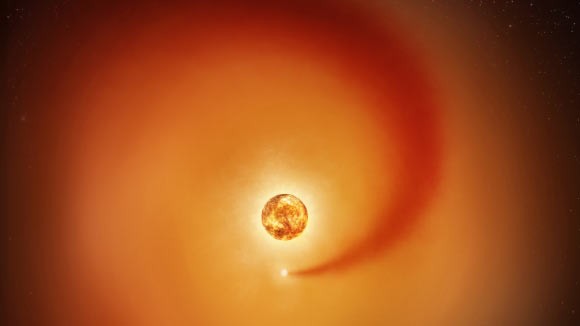
New observations from the Hubble Space Telescope and ground-based observatories have finally provided proof. The companion star, orbiting within Betelgeuse’s atmosphere, carves a trail through the supergiant’s gases every six years. This “wake” is visible in the star’s spectrum, showing changes in emitted colors and the speed of gases around it.
As Dr. Andrea Dupree, from the Harvard & Smithsonian’s Center for Astrophysics, explained: “It’s a bit like a boat moving through water. The companion star creates a ripple effect in Betelgeuse’s atmosphere that we can actually see in the data.” The evidence confirms theoretical models suggesting this interaction was happening all along.
Why This Matters
This discovery is important because it clarifies the dynamics of massive stars near the end of their lives. Betelgeuse will eventually explode as a supernova, bright enough to be visible during the day for weeks. Understanding its behavior now helps astronomers refine predictions about the final stages of other massive stars across the universe.
This is the first time scientists have directly observed such a wake, confirming that Betelgeuse’s odd behavior is indeed shaped by a hidden companion. The study, set to publish in the Astrophysical Journal, marks a breakthrough in stellar evolution research.