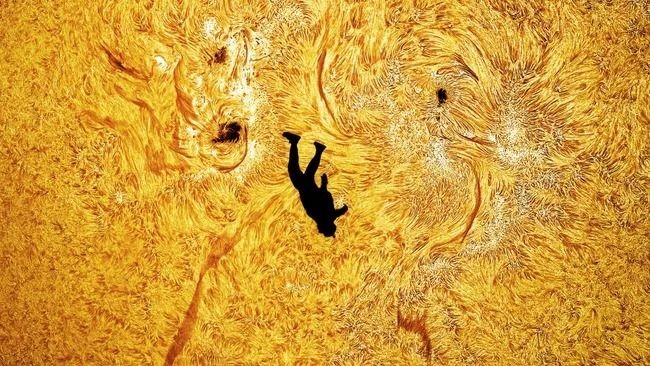
A skydiver, Gabe Brown, was captured in a breathtaking photograph seemingly falling across the sun’s surface, thanks to the meticulous planning and execution of astrophotographer Andrew McCarthy. The image, dubbed “The Fall of Icarus,” required precise coordination between a pilot, a skydiver, and advanced solar imaging techniques.
The Impossible Concept
McCarthy first experimented with photographing solar transits using a SpaceX rocket launch with a specialized hydrogen-alpha (h-alpha) filter, which reveals detailed solar structures. This sparked the idea of capturing a human silhouette against the sun. The challenge was not simply taking the shot, but making it safe and scientifically viable.
The Physics of the Shot
The attempt hinged on aligning the sun’s altitude with the aircraft and skydiver’s trajectory. Too high, and the transit would be too brief; too low, and a safe parachute deployment would be impossible. The team calculated a “sweet spot” where the jump could be executed safely, while keeping Brown within the telescope’s narrow depth of field. This meant that at the wrong altitude, his image would blur.
The Location and Setup
The team chose Willcox Playa Fly-In in Arizona—a vast, flat lakebed—for its open airspace. The pilot needed a clear line of sight to McCarthy’s position on the ground, allowing for precise alignment. The setup included a suite of telescopes:
– Lunt 60mm h-alpha with Powermate and ASI 1600mm camera
– AR 127 mm doublet refractor with hydrogen-alpha filter and ASI 174 mm
– Sky-Watcher Esprit 150mm modified with Lunt wedge and Z CAM E2-S6
– Canon R5 with 800 mm lens and white light filter
The Execution
The pilot used reflected sunlight to steer the ultralight into position while McCarthy tracked the aircraft’s approach. Once aligned, the pilot received a verbal cue from McCarthy, and Brown jumped. The team needed six passes over an hour, as the sun rose, making alignment progressively harder.
McCarthy focused on a particularly active region of the sun, capturing intricate details such as flares and spicules. The final image was assembled from over 100 tiles, providing both a full-disk context and a tight crop of Brown’s silhouette.
“It was an incredible moment to actually capture that and see that happening live on the monitors,” McCarthy said.
The “Fall of Icarus” is a testament to the intersection of precision, scientific understanding, and daring ambition.