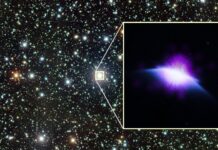
Astronomers have identified a unique cosmic object – a gas cloud lacking stars – that provides direct evidence supporting theories about how dark matter governs galaxy formation in the early universe. Dubbed Cloud-9, this celestial anomaly represents one of the first observed “failed galaxies,” demonstrating a critical mass threshold below which gravity cannot overcome energy dispersion to ignite star formation.
The Discovery of a Cosmic Ghost Town
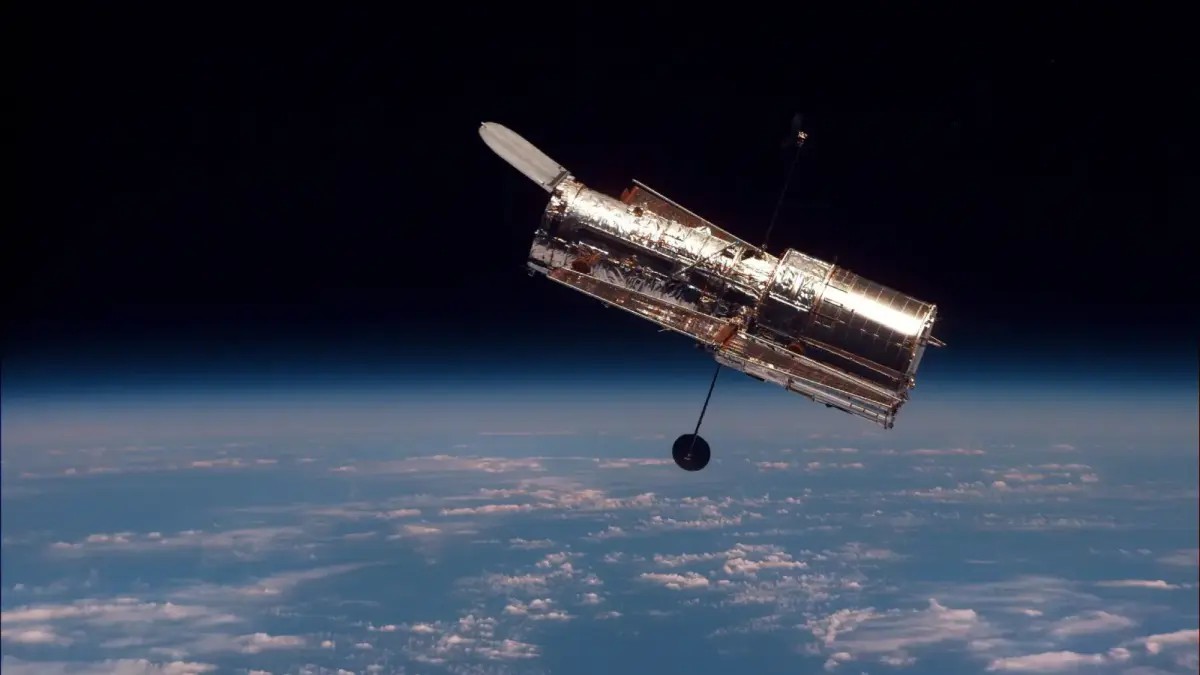
Located near the spiral galaxy Messier-94, approximately 14 million light-years away, Cloud-9 was first detected in 2023 by radio telescopes picking up its faint hydrogen signature. Initially, scientists considered the possibility it was a dim, distant galaxy too faint for ground-based observation. However, high-resolution imaging from the Hubble Space Telescope conclusively revealed the absence of stars within the cloud.
The object spans roughly 4,900 light-years and contains enough hydrogen to equal the mass of 1 million suns – insufficient to sustain star formation. The only explanation, according to researchers, is the presence of a significant dark matter halo providing the gravitational force to maintain its structure.
Why This Matters: Testing the Limits of Galaxy Creation
This discovery is crucial because it validates cosmological models predicting the existence of numerous failed galaxies. These structures should exist in abundance, representing regions where dark matter clumps are too small to pull in enough gas and trigger star birth.
“In science, we usually learn more from the failures than from the successes,” explains Alejandro Benitez-Llambay, principal investigator of the study. “In this case, seeing no stars is what proves the theory right.”
For decades, scientists have theorized that most of the universe’s mass is dark matter, but its detection has remained elusive. Cloud-9 serves as a rare window into the dark universe, offering concrete evidence of dark matter’s influence on cosmic structure. Computer simulations confirmed that even a minimal amount of stars would have been detectable by Hubble, reinforcing the conclusion that Cloud-9 genuinely lacks them.
The Implications for Understanding Dark Matter
The estimated mass of Cloud-9’s dark matter halo is equivalent to about 5 billion suns, placing it at the theoretical boundary between successful and failed galaxy formation. This discovery provides a tangible example of how dark matter dictates the fate of galactic development in the early universe.
The research team emphasizes that Cloud-9’s existence highlights the importance of failures in scientific understanding. By observing what didn’t work, scientists gain valuable insights into the fundamental forces governing cosmic evolution. This finding not only confirms existing theories about dark matter but also encourages further investigation into the vast number of undetected failed galaxies scattered throughout the cosmos.