


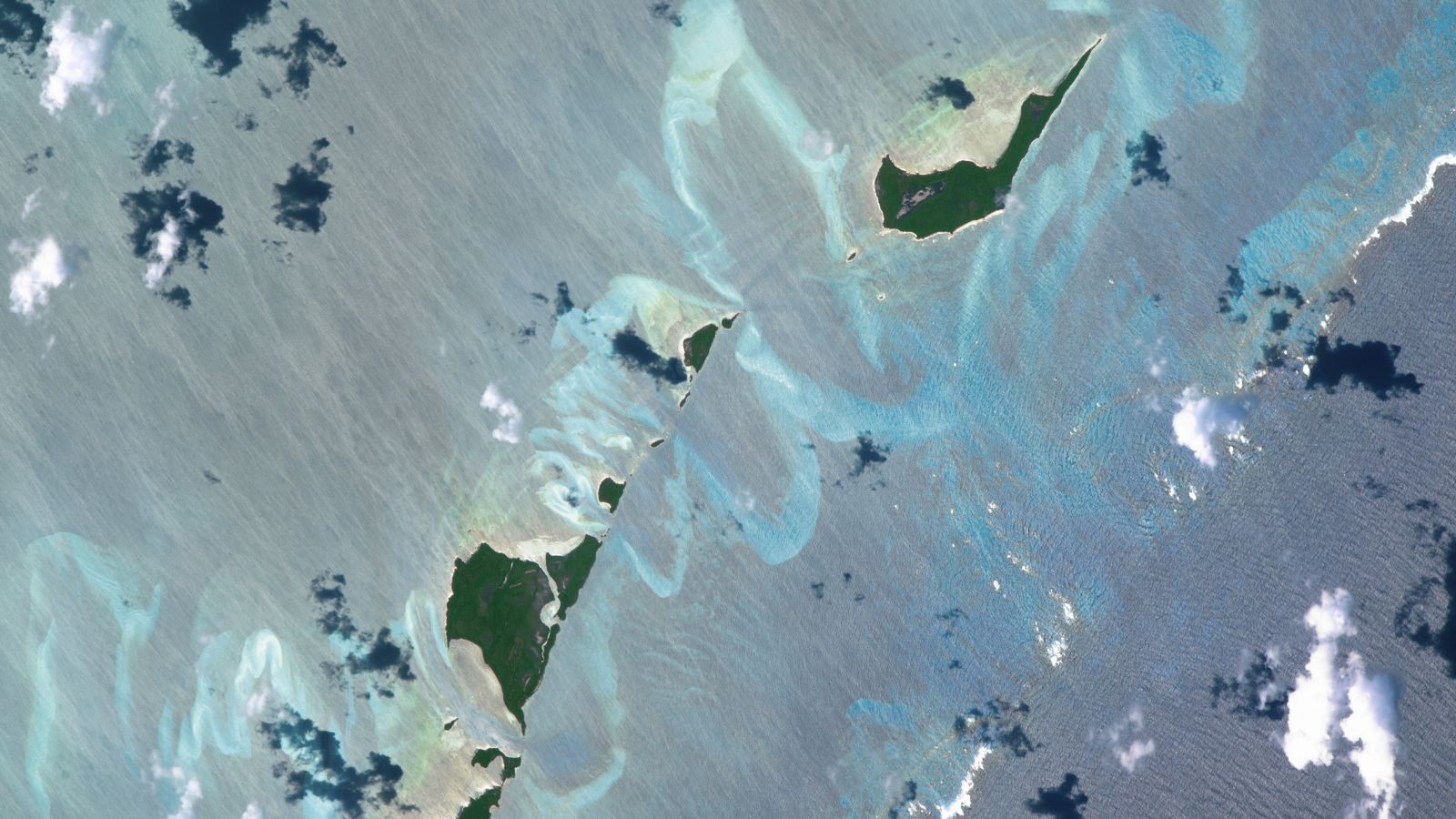
The Bahamas, a chain of over 3,000 islands and cays, presents a mesmerizing spectacle from space. Recent astronaut photography reveals intricate patterns of submerged sandbanks surrounding Carter’s Cays and Strangers Cay, two small islands approximately 125 miles east of Florida. These formations, sculpted by centuries of ocean currents and ancient coral reefs, are a key feature that makes the region easily identifiable to astronauts.
The Making of Underwater Landscapes
The sandbanks visible in the image are not random formations. They have been meticulously carved by consistent ocean currents over decades, allowing sand to accumulate in predictable patterns. The largest, U-shaped bank in the center of the photograph sits directly opposite a break in the underlying coral reef. This is not coincidental; the gap in the reef creates a strong tidal flow, pushing sand backward and maintaining the bank’s unique shape.
The coral reef itself is much older, likely having formed over millennia. Its presence is critical: it defines the shallow, protected waters where these sandbanks thrive. The contrast between the still, ribbon-like sandbanks and the breaking waves at the reef’s edge highlights this dynamic interplay.
Scale and Significance
These particular sandbanks are relatively small compared to other structures in the Bahamas. The Great Bahama Bank, for example, spans an astonishing 80,000 square miles (210,000 square kilometers) and supports a massive seagrass ecosystem. However, even these smaller features contribute to the region’s ecological and geological diversity.
The sandbanks frequently draw comparisons to abstract art or the Northern Lights due to their swirling patterns and ethereal appearance from above. However, their luminosity is an optical illusion: the sand lies just below the surface in some areas, only about 6.5 feet (2 meters) deep. The light water to the upper left of the islands, streaked with shimmer, contrasts sharply with the darker, wave-patterned water beyond the reef.
The Deep Drop-Off and Ocean Currents
The key to understanding these formations lies in the sudden drop-off in the ocean floor beyond the reef. This steep decline creates strong currents, similar to those depicted in the animated film “Finding Nemo,” responsible for the swells seen from airplanes. Behind the reef, however, the wind sculpts the water’s surface into subtle streaks instead.
The drop-off also explains why no sandbanks are visible beyond the reef: the strong currents prevent sediment accumulation in deeper waters. This geological feature is fundamental to the unique landscape of the Bahamas, shaping both its visible islands and its hidden underwater structures.
The interplay between reefs, currents, and sediment deposition creates a constantly evolving, yet remarkably stable, underwater topography that defines the Bahamas as a distinctive region on Earth.


