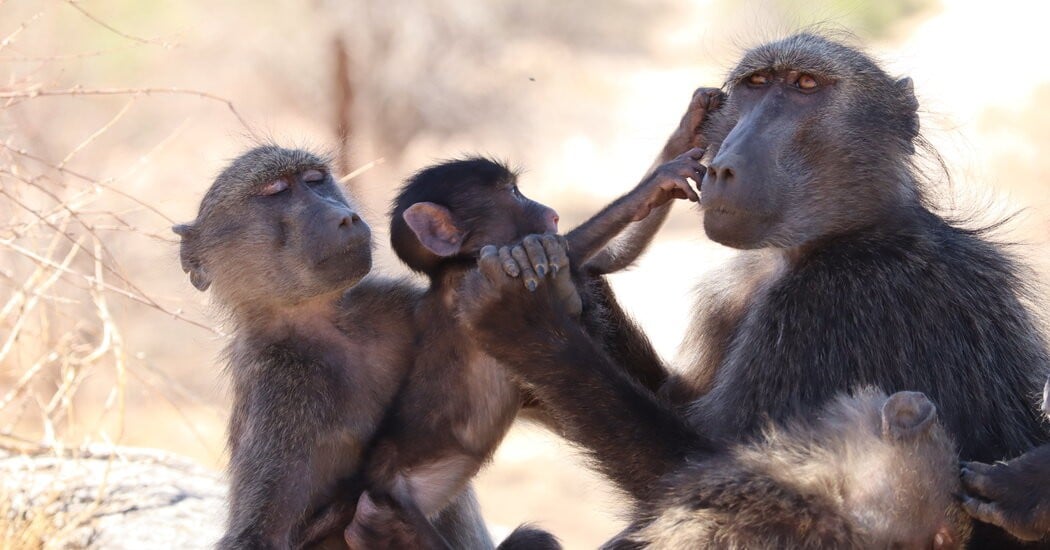
New research suggests baboons exhibit jealousy in ways strikingly similar to human sibling rivalry, providing strong evidence that complex emotional experiences may be more widespread in the animal kingdom than previously thought.
Baboon Sibling Rivalry: A New Study from Namibia
Scientists studying chacma baboons in Namibia’s Tsaobis Nature Park have observed behaviors indicative of jealousy among adolescent siblings. Researchers followed baboon families for extended periods in 2021, documenting how young baboons actively compete for their mothers’ attention. The study, published in Proceedings of the Royal Society B, reveals that these animals don’t simply react passively; they employ deliberate strategies to displace rivals.
Strategic Tactics Observed in the Wild
The tactics observed were often manipulative. Researchers witnessed baboons luring siblings away from their mothers with false promises of play, then swiftly taking their place in maternal grooming sessions. One particularly calculated female baboon, described by behavioral ecologist Axelle Delaunay, used a brief distraction to push her sister aside.
“She played with her for about 10 seconds, just long enough to drive her away from mom. It felt really strategic,” said Dr. Delaunay.
This suggests a level of cognitive planning not usually attributed to non-human primates. The behavior wasn’t random; baboons appeared to understand how to exploit social dynamics within their families.
Why This Matters: Evolution of Emotions
The debate over whether animals experience complex emotions like jealousy has been ongoing. This study adds significant weight to the argument that these emotions aren’t unique to humans. It raises questions about the evolutionary roots of jealousy and how it might function in primate social structures.
As primatologist Joan Silk notes, the relatable nature of these behaviors doesn’t automatically prove their emotional basis. But the consistency of strategic displacement suggests a deeper motivation than simple competition for resources.
The findings underscore that complex social-emotional dynamics are likely more common across species than previously understood, challenging the long-held assumption that jealousy is a uniquely human experience.