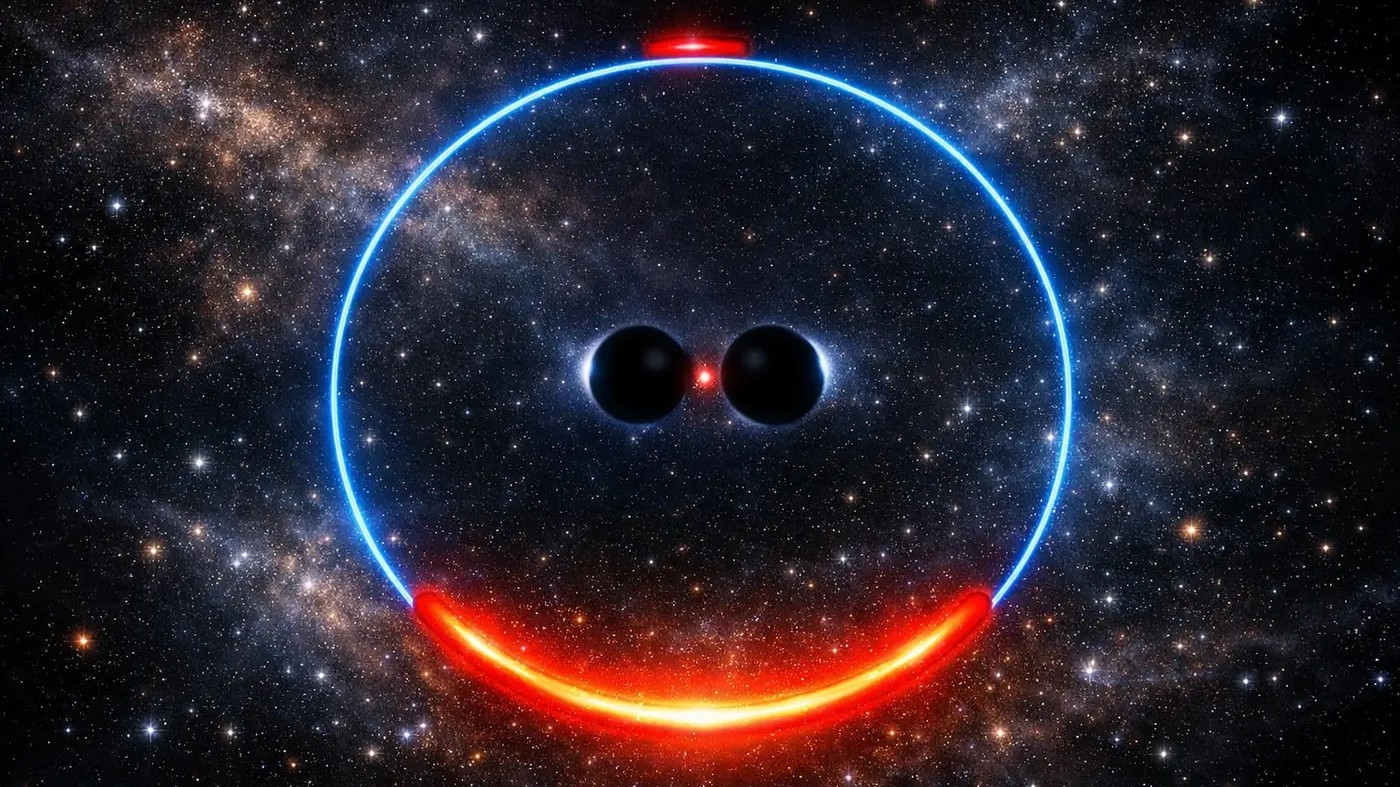
Astronomers may soon be able to detect supermassive black hole pairs locked in a deadly spiral, not through gravitational waves, but by observing how they warp starlight. A new method leverages gravitational lensing – the bending of light around massive objects – to reveal these hidden cosmic duos long before dedicated space-based detectors like LISA become operational.
The Invisible Dance of Galactic Centers
Most large galaxies harbor a supermassive black hole at their core, ranging from millions to billions of times the mass of our Sun. When galaxies collide, these black holes can fall into orbit around each other, eventually merging. Currently, identified binary black holes are widely separated, but the real action happens closer in. Detecting these closer pairs is difficult; existing methods rely on future gravitational wave observatories such as the European Space Agency’s LISA or China’s TianQin.
How Lensing Reveals the Invisible
The key lies in how binary black holes distort spacetime. A single black hole requires perfect alignment to lens starlight, but a pair offers a much higher chance of amplification. As the black holes orbit, they create a shifting “caustic curve” – a region where light is intensely magnified. Stars passing through this curve will periodically flash, appearing brighter as the caustic sweeps over them.
“The chances of starlight being hugely amplified increases enormously for a binary compared to a single black hole.” – Bence Kocsis, University of Oxford
This effect creates a distinctive signature: repeating bursts of starlight, visible over years, that distinguish these systems from other cosmic events. The shape and movement of the caustic curve encode information about the black holes’ masses and orbital decay. As they spiral closer, the lensing signal will change in frequency and brightness, providing further clues.
The Future of Black Hole Hunting
Though observing any single system is limited to a single snapshot, surveys of the night sky will allow for a broader census. The Vera C. Rubin Observatory in Chile and the Nancy Grace Roman Space Telescope (launching in 2027) are expected to detect many such lensing events. These observations could then be combined with data from LISA (operational in the 2030s) to create a detailed map of merging black holes across the universe.
The detection of these hidden giants will not only confirm theoretical models, but also open new avenues for testing gravity and black hole physics in extreme environments. This method promises to deliver a powerful new tool for unraveling some of the universe’s deepest mysteries.