For over a decade, the mathematical community has been locked in a fierce debate over the validity of a massive, controversial proof. Now, a new technological frontier—computer-assisted formalization —offers a potential way to finally resolve the dispute.
The ABC Conjecture Controversy
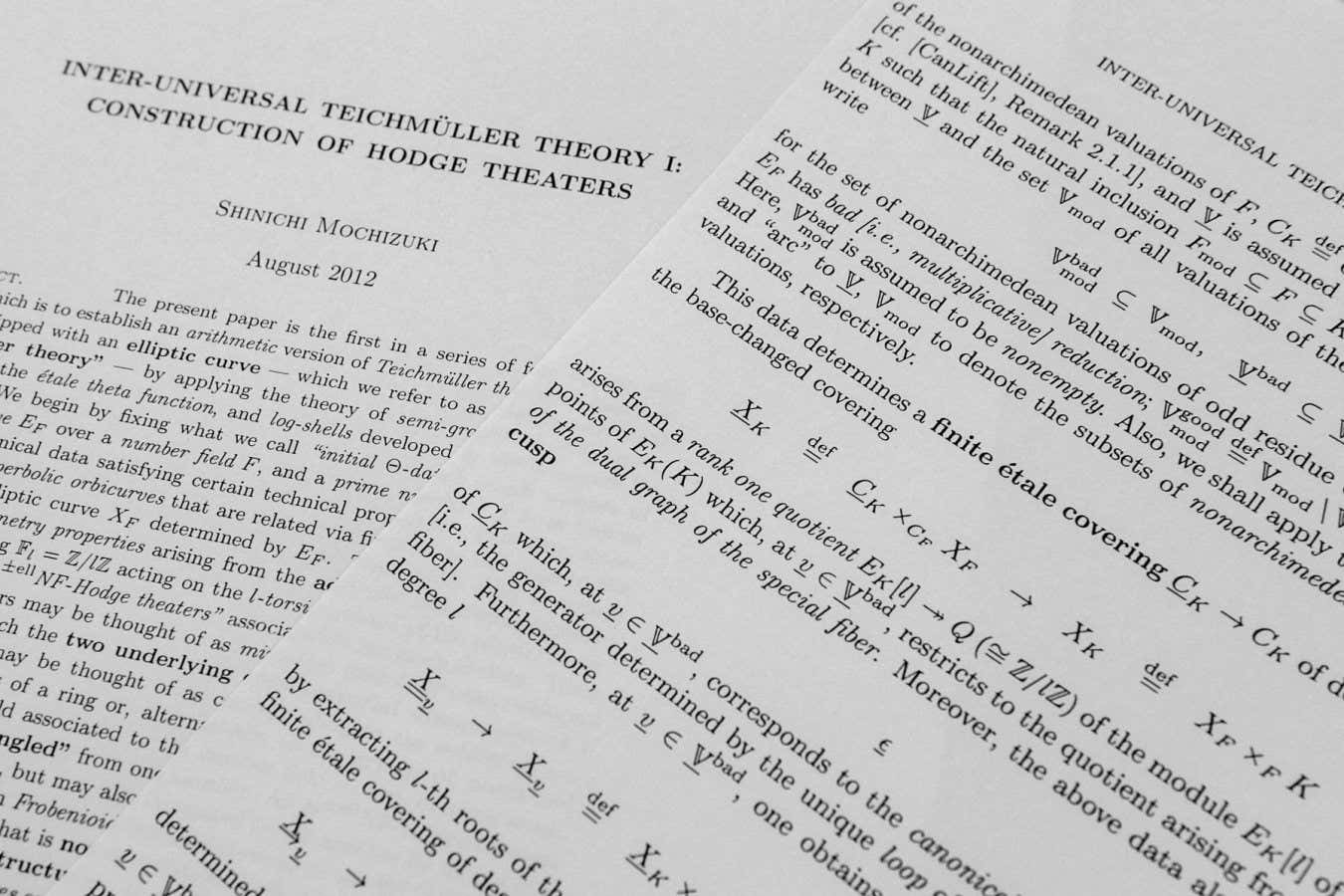
The conflict centers on the ABC conjecture, a fundamental problem involving the relationship between addition and multiplication in prime numbers. In 2012, Shinichi Mochizuki of Kyoto University published a 500-page proof that claimed to solve this long-standing puzzle.
However, his method—a complex framework called Inter-universal Teichmüller (IUT) theory —was so unprecedented that it left the global mathematical community divided. While Mochizuki and his supporters insist the proof is correct, many prominent mathematicians, including Peter Scholze and Jakob Stix, have argued that the logic contains a fatal flaw.
This impasse has created a rare “stalemate” in modern science: one side sees a groundbreaking truth, while the other sees an indecipherable or broken argument.
The Rise of Formalization
To break this deadlock, researchers are turning to Lean, a specialized programming language designed for “formalization.” In this process, mathematical proofs are translated into code that a computer can verify with absolute logical certainty. This removes the “human element”—the potential for misunderstanding, social pressure, or peer-review bias—and replaces it with binary truth.
Two distinct projects are currently attempting to use this technology to settle the matter:
1. The LANA Project (The Search for Truth)
Led by Kato Fumiharu at the ZEN Mathematics Center, the Lean and Anabelian geometry (LANA) project aims to verify the proof once and for all. This group consists of experts in both Mochizuki’s specific theories and the Lean programming language.
Despite their progress, the project has hit a significant roadblock. They have identified a specific, problematic point in the IUT theory that mirrors the error identified by Scholze and Stix in 2018. After eighteen months of intensive study, the team remains stuck on this particular logical knot.
2. Mochizuki’s Project (The Search for Clarity)
In a different approach, Mochizuki and his colleagues have also begun formalizing his work in Lean. However, their goal is not to “prove” their own correctness—since they believe it is already established—but to use the code as a precise communication tool.
Mochizuki argues that Lean will create a “precise record” of his logical structure, making it immune to the misinterpretations that have fueled the controversy for years. While his team has produced an initial 70 lines of code, experts note that this is only the very beginning of what will likely be a monumental task.
Why This Matters
The resolution of the ABC conjecture is about more than just one equation; it represents a turning point in how mathematics is practiced.
- The Validation Crisis: If the computer finds an error, it will settle a decade of academic friction.
- The New Methodology: If the proof is verified, it proves that “formalization” is a viable way to handle increasingly complex mathematical ideas that exceed human cognitive limits.
- The Communication Bridge: The dialogue between the LANA project and Mochizuki’s group suggests that technology might finally provide a common language for mathematicians who have otherwise been unable to communicate effectively.
Conclusion
While the technical hurdles remain immense, the shift toward computer-verified mathematics represents the first real movement in the ABC controversy in years. Whether the code confirms or corrects Mochizuki’s work, the result will fundamentally change how mathematical truth is established and communicated.