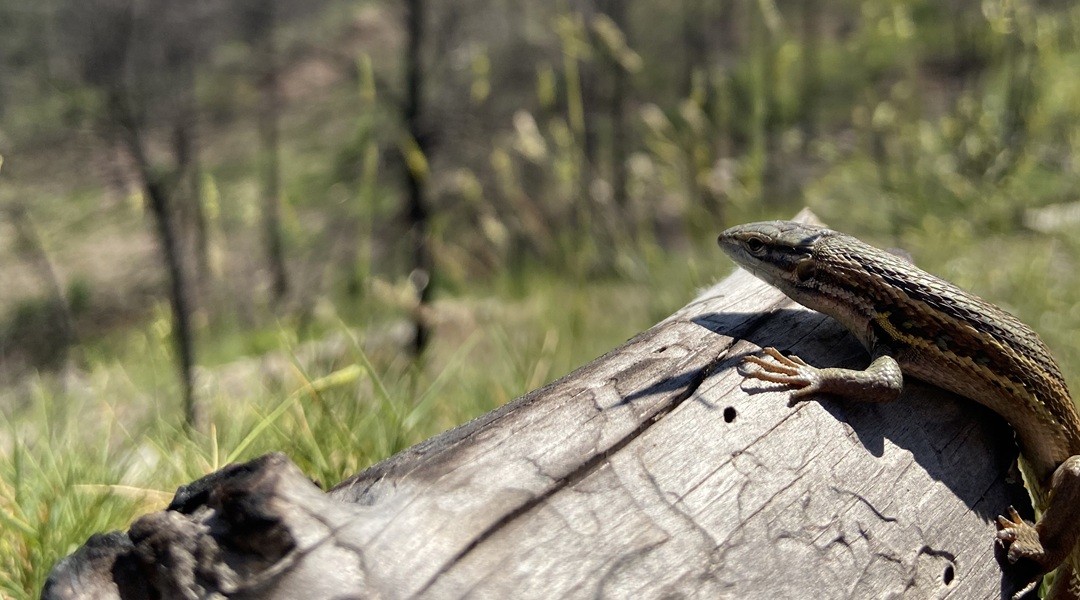
Wildfires are reshaping ecosystems at an accelerating rate, leaving surviving animals exposed to extreme heat and altered habitats. New research reveals that a common Mediterranean lizard, Psammodromus algirus, rapidly adjusts to post-fire conditions by lightening its skin coloration – a likely strategy to reduce heat stress in scorched landscapes. This adaptation highlights the resilience of some species while underscoring the growing dangers posed by increasingly frequent and intense wildfires driven by climate change.
Rapid Color Shifts in Response to Fire
Researchers led by Lola Álvarez-Ruiz at the Centro de Investigaciones Sobre Desertificación in Spain observed a striking change in lizard coloration across five wildfire-affected areas in the Iberian Peninsula between 2018 and 2020. Lizards inhabiting recently burned regions exhibited significantly lighter, gray-yellow tones compared to their darker, olive-brown counterparts in unburned areas.
This shift isn’t permanent: as vegetation recovers within approximately two years, the lizards revert to their original darker coloration. The mechanism relies on basic physics – lighter colors reflect more sunlight, reducing heat absorption in exposed environments where shade is scarce.
Size Matters: Larger Lizards Adapt More Readily
The study also revealed that larger lizards were more prone to the color change than smaller ones. This is likely due to surface-to-volume ratios: smaller lizards heat up and cool down faster, allowing them to rely on behavioral thermoregulation (seeking shade, etc.). Larger lizards retain heat for longer, making overheating a greater risk, thus driving a stronger physiological response.
“Larger, adult lizards have a lower surface-to-volume ratio and retain heat for longer, so overheating may be a bigger risk for them,” Álvarez-Ruiz explained.
The Bigger Picture: Fire as an Evolving Threat
While fire is a natural element in many ecosystems, the speed at which fire regimes are changing is alarming. Human activity and climate change are driving more frequent and intense wildfires, exceeding the evolutionary capacity of many species. Understanding how animals respond to these shifts is crucial for conservation efforts.
The researchers acknowledge that further studies are needed to confirm the direct link between color change and heat absorption, as well as to assess any metabolic or reproductive trade-offs associated with the adaptation. However, this research underscores a critical point: animals are not passive victims of wildfires; some can adapt, but only to a certain extent. The question now is whether they can keep up with the accelerating pace of environmental change.
Reference: L. Álvarez-Ruiz et al., Rapid postfire color shift in a Mediterranean lizard, Journal of Zoology (2025). DOI: https://doi.org/10.1111/jzo.70083