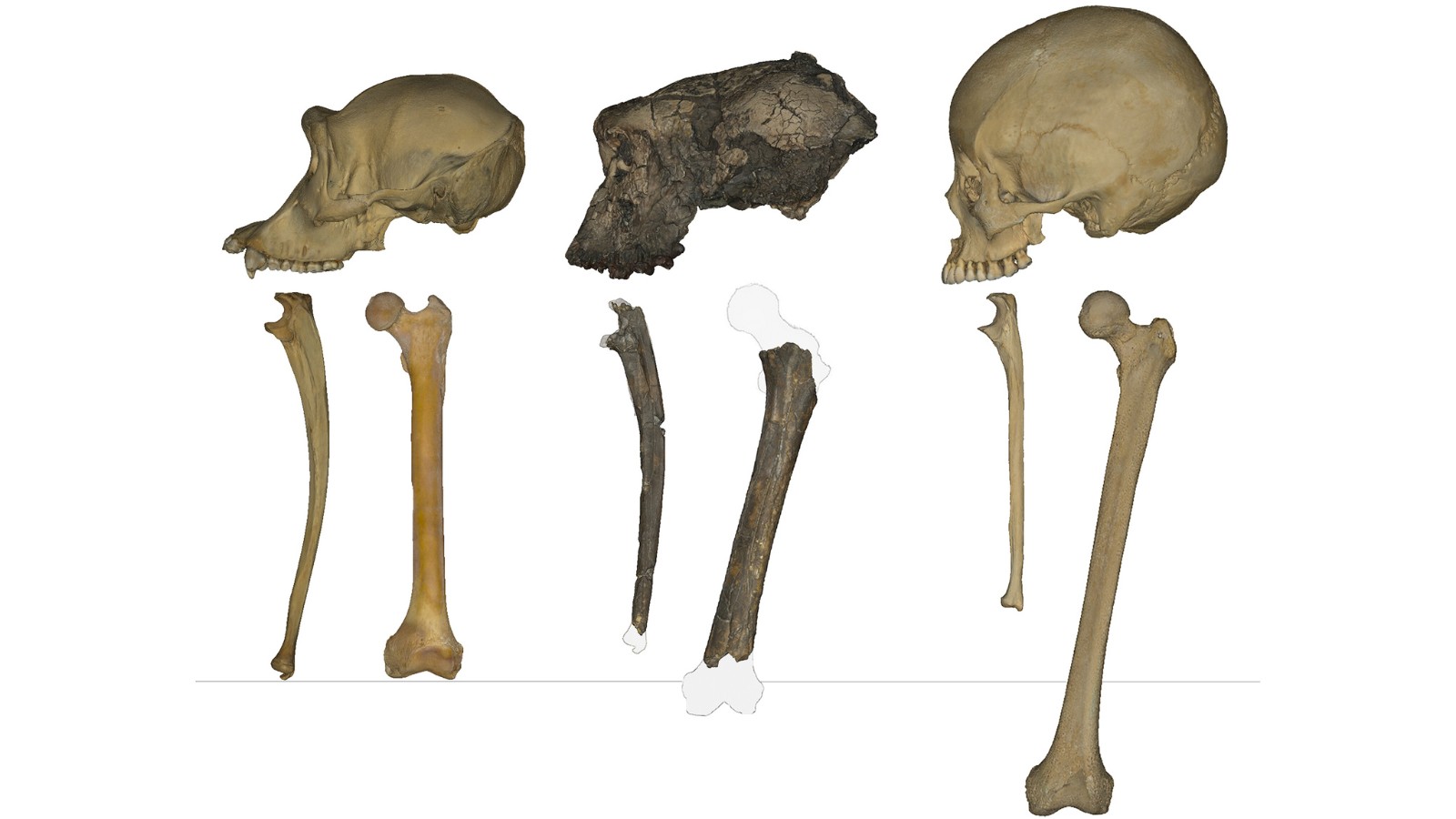
A newly analyzed 7-million-year-old fossil reveals that the species Sahelanthropus tchadensis likely walked on two legs, making it the oldest known member of the human lineage. The discovery, published in Science Advances, centers around a previously unnoticed anatomical feature: a distinct bump on the femur, present only in species that walk upright.
The Key Finding: A Bipedal Ancestor?
For decades, paleontologists debated whether S. tchadensis was a true hominin (a member of the group that includes humans and their extinct relatives). The initial 2002 discovery of the fossil, found in Chad, sparked controversy due to the position of the foramen magnum—the opening in the skull where the spinal cord connects. A central position suggests upright posture, but does not prove two-legged walking.
Now, researchers led by Scott A. Williams of New York University have re-examined the fragmented femur. Beyond confirming inward twisting of the bone and a gluteal muscle attachment consistent with bipedalism, they identified a small but critical bump on the bone’s front. This “femoral tubercle” is a hallmark of upright walking, and its presence definitively places S. tchadensis within the hominin family tree.
Why This Matters: Rewriting Human Evolution
The identification of this early hominin forces a re-evaluation of human evolution. The last common ancestor of humans and chimpanzees lived around 6 to 7 million years ago. If S. tchadensis is indeed a human ancestor, it suggests that this common ancestor was likely more similar to modern apes than previously thought.
“This makes the question of what the last common ancestor between humans and chimpanzees looked like even more puzzling and fascinating,” explains Jeremy DeSilva, a biological anthropologist at Dartmouth College, who wasn’t involved in the study.
Implications and Ongoing Debate
While the evidence strongly supports bipedalism in S. tchadensis, the debate continues. Some scientists suggest that the species could be a bipedal ape that did not evolve into humans. The discovery raises a fundamental question: can an ape walk upright without being a true hominin?
The S. tchadensis fossil challenges long-held assumptions about the origins of human bipedalism and pushes the timeline for the emergence of our lineage further back than previously believed. The study underscores how subtle anatomical details can rewrite our understanding of evolutionary history.
The debate is far from over, but the discovery of the femoral tubercle on S. tchadensis provides a compelling new piece of evidence in the ongoing search for humanity’s earliest roots.