Light is universally understood as the fuel for plant life, driving photosynthesis and enabling expansion. However, new research reveals a more complex reality: light also acts as a structural regulator that can physically restrain growth. Scientists at Osaka Metropolitan University have discovered that exposure to light tightens the bond between a plant’s outer skin and its inner tissues, creating a rigid structure that limits how fast the stem can expand.
This finding challenges the simplistic view of light as purely a growth accelerator. Instead, it highlights a biological balancing act where plants sacrifice speed for strength, a mechanism with significant implications for agriculture and crop resilience.
The Strength-Speed Paradox in Pea Stems
The study, led by Professor Kouichi Soga, focused on the epicotyls (young stems) of pea plants. While previous research established that light affects plant height and thickness, the specific mechanical interactions between tissue layers remained unclear.
To uncover these dynamics, the team developed a specialized technique to measure the adhesive strength between the epidermis (the protective outer layer) and the inner tissues (where most expansion occurs). The results revealed a stark contrast based on lighting conditions:
- Plants grown in darkness: Exhibited weak adhesion between tissue layers, allowing for rapid, albeit often unstable, expansion.
- Plants grown in light: Showed significantly stronger adhesion, binding the outer and inner layers tightly together.
“This phenomenon has never been reported before,” noted Professor Soga. “Compared with plants grown in the dark, the epidermal and inner tissues of plants grown in the light are more tightly bound together.”
p-Coumaric Acid: The Molecular Glue
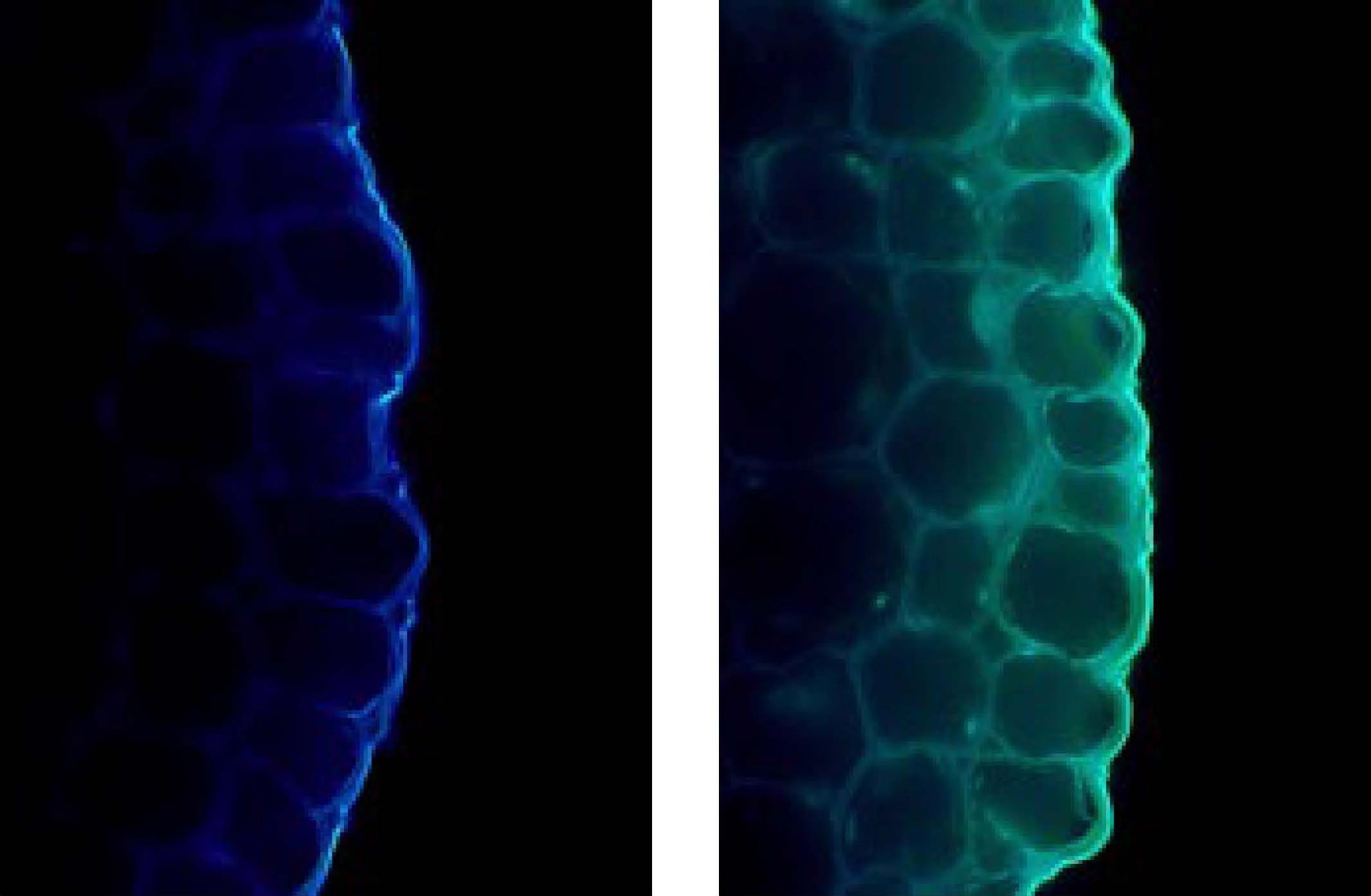
The researchers sought to identify the biochemical driver behind this increased stickiness. Using fluorescence microscopy, they observed that light-exposed stems accumulated higher levels of p-coumaric acid, a phenolic compound known for reinforcing cell walls.
Yuma Shimizu, the study’s first author, explained the mechanism: “This provided strong evidence that the accumulation of p-coumaric acid was a key factor in strengthening the adhesion between the epidermal and the inner tissues.”
In essence, p-coumaric acid acts as a natural cross-linking agent. It integrates into the cell walls, effectively “gluing” the outer protective layer to the inner growing tissue. While this enhances structural integrity, it creates physical resistance against expansion.
Why This Matters for Crop Development
The discovery illustrates a fundamental trade-off in plant biology: structural stability versus growth rate.
When the bond between tissue layers is strong, the inner tissues cannot expand as freely. This results in slower overall stem growth. Conversely, weaker bonds allow for faster elongation but may compromise the plant’s ability to withstand physical stress, such as wind or heavy rain.
Understanding this mechanism offers a new pathway for agricultural innovation. If scientists can manipulate the adhesion strength between tissue layers, they could potentially breed crops with optimized traits:
- Enhanced Resilience: Crops with stronger inter-tissue bonds might be less prone to lodging (falling over), a major cause of yield loss in grain production.
- Controlled Growth: Adjusting these mechanical properties could help manage plant architecture in high-density farming environments.
“These findings could be highly significant for plant cultivation. If we can control adhesion, it may be possible to breed plants with improved tolerance to environmental stress,” Professor Soga concluded.
A Universal Mechanism?
The current study focuses on pea plants, but the researchers believe this light-mediated adhesion process may be a universal feature across many plant species. Future work will involve testing this mechanism under various environmental conditions and across different crops to determine its broader applicability.
By measuring how adhesion changes in response to light, temperature, and other factors, scientists aim to map out a comprehensive model of growth regulation. This could shift agricultural strategies from merely feeding plants to engineering their internal mechanical properties.
Conclusion
Light does not merely power plant growth; it actively shapes their physical structure by reinforcing tissue connections through p-coumaric acid. This increased strength comes at the cost of reduced expansion speed, revealing a critical balance between resilience and growth that could be key to developing hardier, more efficient crops.