Antibiotic resistance is accelerating globally, driven in part by the widespread presence of these drugs in our environment. Now, researchers in India have developed a simple, low-cost method to detect multiple classes of antibiotics in water, food, or clinical samples using nothing more than a smartphone camera and a drop of fluorescent chemical.
This innovation addresses a critical gap in public health monitoring: while we know antibiotic pollution is rising, we lack accessible tools to measure it in real-time outside of expensive laboratories.
The Hidden Cost of Antibiotic Overuse
The global consumption of antibiotics has surged, not only in human medicine but also extensively in agriculture and livestock farming. When these drugs are excreted or discarded, they often seep into soil and water systems. This environmental accumulation disrupts ecosystems and accelerates the development of antimicrobial resistance (AMR).
According to a recent United Nations report, the situation is dire: in some nations, up to one-third of all infections are now resistant to standard antibiotic treatments.
“Antibiotic pollution is increasing at an alarming rate day by day,” says Abhimanew Dhir, assistant professor of chemistry at the Indian Institute of Technology Mandi and senior author of the study. “Residues of several classes of antibiotics are becoming hazardous. Through accumulation in the environment, they enter into the food chain causing adverse effects on human and animal health.”
Why Detection Has Been Difficult
Monitoring antibiotic levels is essential for safeguarding public health and tracking resistance trends. However, current detection methods pose significant logistical barriers.
Standard techniques like chromatography and spectrometry offer high precision but require:
* Large, expensive laboratory equipment.
* Highly skilled personnel to operate.
* Controlled environments that prevent real-time, on-site testing.
“Conventional detection methods have excellent performance but often require huge equipment, high cost, and skilled personnel, which limits real-time detection and monitoring of on-site threats,” explains Chunyan Sun, professor of food quality and safety at Jilin University, who was not involved in the study.
This limitation means that by the time samples are analyzed, opportunities for immediate intervention may have passed. There is a pressing need for portable, affordable sensors that can provide instant results.
How the New Sensor Works
To solve this, Dhir and his team engineered a sensor based on Aggregation-Induced Emission (AIE) materials. These are specialized fluorescent compounds that change their light-emitting properties depending on their physical state—glowing differently when dissolved in liquid versus when in powder form.
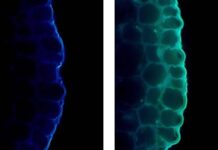
The researchers modified an AIE material to react specifically with chemical groups found on various antibiotic drugs. The result is a visible change in fluorescence intensity:
* Brighter Glow: Indicates the presence of fluoroquinolone-class antibiotics.
* Dimmer Glow: Indicates the presence of thioamide or tetracycline-class antibiotics.
The sensor was tested against 10 different antibiotics across three major drug classes. “To the best of our knowledge, this type of extensive fluorescence recognition towards different antibiotics is unprecedented,” Dhir notes.
From Lab to Smartphone
The true breakthrough lies in the accessibility of the technology. The team demonstrated that the sensor’s color changes could be quantified using a standard color-picking app on a smartphone.
In practical tests, the researchers added antibiotics to urine samples and used the smartphone camera to measure the fluorescence. The method proved effective even at very low antibiotic concentrations, highlighting its potential as a rapid diagnostic tool for both environmental monitoring and clinical settings.
A Step Toward Accessible Health Monitoring
This new sensor offers a practical alternative to traditional lab-based testing. By enabling detection anywhere—from a farmer’s field to a local clinic—it removes the bottleneck of sending samples to centralized facilities.
While further research is needed to refine the technology for commercial use, this work marks a significant step forward. It demonstrates that sophisticated chemical analysis can be democratized through simple, visual cues and ubiquitous technology.
In summary, this smartphone-based fluorescent sensor provides a rapid, affordable, and portable solution for detecting antibiotic pollution, helping to combat the growing crisis of antimicrobial resistance.