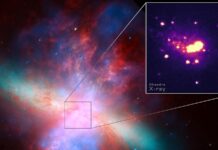
Supermassive black holes, some of the most enigmatic objects in the universe, may have formed from the collapse of massive, ancient stars that existed in the early cosmos. New research suggests that these primordial stars, significantly larger than any observed today, could have directly seeded the creation of black holes at the centers of galaxies.
The Early Universe and First Stars
The universe shortly after the Big Bang was vastly different from what we observe now. It was filled with mostly hydrogen and helium, the lightest elements, and lacked the heavier elements forged in later generations of stars. Under these conditions, the first stars likely grew to enormous sizes—possibly hundreds of times the mass of our sun. These behemoths burned through their fuel rapidly, collapsing at the end of their lives not into typical stellar remnants like neutron stars, but directly into black holes.
Computer Models Confirm the Theory
Scientists use computer models to simulate these early star formations. These simulations show that stars exceeding a certain mass threshold—around 100 times that of our sun—would have been unstable. Instead of exploding as supernovas, they would have undergone direct collapse, forming black holes with enough mass to eventually become the supermassive black holes we find at the cores of most galaxies today. This process avoids the energy loss associated with supernovae, making it a more efficient way to create large black holes quickly.
Why This Matters
Understanding how supermassive black holes formed is crucial for understanding galaxy evolution. These black holes aren’t just passive residents; they actively shape the galaxies around them through gravitational influence and energy output. If these black holes grew from ancient stars, it means that the earliest galaxies formed around these massive seeds, influencing their structure and development.
The discovery raises further questions: Were these ancient stars common, or were they rare cosmic events? What role did dark matter play in their formation? These questions drive ongoing research in astrophysics, with scientists continuing to refine models and search for observational evidence to support the theory.
The Role of Science Competitions
Research into these early stars and black hole formation is often driven by young scientists through programs like the Regeneron Science Talent Search, a prestigious annual competition for high school students. These competitions encourage rigorous scientific exploration, bringing the next generation of researchers into fields like astrophysics.
In conclusion, the possibility that supermassive black holes originated from ancient, massive stars offers a compelling explanation for their existence. This theory suggests that the seeds of these galactic giants were sown in the very early universe, shaping the cosmos as we know it.