A 3,000-year-old artifact unearthed from the Sanxingdui archaeological site in Southwest China reveals a mysterious ancient culture’s mastery of meteoritic iron. The axe-like object, discovered in a ritual pit, is believed to have been forged from metal that fell to Earth from space, predating widespread iron smelting by centuries. This discovery not only expands understanding of the Sanxingdui civilization, but also challenges conventional timelines for early iron use globally.
The Sanxingdui Enigma
The Sanxingdui culture flourished between 2800 and 600 BCE, peaking during the Shang Dynasty (roughly 1600–1050 BCE). Known for its striking, otherworldly art and ritualistic practices, the civilization left behind a trove of artifacts in eight sacrificial pits. These pits contained over 17,000 items: bronze masks, figurines, ivory, and jade tools – all suggesting a society deeply focused on ceremony and offering. The precise nature of these rituals remains unknown, but charred remains indicate deliberate burning of some objects, hinting at a complex system of sacrifice or veneration.
A Weapon From the Heavens
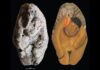
The iron artifact, designated K7QW-TIE-1, was found embedded in the wall of Pit No. 7. Measuring 20 cm (8 inches) long and 5–8 cm (2–3 inches) wide, its poor condition required researchers to excavate the entire surrounding pit block for laboratory analysis. X-ray fluorescence revealed a composition of over 90% iron, with 7.41% nickel – a signature of meteoritic iron.
The presence of such high iron content is significant because iron smelting didn’t become commonplace in China until around 800 BCE. Before this, metalworkers relied on bronze, an alloy of copper and tin, for tools and weapons. Meteoritic iron, however, was a rare and difficult-to-obtain material.
Unique Metallurgical Practices
While meteoritic iron artifacts have been found elsewhere in China, the Sanxingdui piece stands out. Other examples often combined space metal with bronze, but this artifact appears to be made entirely from iron. The researchers suggest this points to a unique metallurgical tradition in Southwest China, distinct from those in the Central Plains.
This discovery also raises questions about the cultural significance of meteoritic iron to the Sanxingdui people. Its presence in a ritual pit suggests it wasn’t just another metal but something precious enough to be included in sacred ceremonies, possibly even burned as an offering.
“The presence of meteoritic iron at Sanxingdui further highlights the distinctive metallurgical practice in Southwest China….”
Conservation and Future Research
The artifact’s fragile state presents conservation challenges. Further high-resolution analysis is needed to refine its classification and fully understand its function and ritual role. For now, it remains a compelling reminder that ancient civilizations often possessed knowledge and technologies far more advanced than previously assumed.
The Sanxingdui find underscores how ancient cultures interacted with the cosmos, utilizing materials from beyond our world in ways that continue to fascinate and challenge modern understanding.