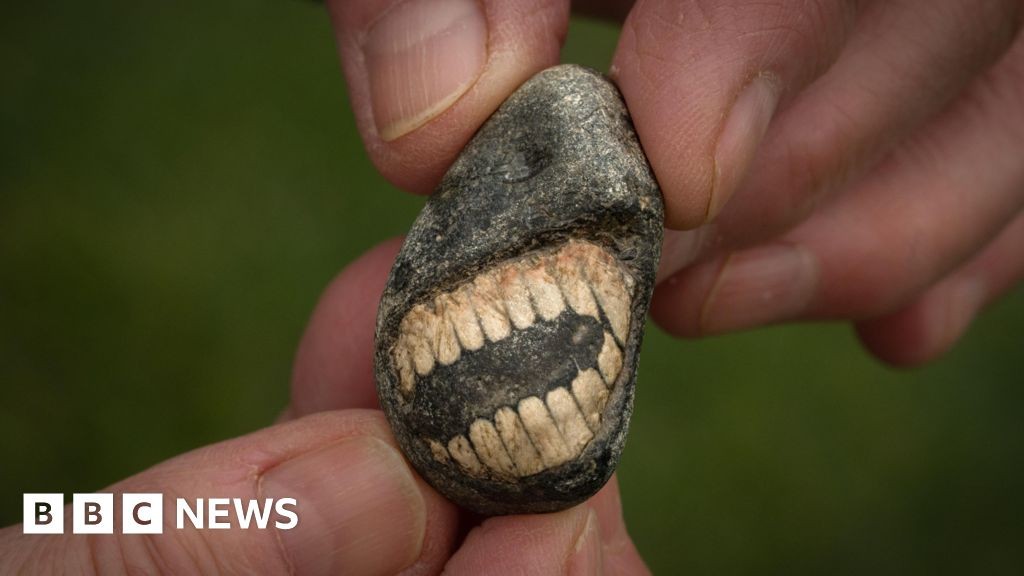
A 64-year-old fossil hunter, Christine Clark, discovered a remarkably well-preserved fossil resembling a smiling mouth on Holy Island, Northumberland, during a Boxing Day walk. The unusual find, identified by the British Geological Survey (BGS) as part of an ancient marine animal, has garnered attention for its unique appearance and the historical context of fossil collecting in the region.
The Discovery and Initial Reaction
Clark, who regularly searches for fossils on Holy Island with her husband, Gerard, initially mistook the pebble-like object for “someone’s fake teeth.” Posting a photo to a Facebook fossil identification group, she received confirmation that it was indeed a fossilized fragment of a crinoid—an ancient marine animal related to sea urchins and sea cucumbers. The discovery highlights the accessibility of paleontological finds for amateur enthusiasts.
The History of “Cuddy’s Beads”
The area around Holy Island is renowned for its “Cuddy’s Beads,” which are fossilized segments of crinoid stems. The name originates from St. Cuthbert, a 7th-century monk buried on the island, with local folklore attributing the fossils to his spiritual influence. In the 1300s, people believed collecting these “beads” enhanced their spirituality, and the tradition has persisted for centuries.
Scientific Identification and Geological Context
The BGS confirmed that the “smiling” fossil is a portion of a crinoid stem known as a columnal. These animals first appeared over 500 million years ago, making them among the oldest complex life forms on Earth. The specimen likely originates from the Alston formation, a dark limestone dating back around 350 million years.
Why Crinoids Matter
Crinoids are echinoderms, meaning they share ancestry with sea urchins and starfish. Their fossilized remains are common along the Northumberland coast due to the region’s geological history. While complete crinoid fossils are rare, individual stem segments—the Cuddy’s Beads—are frequently found. These fossils stand out against surrounding rock due to their distinct color and composition.
How to Identify Fossils
The BGS and the Natural History Museum offer identification services for those who find potential fossils. Key indicators include differences in color, composition, and the presence of well-defined lines in the fossilized material.
The discovery serves as a reminder that even casual beachcombing can yield significant paleontological finds, connecting individuals to deep geological history. The blend of scientific identification, local folklore, and accessible fossil hunting creates a unique cultural and scientific landscape along the Northumberland coast.