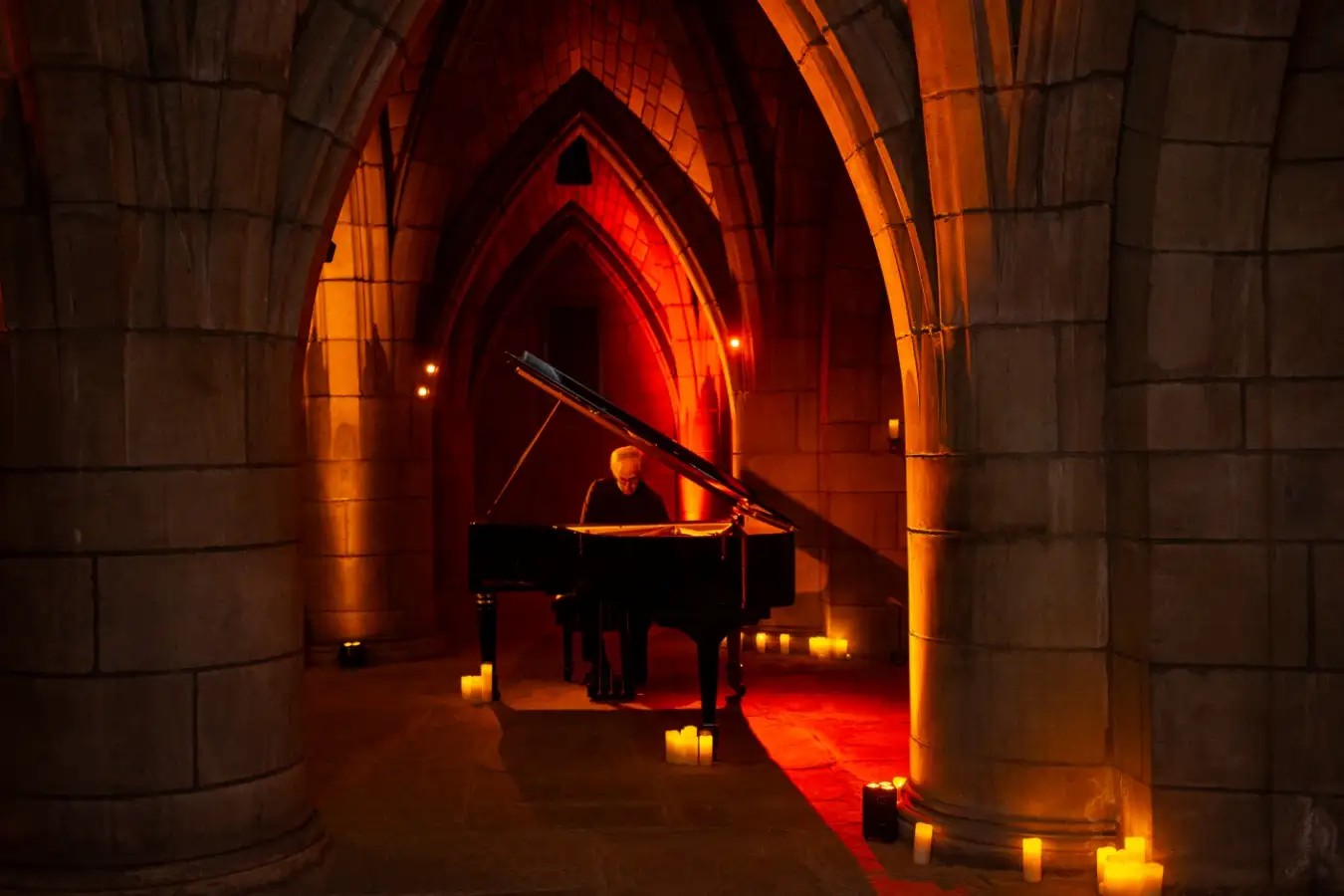
In an unconventional setting—a candlelit crypt beneath the Church of the Intercession in New York City—composer and jazz instrumentalist Jeff Beal debuted his latest work, New York Études, Vol. II. Organized by the non-profit Death of Classical, the performance transformed a cavernous, eerie space into a venue for profound musical and emotional intimacy.
The Intersection of Music and Neurology
Jeff Beal is a highly accomplished musician, a five-time Emmy winner known for his evocative scores, including the political drama House of Cards. However, his recent work is shaped by a deeply personal battle with multiple sclerosis (MS), a chronic condition diagnosed in 2007.
MS occurs when the immune system attacks the protective coating of nerves, leading to lesions in the brain and spinal cord. For Beal, these lesions are concentrated in the corpus callosum —the vital bridge that transmits signals between the brain’s two hemispheres. This specific area is critical for musicians, as it coordinates the complex integration of sound and physical movement.
Interestingly, neurological research suggests a reciprocal relationship between music and the brain: musicians often possess a larger corpus callosum, as the discipline of playing instruments can strengthen these neural connections. Beal has embraced this connection, noting that his continued musical activity may help manage the progression of his symptoms.
Defying Physical Limitations
The technical difficulty of the new album serves as a testament to Beal’s resilience. In the track “New Leaf,” he intentionally challenges his physical constraints by performing the entire melody with his non-dominant hand. The piece, characterized by melodies that mimic a leaf dancing in a breeze, acts as a musical exercise in overcoming neurological hurdles.
A Sonic Portrait of Grief
Beyond the technical mastery, New York Études, Vol. II is a deeply emotive collection. Much of the album was composed while Beal was processing the death of his mother, lending the tracks a heavy, contemplative atmosphere.
The music explores the delicate boundary between life and death:
– The compositions act as a vehicle for mourning and reflection.
– The final track, “Last Breath,” provides a somber, resonant conclusion to the journey.
– The setting of the crypt—a place traditionally associated with mortality—complemented the album’s themes of loss and memory.
The performance was more than a recital; it was an intimate experience that bridged the gap between the performer’s personal struggle and the audience’s shared human emotions.
Conclusion
Jeff Beal’s New York Études, Vol. II is a powerful intersection of neurological struggle and artistic triumph. It stands as both a technical feat of musical discipline and a moving exploration of grief and resilience.