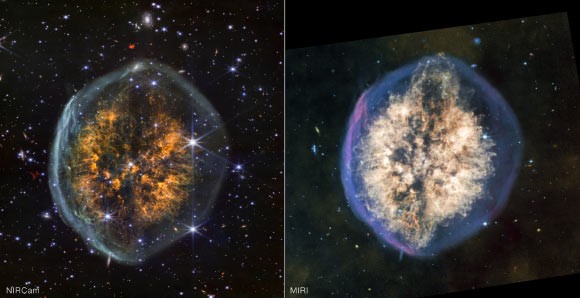
The James Webb Space Telescope has revealed an extraordinary image of PMR 1, a planetary nebula in the Vela constellation, which strikingly resembles a human brain. This new view, captured in both near- and mid-infrared light, offers unprecedented detail of the nebula’s structure and evolution.
A Distant Stellar Remnant
PMR 1, also known as IRAS 09269-4923, resides approximately 5,000 light-years from Earth. Initially detected by the Spitzer Space Telescope in 2013, the nebula has now been observed with far greater clarity by Webb’s advanced instruments.
The imagery shows a distinct “brain-like” formation defined by a dark vertical lane bisecting the nebula into two hemispheres. Astronomers believe this structure may be caused by powerful outflows or jets erupting from the central star, a common phenomenon in dying stars.
How Stars Die: The Stages of a Planetary Nebula
Planetary nebulae are formed when stars nearing the end of their life cycles expel their outer layers into space. Webb’s observations reveal that PMR 1 consists of an outer shell of hydrogen gas, shed earlier in the process, and a more structured inner cloud containing a mix of gases.
The telescope’s MIRI (Mid-Infrared Instrument) data shows evidence of gas being ejected from the star, particularly at the top of the nebula. The exact fate of the star remains uncertain; its mass will determine whether it ends its life as a supernova or slowly cools into a white dwarf.
Why this matters: Planetary nebulae play a vital role in the universe’s chemical evolution. Dying stars eject heavy elements (like carbon, nitrogen, and oxygen) into space, which become the building blocks for future stars and planets. The precise mechanisms of stellar death are still being studied, and Webb’s observations provide crucial insights into this process.
“Webb has captured a moment in this star’s decline.” — Webb astronomers
Ultimately, the fate of PMR 1’s central star will depend on its mass. More massive stars end in spectacular supernovae, while Sun-like stars become white dwarfs. This observation highlights the dynamic and rapid nature of stellar evolution in cosmic terms.