Astronomers have made a groundbreaking discovery using the James Webb Space Telescope: the first confirmed detection of hydrogen sulfide gas in the atmospheres of three massive exoplanets orbiting the star HR 8799. This finding provides critical evidence about how these gas giants formed, suggesting they accumulated solid materials early in their development—a process that could shed light on planet formation across the universe.
The HR 8799 System: A Unique Laboratory
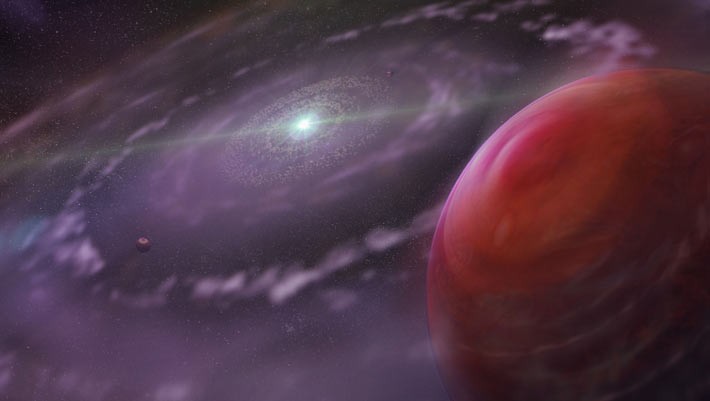
HR 8799 is a relatively young star, only 30 million years old, located approximately 129 light-years away in the constellation Pegasus. Unlike most exoplanets, which are detected indirectly, the four planets orbiting HR 8799 (b, c, d, and e) are directly visible through powerful telescopes. These super-Jupiters range from five to ten times the mass of Jupiter and orbit at vast distances from their star—about 15 times farther than Earth is from the Sun.
This system is notable because it’s the only one currently known to host four massive gas giants. The discovery raises fundamental questions about how such systems form, given that most other observed exoplanetary systems have fewer, or smaller, companions.
Sulfur as a Key Indicator of Solid Formation
The research team, led by Dr. Jean-Baptiste Ruffio from the University of California, San Diego, used Webb’s exceptional sensitivity to analyze the atmospheric composition of planets c, d, and e. The key finding? The presence of hydrogen sulfide (H₂S) gas.
Why does sulfur matter? Unlike carbon or oxygen, which can originate from both gas and solid materials in a planetary disk, sulfur at such distances from a star must have come from solid material. Gas-phase sulfur would not survive at these temperatures. This means the planets accreted sulfur in the form of solids during their formation.
“There’s no way these planets could have accreted sulfur as gas,” Dr. Jerry Xuan, a postdoctoral researcher at UCLA and Caltech, explained.
The team developed new data analysis techniques to extract the weak signals from Webb’s observations, given that the planets are approximately 10,000 times fainter than their star.
Universal Trends in Planet Composition
The ratio of sulfur to hydrogen, as well as carbon and oxygen, is significantly higher in these exoplanets than in HR 8799 itself. This indicates a distinct compositional difference between the planets and their parent star.
Interestingly, this same pattern of enrichment in heavy elements is also observed in Jupiter and Saturn in our own Solar System. This suggests that planets across different systems may form with a similar tendency to accumulate heavy elements in roughly equal proportions.
“It’s not easy to explain the uniform enrichment of carbon, oxygen, sulfur and nitrogen for Jupiter, but the fact that we’re seeing this in a different system is suggesting that there’s something universal going on in the formation of planets,” Dr. Xuan said.
Future Implications for Earth-Like Planet Searches
The methods used in this study—visually and spectrally separating planets from their stars—will be crucial for future exoplanet research. While currently limited to gas giants, as telescopes improve, scientists anticipate applying these techniques to study Earth-like planets in detail.
The search for Earth analogs remains a long-term goal, with scientists estimating it could take decades before they obtain a spectrum of an Earth-like planet and begin searching for potential biosignatures in its atmosphere. However, these findings mark a significant step toward that ultimate objective.
In conclusion, the detection of hydrogen sulfide in the atmospheres of HR 8799’s gas giants confirms that these planets formed by accreting solid materials, adding to growing evidence of universal patterns in planet formation. This breakthrough provides valuable insights for future exoplanet searches, bringing us closer to understanding the diversity of planetary systems beyond our own.