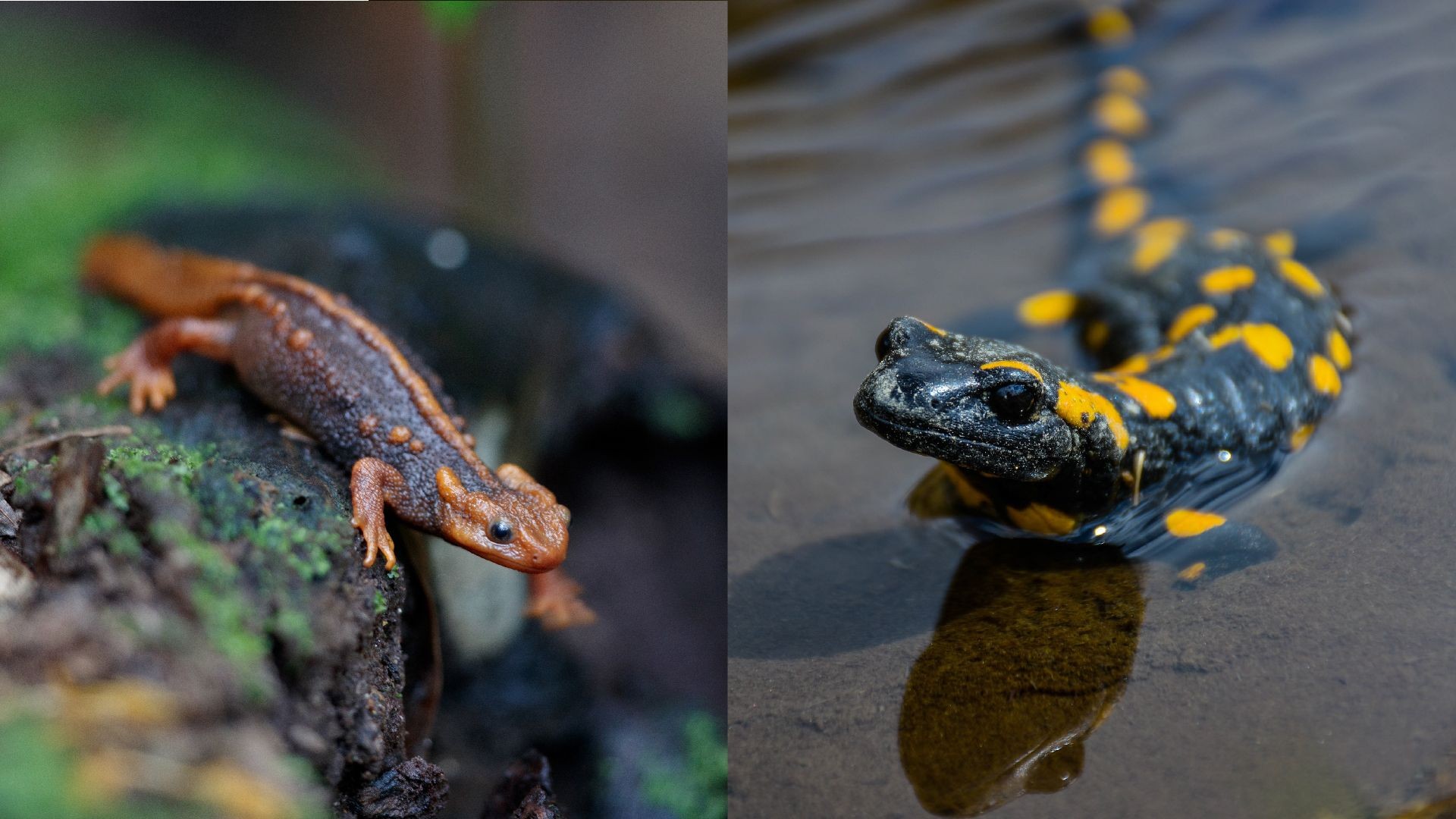
The distinction between newts and salamanders often causes confusion, but it’s rooted in scientific classification rather than easily visible traits. All newts are salamanders, but not all salamanders are newts. This means “newt” refers to a specific subfamily within the broader order of salamanders.
The Scientific Breakdown
Salamanders belong to the order Caudata (Latin for “tailed”), encompassing ten distinct families. Newts, scientifically categorized as the subfamily Pleurodelinae within the Salamandridae family, don’t have one single characteristic that separates them from other salamanders.
Identifying Traits: Skin and Life Cycle
While no single trait defines all newts, some species exhibit distinct features. Newts often have rougher, warty skin compared to the smooth, slimy skin of many other salamanders. This is linked to higher toxicity levels; newts generally contain more poison glands in their skin. For example, the rough-skinned newt (Taricha granulosa ) harbors tetrodotoxin, a deadly neurotoxin also found in pufferfish.
Life cycles also vary. Many salamanders transition from aquatic larvae to terrestrial adults (biphasic lifestyle). Some newts take this further with a triphasic cycle: aquatic larva, terrestrial juvenile (the bright orange “red eft” in eastern newts), and finally, an aquatic adult. However, some newt populations skip the terrestrial phase altogether, remaining entirely aquatic.
Historical Naming and Modern Taxonomy
The inconsistent traits in newts stem partly from early herpetological naming practices. The term “newt” was initially used informally for warty salamanders. As taxonomy advanced, scientists grouped these salamanders and their closest relatives under the newt subfamily, resulting in a diverse group with varying characteristics.
Beyond Newts: Salamander Diversity
The salamander order is incredibly diverse. Some species are lungless, developing entirely within the egg. Others, like axolotls, remain in their larval stage throughout life. Size ranges dramatically, from inch-long species to the six-foot-long Chinese giant salamander.
Salamanders play vital roles in ecosystems as both predators and prey. Their health is also an indicator of environmental conditions, as demonstrated by studies on the eastern hellbender, North America’s largest salamander.
In conclusion, understanding the difference between newts and salamanders requires recognizing that “newt” is a specific subgroup within the broader, incredibly diverse world of salamanders. Their defining traits are more about classification than clear-cut physical differences.