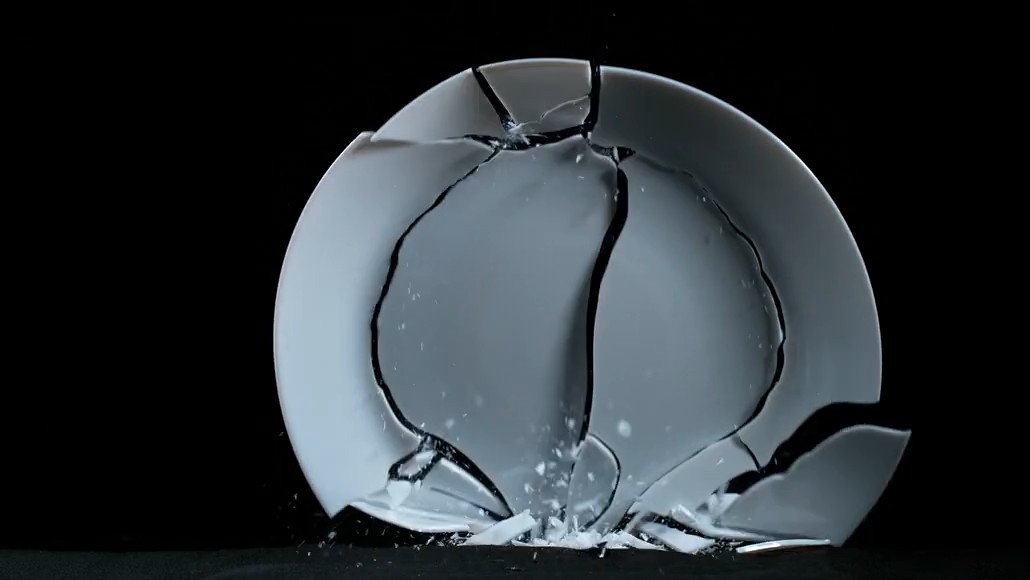
Why do shattered objects—from glass to asteroids—follow predictable patterns? The answer lies in fundamental physics, specifically how materials respond to stress under extreme conditions. Recent research has revealed that the way things break isn’t random; it’s dictated by underlying mathematical principles. This discovery isn’t just about understanding breakage; it sheds light on material behavior, structural integrity, and even the formation of cosmic debris.
The Mechanics of Failure
The key is understanding the mechanics of fracture. When an object experiences stress, it doesn’t shatter uniformly. Instead, cracks form and propagate in a predictable manner. This process is governed by factors like density, the material’s resistance to deformation, and its internal structure. Whether it’s a glass pane, a rocky asteroid, or a brittle plastic, the failure points emerge along lines of least resistance.
Underlying this predictability is the concept of thermodynamics. Energy concentrates at fracture points, initiating chain reactions that propagate through the material. The speed and direction of these cracks depend on the material’s properties, but the overall pattern remains consistent.
From Atoms to Asteroids
This phenomenon isn’t limited to everyday objects. Even at the microscopic level, atoms and their interactions determine how materials fail. The nucleus of an atom, with its protons and neutrons, dictates the stability of chemical bonds. When stress exceeds these bonds, the material breaks apart.
The same principles apply to larger-scale events. When an asteroid collides with another object in space, the resulting debris field follows a predictable distribution. The cracks and fractures that emerge from the impact aren’t random; they’re the result of physics at work.
Why This Matters
The predictability of material failure has real-world implications. Engineers can design structures to withstand stress by understanding fracture mechanics. This knowledge is critical in fields like aerospace, civil engineering, and materials science.
The ability to model fracture patterns accurately also helps scientists study the formation of cosmic objects. By analyzing the way asteroids break apart, they can infer the conditions of their origins and the processes that shaped them.
Beyond Observation: The Role of Theory
The work relies on theoretical frameworks in physics —specifically, how stress concentrates at weak points in materials. This is a prime example of how mathematical theory can predict real-world outcomes. Scientists don’t just observe how things break; they model the process using equations that describe energy transfer and material deformation.
“The universality of fracture patterns suggests that the laws governing material failure are fundamental, transcending scale and composition.”
In conclusion, the predictable nature of shattering isn’t accidental. It’s a consequence of physics, mathematics, and the inherent properties of matter itself. By understanding these principles, we can design better materials, predict failures, and gain deeper insights into the universe around us.