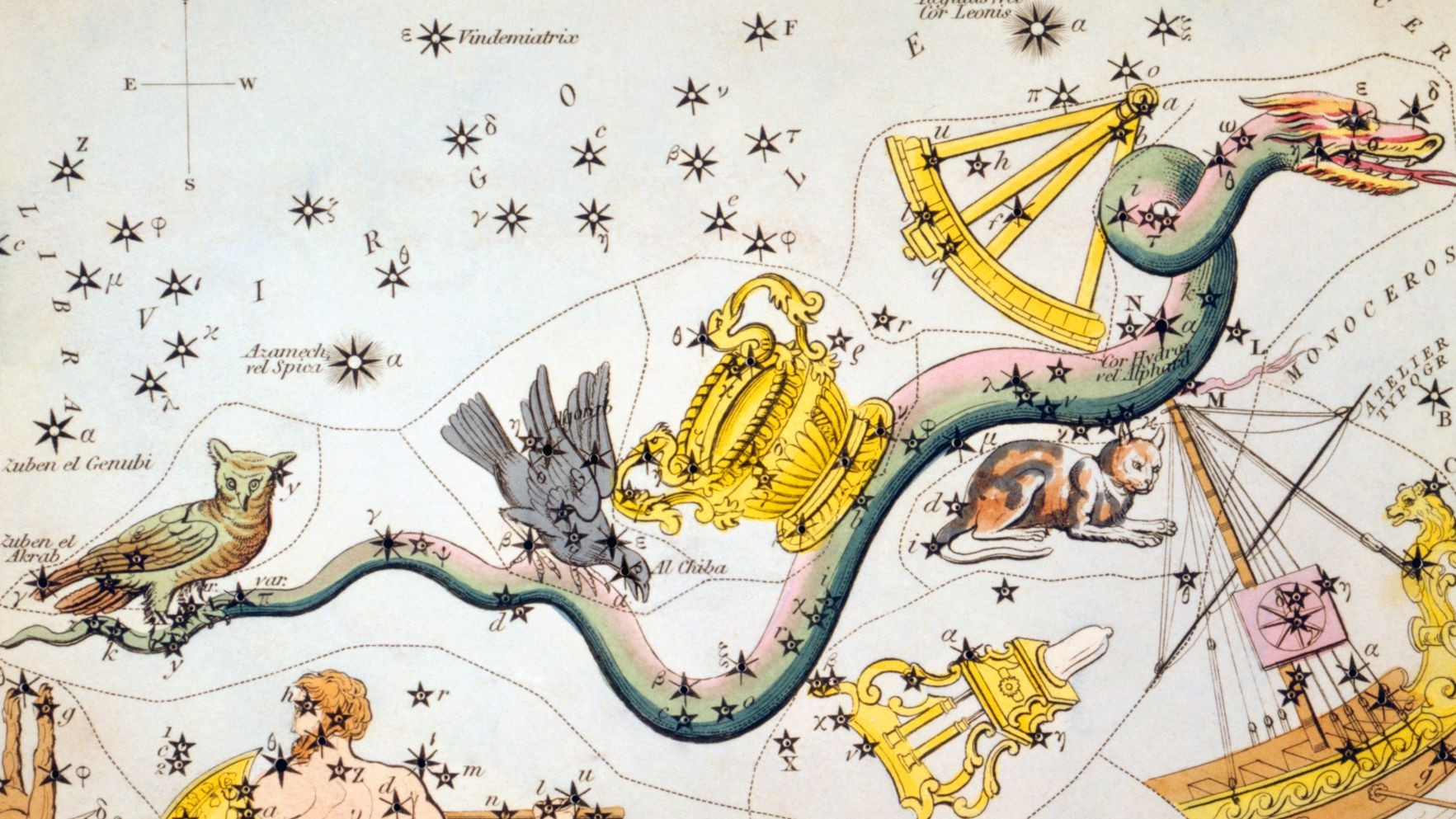
As spring arrives, the night sky undergoes a dramatic shift. The familiar winter giants fade, replaced by a new set of sparkling constellations that dominate the celestial horizon. While modern astronomy reveals these stars as distant orbs of plasma powered by nuclear fusion, for millennia, humans have looked up and seen something else entirely: stories.
Ancient cultures did not leave the stars as an abstract void. Instead, they mapped their myths, heroes, and fears onto the heavens, creating a cosmic narrative that helped explain the world below. This practice connects us to a universal human desire to find meaning in the unknown.
Here are four prominent spring constellations, the myths that define them, and how to spot them in your own night sky.
Bootes: The Guardian of the Bears
Bootes is a constellation steeped in agricultural imagery and cross-cultural interpretation. In Greek mythology, Bootes is depicted as a herdsman or plowman, often shown driving the “plow” formed by the nearby Big Dipper asterism. Its brightest star, Arcturus, translates to “guardian of the bears,” referring to its protective position near Ursa Major and Ursa Minor.
However, the stars do not speak only one language. Ancient Chinese astronomers viewed Bootes and the neighboring Virgo as part of a massive Azure Dragon, with Arcturus serving as the dragon’s shining horn. This illustrates how different cultures project their own symbolic landscapes onto the same stellar canvas.
How to find it:
Bootes is easily located using the “arc to Arcturus” method. Find the Big Dipper in the northern sky and follow the curve of its handle outward. Extend this imaginary line roughly the length of the Big Dipper itself, and you will land on Arcturus, the fourth-brightest star in the night sky.
Corona Borealis: The Crown of Ariadne
Corona Borealis, or the Northern Crown, is a delicate semi-circle of stars that holds significant mythological weight. In Greek legend, this arc represents the crown given to Ariadne by Dionysus after she helped Theseus defeat the Minotaur. It is a symbol of reward and divine favor.
The interpretation shifts dramatically across cultures. Medieval Arabian astronomers called it Al Fakkah, viewing it as a celestial bowl. Indigenous Australian peoples saw a great boomerang, while the Shawnee tribe of North America envisioned dancing star maidens. These diverse perspectives highlight how the same pattern can evoke entirely different cultural symbols.
How to find it:
Look for Arcturus (in Bootes) and scan roughly 20 degrees to its lower left—about the width of two clenched fists held at arm’s length. You will see the faint, glittering arc of the crown.
A Cosmic Event to Watch:
Corona Borealis may soon host a rare astronomical event. The binary star system T Corona Borealis is a recurrent nova that erupts periodically. Recent studies suggest it could explode into visibility as early as late June, offering a unique opportunity to witness a star suddenly brighten in the night sky.
Leo: The Invulnerable Lion
Leo is one of the most recognizable constellations, easily identified by its “sickle” shape that resembles a question mark. In Western tradition, it represents the Nemean Lion, a beast with impenetrable fur that terrorized the town of Nemea. The hero Heracles was forced to strangle the creature with his bare hands to complete one of his twelve labors. Zeus later placed the lion in the stars as a tribute.
This association with the lion is not exclusive to Greece. Ancient Egyptians, Babylonians, and Persians all linked Leo to powerful felines. For the Egyptians, Leo’s significance was tied to the Nile; as the sun passed through this constellation, the river would flood, bringing fertility to the land. Thus, Leo became a symbol of both strength and life-giving renewal.
How to find it:
Look to the southwestern sky at sunset. The sickle shape is distinct, with the bright star Regulus marking the bottom of the curve. Regulus is known as the “heart” of the lion.
Hydra: The Serpent and the Crab
Hydra is the longest constellation in the sky, winding across a vast stretch of stars. Like Leo, it is tied to Heracles’ labors. Hydra was a multi-headed water serpent; when Heracles cut off one head, two more grew back. Guided by Athena, he used fire to cauterize the wounds, preventing regeneration, until only one immortal head remained.
During the battle, the goddess Hera sent a giant crab to distract Heracles. He crushed it, but Hera honored the crab’s bravery by placing it in the sky as Cancer. Interestingly, scholars believe the Greek myth of Hydra may be a retelling of an older Babylonian story involving the hero Gilgamesh and a winged serpent known as the Mush-dragon. This suggests that some celestial myths are far older than the cultures that popularized them.
How to find it:
Locate the bright stars Chertan and Regulus in Leo. Draw an imaginary line from Chertan through Regulus and extend it about 20 degrees into open space. You will find the faint, circlet-like head of the serpent, with a trail of stars winding eastward toward the star Spica in Virgo.
Conclusion
These constellations are more than just navigation aids; they are historical archives of human imagination. By learning their stories, we do not just identify stars—we connect with the shared heritage of observation and storytelling that has guided humanity since the dawn of time.