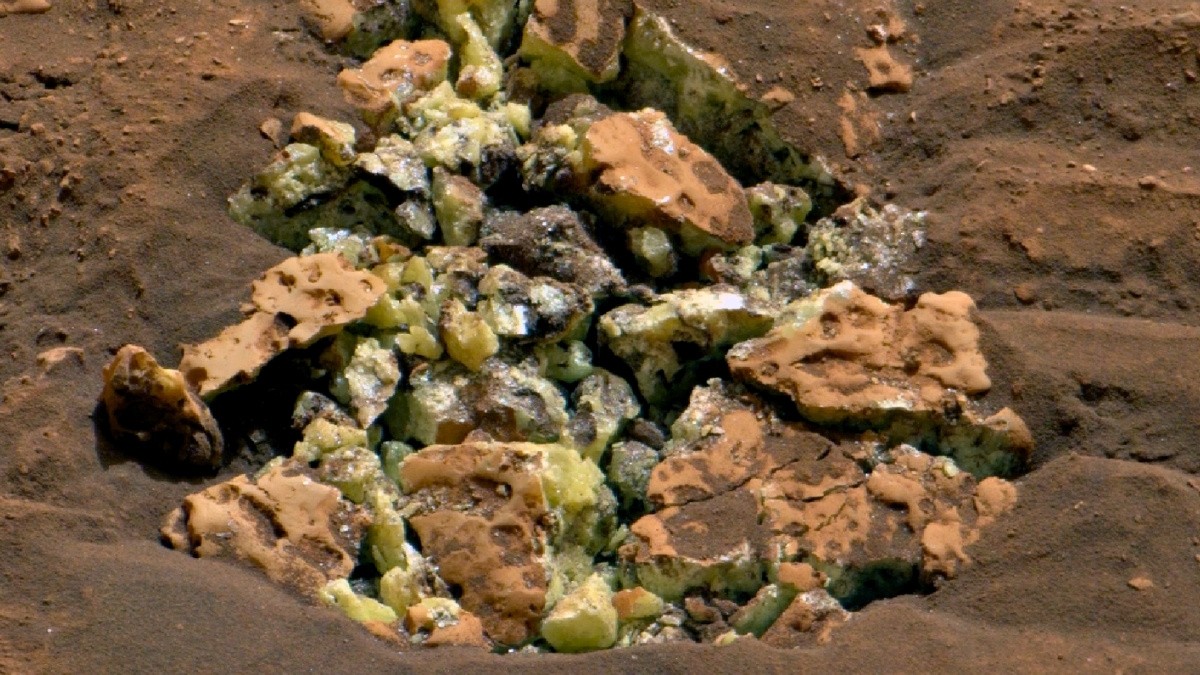
NASA’s Curiosity rover unexpectedly unearthed a significant geological anomaly on Mars: a deposit of pure elemental sulfur. The discovery, made in May 2024 within the Gediz Vallis Channel, marks the first confirmed instance of naturally occurring, uncombined sulfur on the red planet. This finding isn’t just a scientific curiosity; it challenges existing models of Martian geochemistry and raises the possibility of unknown processes shaping the planet’s surface.
Unexpected Chemistry in an Ancient Waterway
The sulfur was revealed when Curiosity inadvertently crushed a rock, exposing bright yellow crystals. While sulfate minerals – sulfur compounds – are known to be common on Mars, indicating past water activity, finding elemental sulfur is unusual. The conditions required for its formation aren’t well understood in the region where Curiosity operates, suggesting that something atypical is occurring.
According to Ashwin Vasavada, a project scientist at NASA’s Jet Propulsion Laboratory, “Finding a field of stones made of pure sulfur is like finding an oasis in the desert… It shouldn’t be there, so now we have to explain it.” This underscores the importance of the discovery: it forces scientists to re-evaluate assumptions about Martian geological processes.
Why This Matters: Beyond Water History
Sulfates on Mars primarily tell us about the planet’s past water activity. When water evaporates, it leaves behind these salts, providing clues about ancient environments. Pure sulfur, however, requires a more specific set of conditions to form.
The presence of sulfur is significant because it’s an essential element for life. Organisms use sulfur compounds to create amino acids – the building blocks of proteins. Although this discovery doesn’t prove life exists (or existed) on Mars, it reinforces the idea that the planet once contained, and perhaps still does, the chemical ingredients necessary for it.
The Bigger Picture: Mars Exploration Advances
Curiosity’s accidental discovery highlights the value of in-situ exploration. The rover stumbled upon this sulfur deposit because of its path, not a targeted search. This reinforces the idea that serendipity plays a role in scientific breakthroughs.
Meanwhile, NASA’s Perseverance rover continues its own investigations, recently setting a record for the longest single drive on another planet (411 meters in June 2025). Both rovers symbolize humanity’s drive to understand the universe, pushing the boundaries of robotic exploration.
The next step for scientists will be to model the geological evolution of Mars in greater detail, to explain how elemental sulfur could have accumulated on the surface. Until then, this discovery remains a tantalizing mystery, reminding us that Mars still holds many secrets.