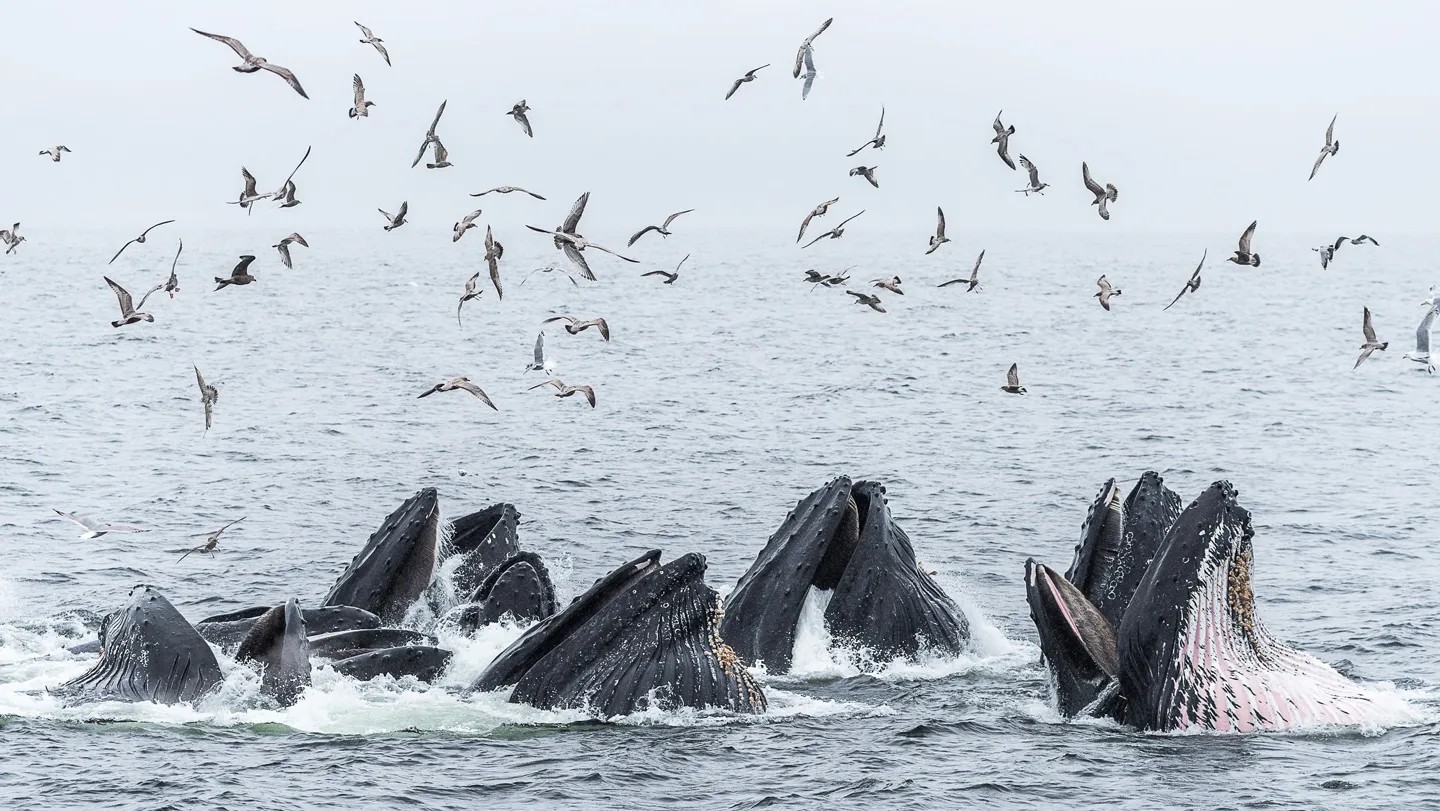
Decades after near extinction from commercial whaling, humpback whale populations in Canada are thriving, largely due to a learned feeding behavior known as bubble netting. Recent research confirms this recovery isn’t just about numbers; it’s about whales teaching each other how to hunt more effectively.
The Rise of Cooperative Hunting
In the Kitimat Fjord System of British Columbia, humpback whale numbers have been growing at 6–8% annually, now exceeding 500 individuals. This growth is tied directly to bubble netting: a coordinated technique where groups of whales (up to sixteen) create underwater “nets” of bubbles to trap schools of herring. Some whales circle while exhaling air from their blowholes, while others vocalize, herding prey into concentrated areas for easy capture.
“It gives me the chills. It’s one of the most incredible things I’ve ever witnessed.” – Éadin O’Mahony, marine mammal ecologist
This behavior was first documented in Alaska, but its spread in the Kitimat Fjords since 2005, in collaboration with the Gitga’at First Nation, reveals a crucial pattern.
Social Learning in Action
Researchers analyzed nearly 7,500 photographs of whales to map their social interactions and track how bubble netting spread through the population. The data showed that certain “key individuals” acted as teachers, passing the technique to others. This isn’t random; whales learn a specific order within bubble-netting groups, and the behavior spreads predictably through social bonds.
Though unconfirmed, there is a theory that Canadian whales may have first learned this from Alaskan populations in shared breeding grounds in Hawaii. However, observational data is still needed to verify this hypothesis.
Why This Matters
The efficiency of bubble netting becomes critical as environmental conditions change. During a heat wave from 2014–2016, when fish became scarce, bubble netting allowed whales to access a wider range of prey than traditional lunging. This adaptability underscores why social learning is so valuable in a shifting ecosystem.
The implications extend beyond efficiency. Losing even one whale capable of teaching bubble netting could weaken the entire population’s resilience. This highlights the urgent need for conservation efforts focused on areas like the Kitimat Fjord System, where whales learn and share these critical survival skills.
In essence, humpback whale recovery isn’t just a story of population growth; it’s a testament to the power of collective knowledge and the importance of protecting the social structures that sustain it.