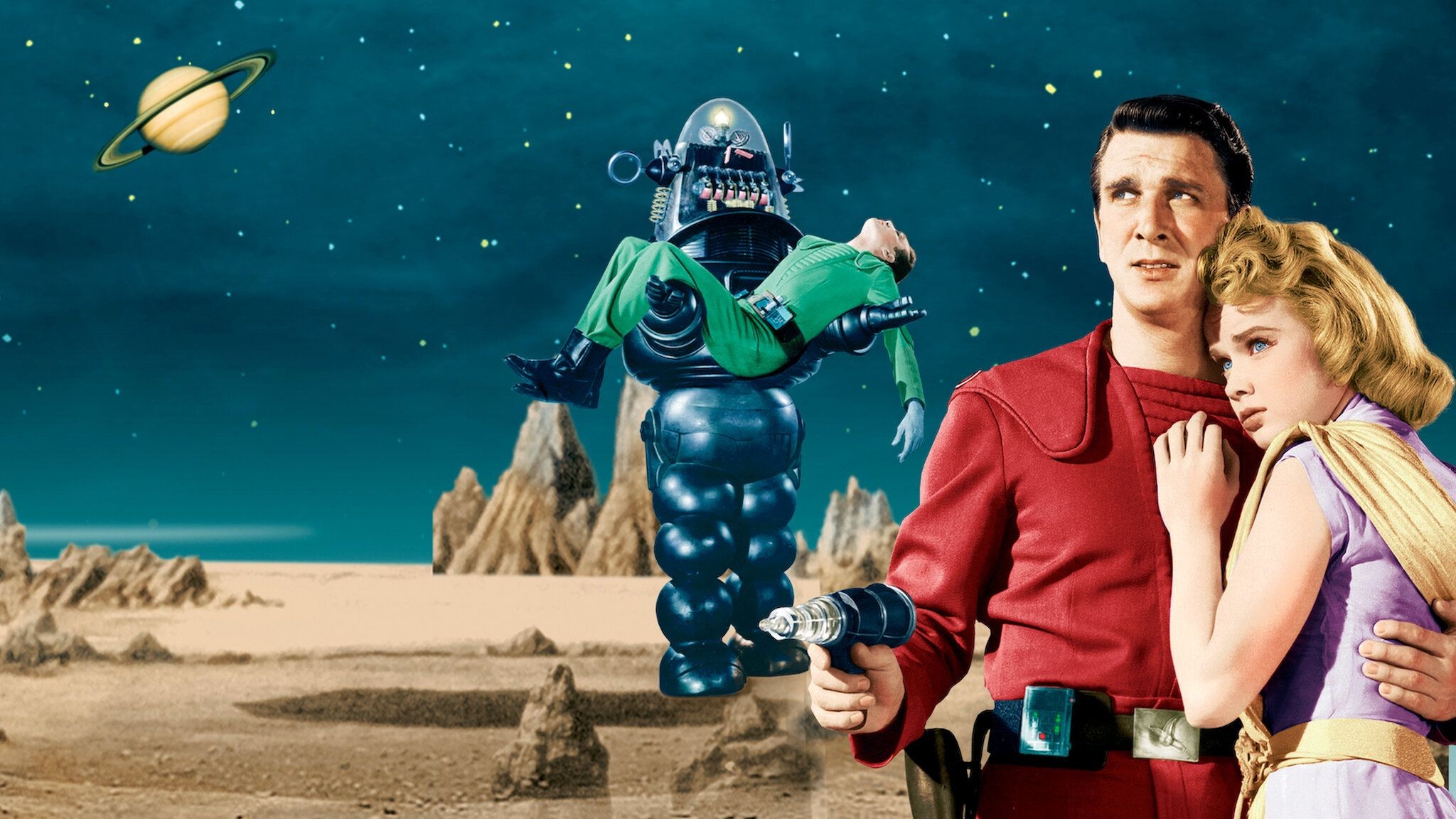
Seventy years after its release, Forbidden Planet remains a landmark achievement in science fiction cinema. While Leslie Nielsen later became a comedic icon, his role as Commander John J. Adams in this 1956 film showcased his early talent in serious roles, establishing a foundation for the space opera genre as we know it.
The Birth of Modern Sci-Fi
Forbidden Planet didn’t just present a futuristic vision—it built one. With advanced spacecraft, alien landscapes, and the iconic Robby the Robot, the film laid the groundwork for Star Wars, Star Trek, and countless other space-based franchises. In an era dominated by monster movies and Cold War anxieties, MGM invested heavily in a high-budget space adventure that dared to be both spectacular and intellectually engaging.
The 1950s saw science fiction often relegated to B-movies, filled with giant insects or political allegories. While films like The Day the Earth Stood Still offered grounded, philosophical takes, Forbidden Planet distinguished itself with pure visual ambition. It depicted a future where humanity had successfully colonized space, a vision that felt impossibly distant at the time but now seems almost prescient.
The Allure of Altair IV
The story follows the United Planets Cruiser C-57D, commanded by Adams, as they investigate the fate of a previous expedition to the alien world of Altair IV. Dr. Edward Morbius, the sole survivor, warns of an unseen danger lurking on the planet. This setup cleverly mirrors Shakespeare’s The Tempest, with Morbius as Prospero and his daughter, Altaira, as Miranda, but with a distinctly sci-fi twist.
The film’s true innovation lies in its reinvention of classic archetypes. Ariel becomes Robby the Robot, a fully functional, Asimov-inspired machine capable of replicating anything from clothing to whisky. The creature representing Caliban is even more radical: an invisible, psychic manifestation of Morbius’s subconscious desires—a concept that predates similar themes in Star Trek.
Groundbreaking Visuals and Sound
Forbidden Planet pushed the boundaries of special effects. The “id monster” was rendered using a revolutionary technique involving pencil drawings flipped into negatives, creating a terrifying, transparent form. This method, along with the film’s overall visual design, inspired generations of VFX artists, including those who would later work on Star Wars.
Even more groundbreaking was the electronic score by Bebe and Louis Barron. Using homemade instruments and electronic devices, they created a unique, otherworldly soundscape that redefined film music. Despite its originality, the score was deemed ineligible for an Oscar due to the musicians’ union objecting to the lack of traditional instruments.
A Legacy With Complexities
While Forbidden Planet broke new ground, it hasn’t aged perfectly. The all-male crew and Adams’s interactions with Altaira reflect the problematic gender dynamics of the 1950s. Some scenes feel uncomfortable by modern standards, with the power imbalance between the characters being starkly apparent.
However, these flaws don’t diminish the film’s historical significance. Forbidden Planet was a bold experiment that not only defined the visual language of science fiction but also established many of the tropes and themes that continue to resonate today. From the phrase “reversing polarity” to the very concept of faster-than-light travel, the film’s influence is undeniable.
Ultimately, Forbidden Planet remains a pivotal work—a reminder that even flawed masterpieces can shape an entire genre and inspire future generations of filmmakers.