A significant northward shift in the Gulf Stream, confirmed by satellite data, provides growing evidence that the Atlantic Meridional Overturning Circulation (AMOC)—the system of ocean currents regulating Europe’s climate—is weakening. New modeling suggests this shift could be an early warning sign of an imminent, catastrophic collapse of the AMOC, with potentially drastic consequences for global weather patterns.
The Role of the AMOC and Gulf Stream
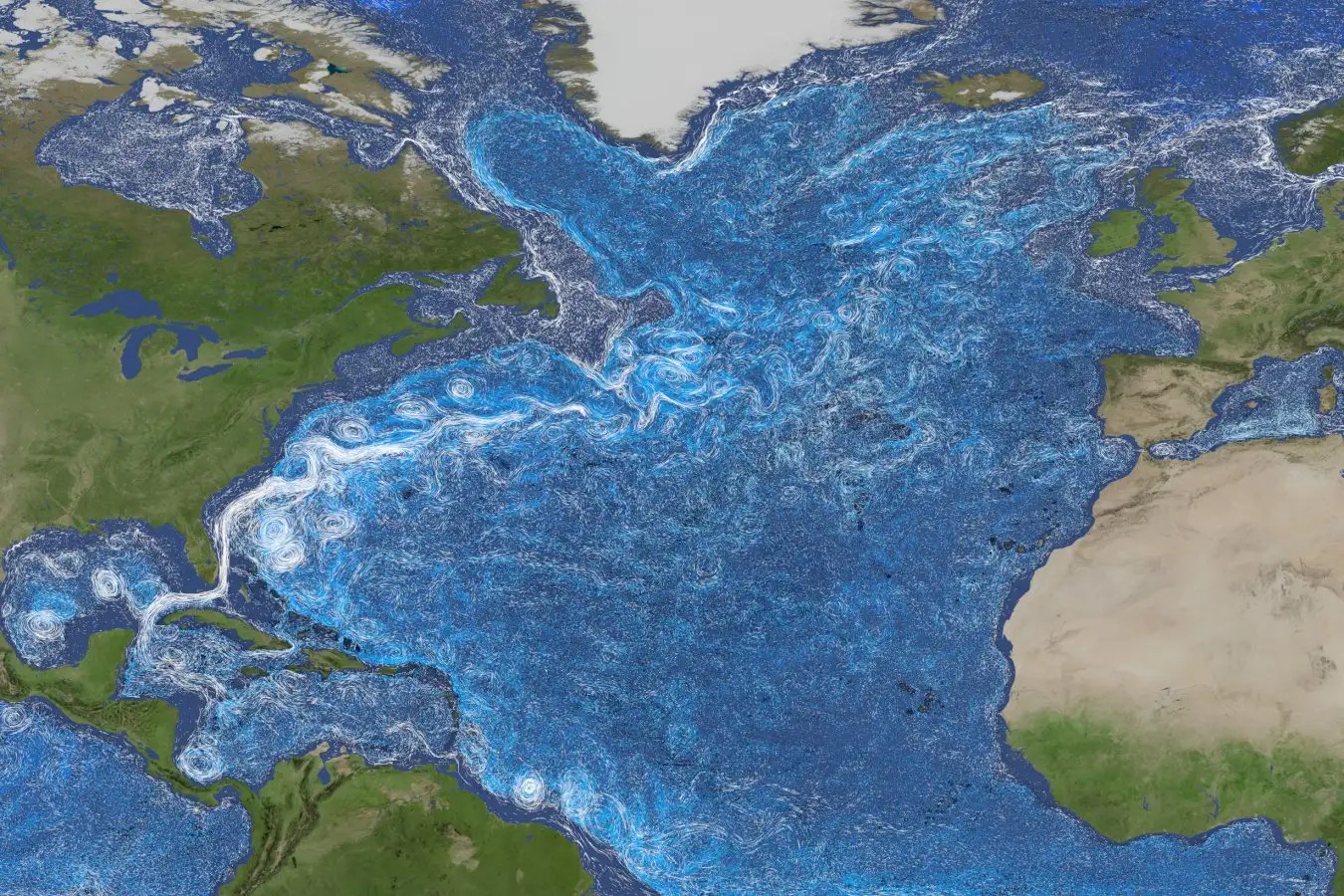
The AMOC functions by carrying warm, salty water from the tropics northward towards Europe, where it cools, sinks, and returns south along the ocean floor. The Gulf Stream is a critical component of this circulation, running along the US East Coast before veering into the Atlantic. Its health is directly linked to the stability of the broader AMOC system.
The primary threat to the AMOC is freshwater influx from the melting Greenland ice sheet. This dilutes the salt content of the water, reducing its density and hindering its ability to sink—a crucial process for maintaining the current’s flow. While scientists have long predicted this weakening, direct proof has been elusive.
New Evidence: A Northward Shift
Researchers at Utrecht University, using high-resolution modeling (10km pixels versus the typical 100km), have demonstrated a clear connection between a weakening AMOC and a northward shift in the Gulf Stream’s path. Satellite data confirms this shift is already happening: the Gulf Stream has moved roughly 50 kilometers north over the past 30 years.
This movement occurs because the weakening AMOC also diminishes the Deep Western Boundary Current, which normally pulls the Gulf Stream southward along the North American coast. As the current weakens, the Gulf Stream curves northward instead.
Modeling a Catastrophic Scenario
The study’s modeling shows that after 392 simulated years, the Gulf Stream jumps over 200 kilometers north in just two years. Twenty-five years later, the AMOC collapses entirely. While this is an idealized scenario, it highlights a critical correlation: an abrupt shift in the Gulf Stream could be the earliest detectable indicator of an impending AMOC shutdown.
A complete collapse would trigger extreme cooling in Europe; London could experience -20°C (-4°F) cold snaps, while Oslo, Norway, could reach -48°C (-54°F). This makes preparation—insulating infrastructure and shifting agricultural zones—a matter of urgency.
Uncertainties and Next Steps
Despite the alarming findings, the exact timing of a potential collapse remains unclear. Projections vary from decades to centuries. Further complicating matters, the rate of freshwater influx from Greenland could accelerate or shift unpredictably. The model assumes a specific rate and location of freshwater input, which may not reflect real-world conditions.
However, this research provides a measurable early warning signal that has not been available until now. Though additional model corroboration is needed, the findings suggest that the AMOC is slowing faster than previously predicted, potentially bringing a climate tipping point closer than anticipated.