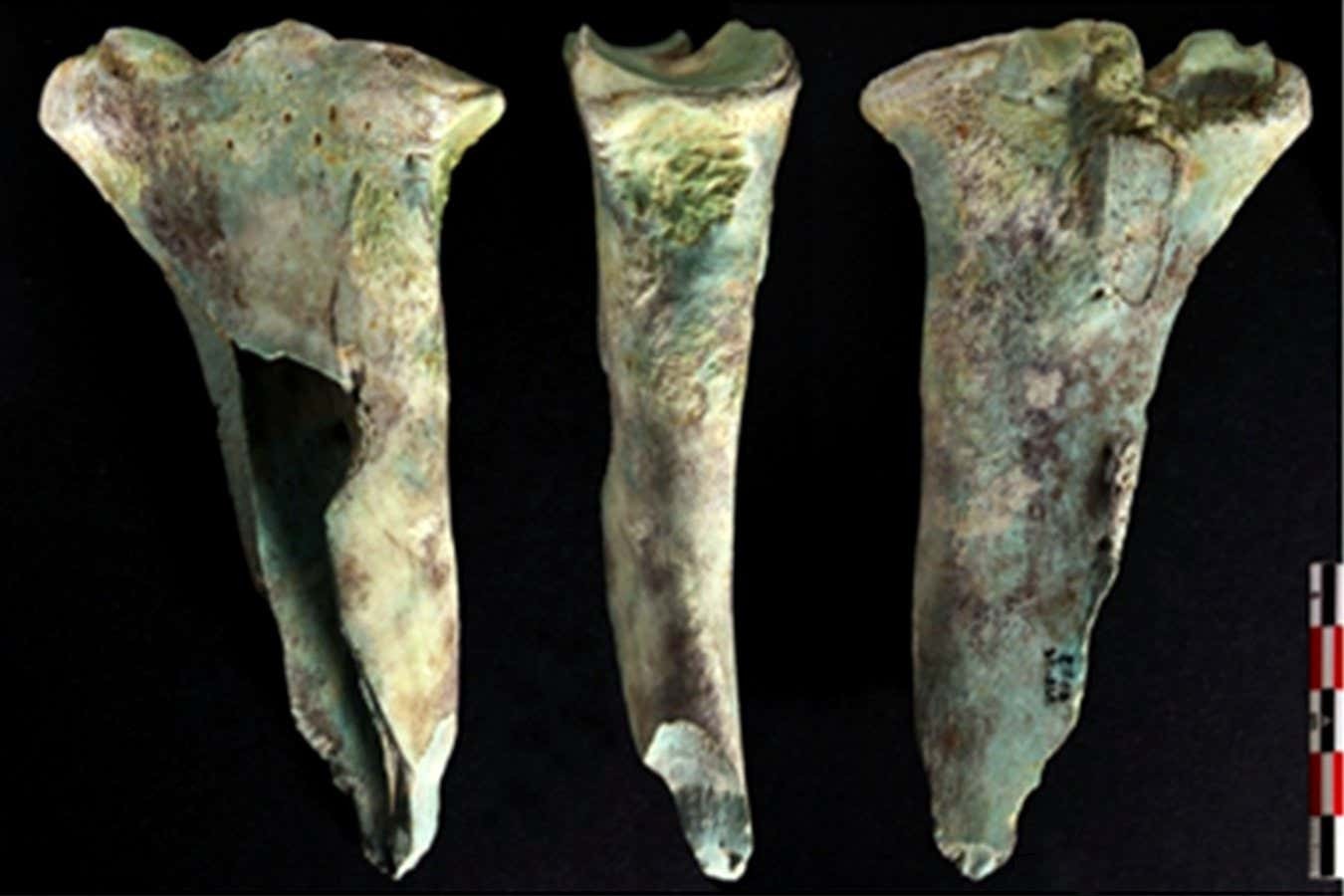
New research reveals that for nearly a millennium, Bronze Age miners in Britain deliberately used animal bones alongside metal tools. This wasn’t a lack of technology, but a strategic choice driven by efficiency, cost, and the specific demands of extracting copper from soft rock.
A Toolkit of Surprises
For decades, archaeologists assumed that once metalworking became prevalent, stone and bone tools would quickly vanish from professional mining sites. After all, metal is harder, sharper, and seemingly superior. However, a detailed study of artifacts from the Great Orme copper-mining complex in North Wales challenges this linear view of technological progress.
The research, led by Olga Zagorodnia of the British Museum and independent archaeologist Harriet White, analyzed 150 bone fragments dating between 3700 and 2800 years ago. The findings show that bone tools were not accidental debris, but deliberately crafted instruments essential for specific mining tasks. This practice persisted for at least nine centuries, indicating that Bronze Age communities maintained a diverse, adaptable toolkit rather than abandoning older materials entirely.
Decoding Wear Patterns
Since the early 1990s, excavations at Great Orme have uncovered over 30,000 bone fragments. While earlier studies identified the species—primarily cattle, with some sheep, goats, and pigs—they largely focused on taxonomy rather than function. A 2011 study hinted at tool use, but the new research provides definitive proof through high-resolution microscopy and experimental archaeology.
Zagorodnia and White compared the microscopic wear marks on ancient bones with those created by modern replicas used in simulated mining conditions. The results were striking:
- Rapid Wear Development: The experiments showed that distinct wear patterns formed quickly, validating the microscopic evidence found on the ancient artifacts.
- Specific Fracture Patterns: When researchers split bone replicas to create wedges, they produced circular fracture patterns identical to those seen in the archaeological samples.
This methodological approach connected the researchers directly to the practical realities faced by Bronze Age miners, confirming that these bones were shaped and used with intent.
Specialized Roles for Different Bones
The study identified several distinct types of bone tools, each suited to a specific task in the copper extraction process. This specialization suggests a sophisticated understanding of material properties:
- Limb Bone Wedges: Likely used for splitting soft, copper-bearing rock. The bones showed signs of intentional tapering and polishing, suggesting they were hafted (attached to handles) and used like metal picks.
- Rib Scrapers: These were probably used to scrape soft, sandy limestone. They may also have served as stirrers or scrapers during water-based processing, where miners separated copper ore from waste material.
- Scapula and Pelvis Scoops: These broader bones functioned as rakes or shovels for moving loose ore.
“What we may be seeing at Great Orme is not a new invention, but the continuation of a long-standing technological tradition [predating metal-working],” says Zagorodnia.
Why Stick with Bone?
The persistence of bone tools raises important questions about economic and practical decision-making in the Bronze Age. The researchers argue that bone was a readily available resource in pastoral societies. Crucially, crafting a tool from bone was significantly less labor- and resource-intensive than smelting and shaping metal.
This finding parallels discoveries at other prehistoric mining sites across Europe. It suggests that communities were not simply “upgrading” to metal in a blanket fashion. Instead, they employed a flexible approach to technology, using metal where it offered a clear advantage and bone where it was more efficient or cost-effective.
Implications for Understanding Ancient Society
The presence of specialized bone tools points to organized mining practices and a workforce with specific skills. It challenges the narrative of a abrupt technological revolution, replacing it with a more nuanced picture of gradual adaptation and hybrid toolkits.
Simon Timberlake, a freelance archaeologist based in Cambridge, praised the study’s scientific rigor. “Both authors have brought a level of scientific discrimination not previously seen to this unique field of artefact study,” he noted. “The only way we can understand the people who helped change the technology of the Stone Age to the Metal Age is through the study of the tools they used.”
Conclusion
The Great Orme findings remind us that technological advancement is rarely a simple replacement of old with new. Bronze Age miners were pragmatic professionals who leveraged every available material to their advantage. Their willingness to use bone alongside metal reveals a deep practical knowledge of their environment and a sophisticated, cost-conscious approach to industry that resonates even today.