


It’s easy to forget that the air around you is a variable we have learned to master. Air conditioning isn’t just about feeling cool in a heatwave. It is the precise control of temperature, humidity, air purity, and even motion within an enclosed space, completely independent of what is happening outside. Without it, modern office life, hospital safety, and industrial manufacturing would look very different.
The roots of this technology are humble. In India, people have long hung wet grass mats over windows. As air passed through, evaporation cooled it. It was simple. It was effective. But true modern air conditioning began in the 19th-century textile industry. Factories used atomized sprays of water to humidify and cool the air simultaneously. Dry air ruins cotton threads. This industrial need sparked the innovation that followed.
Willis Carrier changed everything. Based in Buffalo, New York, Carrier developed “dew point control” in the early 20th century. His insight was basic physics: cool air reaches saturation and loses moisture through condensation. By removing that moisture, you control the environment. He didn’t stop there. By 1922, he installed a system at Grauman’s Metropolitan Theatre in Los Angeles. Conditioned air flowed from the ceiling and exited at the floor. It set a precedent.
The Milam Building in San Antonio, Texas, became the first fully air-conditioned office building in the late 1920s. This was a turning point for commercial real estate. Then came Freons in the early 1930s. These refrigerant gases were highly efficient and less toxic than earlier compounds containing fluorine, chlorine, or bromine. The technology scaled up. By the mid-1930s, American railways installed small units on trains. By 1950, compact units were practical for single rooms. Since the late 1950s, the reach of air conditioning has expanded well beyond the United States into developed regions worldwide.
The Mechanics of Cooling
How does a simple unit actually work? It relies on a volatile liquid called a refrigerant. This liquid is passed through evaporator coils. Air from inside the room blows across these coils. The refrigerant evaporates, absorbing the heat from the air. As the air cools, it reaches its saturation point. Moisture condenses on fins over the coils. The water drains away. A blower returns the cooled, dehumidified air to the room.
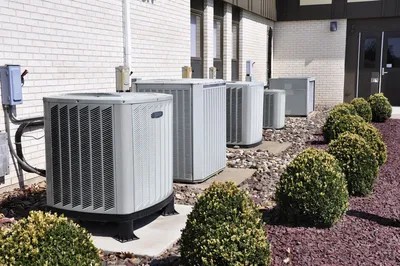
Meanwhile, the vaporized refrigerant moves to a compressor. It is pressurized and forced through condenser coils outside. Contact with outside air causes the refrigerant to condense back into a liquid. It releases the heat it absorbed inside. That heated air is expelled outdoors. The liquid recirculates to the evaporator to repeat the cycle.
Some units reverse this function. In winter, the inside coils condense the refrigerant to release heat rather than cool. This is a heat pump. It offers both cooling and heating from the same hardware.
Alternative Systems and Design
Not all cooling uses direct refrigerant coils. Some systems rely on chilled water. Water is cooled by refrigerant at a central location and then pumped through coils elsewhere in the building. Large factories sometimes use versions of the old air-washer systems. Water is sprayed over glass fibers, and air is blown through it. This avoids the massive amount of coils otherwise needed.
Dehumidification can also be achieved differently. Some systems pass air through silica gel, which absorbs moisture. Others use liquid absorbents for dehydration.
Design depends on the building. A self-contained unit serves a single space. Tall buildings are more complex. They use ducts to deliver cooled air. The induction system cools air once at a central plant. It then conveys the air to individual units. Water adjusts the temperature based on variables like sunlight exposure. The dual-duct system sends warm and cool air through separate ducts. They mix to reach the desired temperature.
Variable air volume is another common method. It regulates the amount of cold air supplied. Once the target temperature is reached, the flow cuts off. This is widely used in high-rise and low-rise commercial or institutional buildings.
Distribution Matters
Direct exposure to cool air can be uncomfortable. Sometimes, cooled air needs slight reheating before it enters a room. Distribution methods vary. Ceiling diffusers blow air along the ceiling level, allowing it to settle. Linear diffusers use a plenum box or duct with a rectangular opening. Louvers divert the down-flowing air. Circular units have fins that radiate air. Some ceilings are perforated to allow passage. Others are simply cooled to circulate air via basic ventilation.
The goal is always consistency. Comfort is not just about temperature. It is about the quality of the air you breathe and the stability of the environment around you. We have moved from wet grass mats to sophisticated heat pumps that manage entire city blocks. The technology continues to evolve, driven by energy efficiency and environmental concerns. But the core principle remains unchanged. Remove heat. Control moisture. Recirculate.
We take this control for granted until the power goes out. Then the illusion of separation between inside and outside vanishes. The sweat returns. The air becomes heavy. The comfort of the modern world is built on a cycle of evaporation and compression, hidden in the walls and ceilings of our daily lives. How much longer will we rely on mechanical cooling as global temperatures rise? The answer dictates the next chapter of this technology.


