Heavyweights
A black hole is sitting inside a “little red dot” (LRD). This tiny galaxy weighs almost nothing compared to what eats at its center. It’s not just big. It’s outrageously disproportionate.
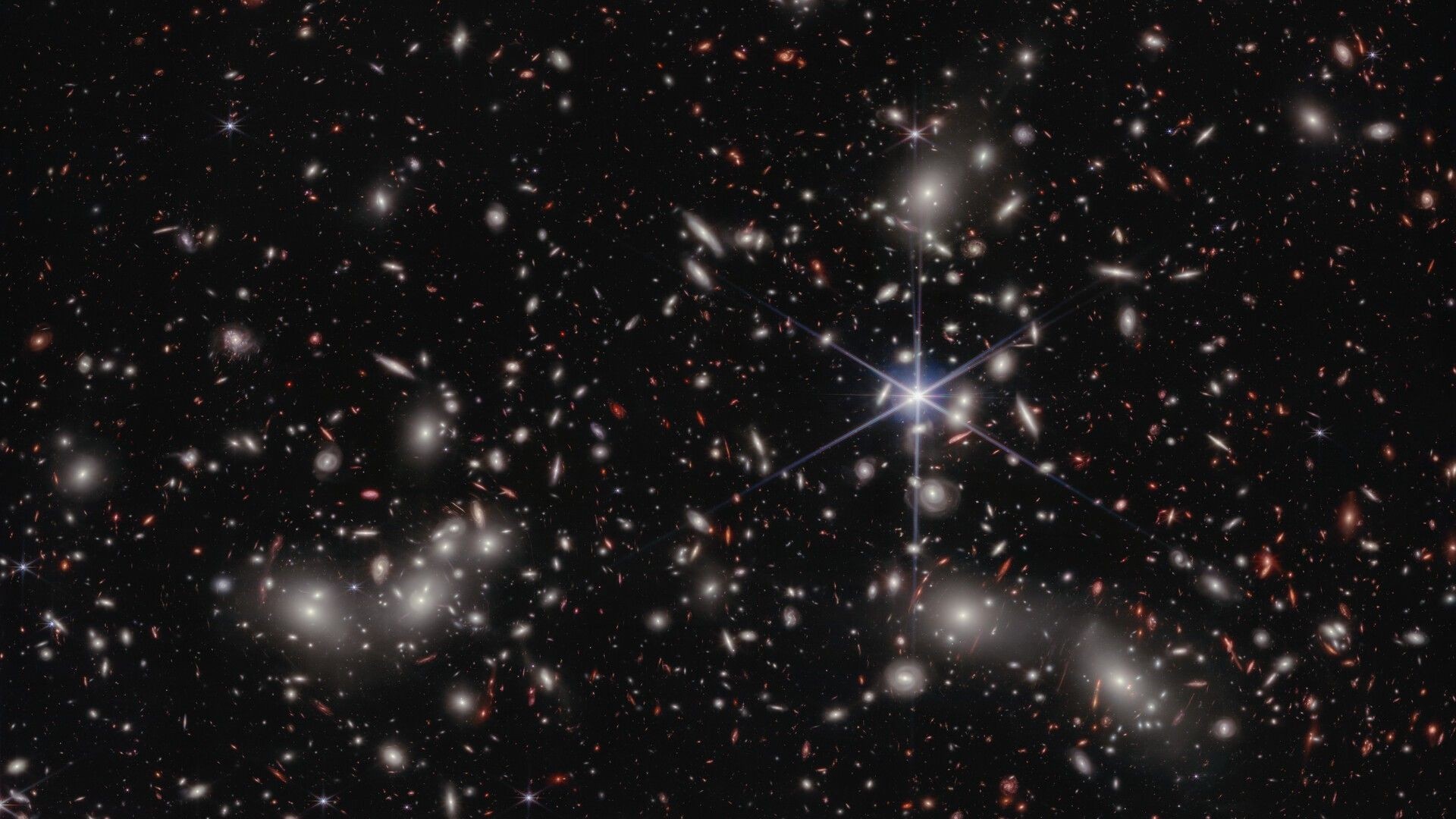
The object, named Abell2744-0QSO1 or simply QSO1, was spotted by the James Webb Space Telescope (JWSW) back in 2023 when the universe was barely 700 million years old # It was compact # It glowed with the heat of active feeding. Astronomers have argued over its mass for a while now. Indirect guesses suggested about 40 million suns’ worth of weight. That feels wrong for something so young. Small systems shouldn’t harbor such beasts.
Now they’ve stopped guessing.
Published on May 27 in Nature a new study puts a pin on the number. They weighed the thing directly. The answer is 50 million solar masses # The host galaxy? Maybe 20 million stars’ mass # If those numbers are right the black hole outweighs everything around it. Completely.
“There may be no need to invite anything too exotic into this equation to explain the properties of LRDs”
This suggests old methods actually work here. The rules we use for nearby black holes seem to hold up 7 billion light years away # That’s unexpected. Some people thought LRDs needed weird new physics # Turns out the physics are the same # The results just don’t fit the standard growth model #
Seeing Through the Lens
How do you weigh a dot?
Gas spins faster when it gets close to a massive object # It’s Kepler’s old rule. Map the speed map the distance. You get the mass #
But QSO1 is small and far # Blurry as hell to the eye #
Lucky break: The Abell 274 galaxy cluster sits between us and QSO1 # It acts like a gravitational lens. Gravity bends light like glass #
This warped space did two things for the team led by Ignas Juodżbalis:
* Brightened QSO1 by a factor of six #
* Stretched it out by 3.5 times spatially #
The team used the Near-Infrared Spectrograph on JWST # They tracked hydrogen lines # Red shifted vs. blue shifted tells you direction #
Here’s the rub.
Even stretched the rotation in the inner parts was finer than JWST can resolve directly. You can’t just take a picture of that speed gradient #
Enter spectroastrometry #
This trick looks at tiny shifts in light position across different colors # It’s sneaky precise # You measure where the glow comes from down to sub-pixel levels # Juodżbalis called it a way to “reconstruct the rotation curve below the instrumental resolution” #
Cosimo Marconcini # a co-author from Florence # ran a separate 3D check. He modeled gas plus instrument errors independently # He got the same 50 million # That independence gives it weight #
The Naked Truth
Fits a black hole model perfectly # Does not fit a dense star cluster # If you tried to argue this was a clump of stars with a hard edge you’d look ridiculous. Exotic scenarios usually win these bets when things get messy.
Except not here #
A 50 million solar mass hole sitting on top of a 20 million solar mass galaxy. We call these naked black holes # This is the fattest one found so far.
This breaks the standard story # Usually # galaxies and black holes grow together # A symbiotic dance over billions of years # One feeds the other.
QSO1 shows up before the party starts # Just the monster. No host yet #
This implies the seed formed before the galaxy could develop # How? Two possibilities remain. Both are weird:
- Direct collapse clouds. Massive pockets of pristine gas imploding without making stars first.
- Primordial holes. Leftovers from the first second of the Big Bang.
Data can’t split them yet. Theory hasn’t decided either #
The team is looking at ground-based observations next # Checking local counterparts.
Does a black hole grow first? Does it wait? Maybe it was born hungry and skipped breakfast #
The galaxy didn’t show up in time. Or maybe it never will.