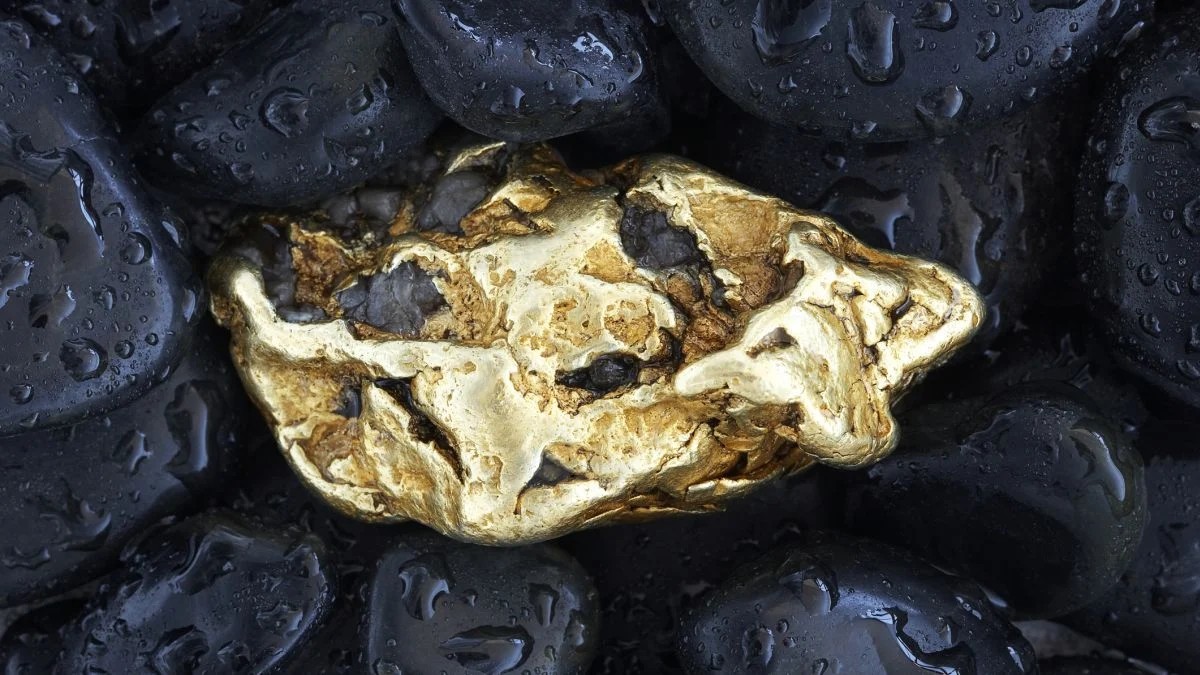
Gold shines. Always has, always will.
It doesn’t rust. It doesn’t tarnish. It just sits there, bright and stubbornly yellow, mocking the rest of the periodic table. We call this chemical nobility. It means the metal basically ignores the world around it. Oxygen comes along trying to bond? Gold says no thanks.
This resistance is legendary. But nobody knew exactly why —on an atomic level, at least. Until now.
Computational chemists Santu Biswas and his partner Matthew M. Montemore at Tulane University ran the simulations. They cracked the code.
The surface geometry. That’s it. That’s the punchline.
The Tight Fit Problem
On bulk gold—the stuff in your jewelry—the atoms on the surface pack together like a crowd at a sold-out concert. A hexagonal pattern. Tightly wound. No space to move.
When an oxygen molecule (dioxygen) hits that surface, it wants to break apart into two reactive atoms so it can start eating away at the metal. That’s how rust forms. But on gold, there is no room.
The molecule bumps up against the wall of gold atoms. It can’t squeeze in. It can’t break apart. It just bounces off.
The pattern is so tight the oxygen can’t break apart to trigger oxidation.
It’s a simple game of chicken won by space constraints. The gold doesn’t actively repel the oxygen; it just doesn’t have the physical room for the chemistry to happen. The tight hexagonal packing is actually the most stable, comfortable arrangement for gold atoms. The anti-corrosion? That’s just a happy side effect of being comfy.
Wait, Nanoparticles Exist
Here is the rub. If bulk gold is inert, why did scientists get so excited in the 198s when they found out gold nanoparticles were excellent at activating oxygen?
Nanoparticles are tiny. They catalyze reactions like converting toxic carbon monoxide into harmless carbon dioxide. For that to work, you need reactive oxygen. You need the dioxygen to split open.
So, if bulk gold resists oxygen so hard, how do the tiny particles drive oxidation so easily? It didn’t make sense.
Biswas and Montemor e looked at the surface structures of these tiny particles in their computer models. They compared two setups.
- Reconstructed surfaces. The tight, hexagonal packs.
- Unreconstructed surfaces. Looser, square-like patterns.
The results were staggering.
On the loose square surfaces, the oxygen split apart effortlessly. In fact, it happened billions to trillions of times easier than on the tight hex ones. The geometry simply had enough wiggle room. Enough “purchase,” as the researchers put it, for the molecule to tear itself open.
Designing the Catalyst
This explains the paradox. Tiny gold particles probably don’t fully form that perfect, tight hexagonal structure. They keep some of those loose, square patches exposed.
Gold isn’t noble because it hates oxygen. It’s noble because its preferred shape doesn’t fit oxygen’s requirements.
Change the shape? You change the chemistry.
The findings suggest we can engineer gold surfaces specifically to keep those reactive square motifs. Or suppress them if we want stability. We can tweak the geometry to balance corrosion resistance with catalytic power.
“Creating surfaces with square or rectangular structures may improve catalytic activity,” the researchers wrote.
So maybe gold isn’t as lazy as we thought. Maybe it was just wearing the wrong outfit. Now that we know the cut of the suit matters, we can tailor it.
Whether we use that knowledge to clean the air or just make better jewelry remains to be seen. Gold stays yellow either way. But the door to reactivity? That just swung wide open.