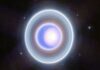
The rings of Uranus are far more complex and chemically diverse than previously assumed. While they may appear as uniform halos in distant photographs, new research reveals that the planet’s outermost rings are composed of radically different materials. This discovery not only reshapes our understanding of these specific rings but also offers critical clues about the violent history and formation of the entire Uranian system.
By synthesizing nearly two decades of observations from the Keck Telescope, the Hubble Space Telescope, and the James Webb Space Telescope, astronomers have peeled back the veil on Uranus’s faintest structures. The study, led by Imke de Pater of the University of California, Berkeley, highlights a stark contrast between two outer rings: the mu and nu rings.
A Study in Contrasts: Blue Ice vs. Red Dust
The most striking finding is the distinct coloration and composition of these two neighboring rings, which suggests they originate from different sources and processes.
- The Mu Ring (Outer): This ring appears blue in observations. The color indicates it is composed of tiny, pure water-ice grains. These particles are believed to be ejected from Mab, a small moon orbiting near the ring. This implies that Mab is primarily icy, differing from the rocky composition of other nearby moons.
- The Nu Ring (Inner): In contrast, this ring appears red. It is rich in dust and contains complex organic molecules known as tholins. Unlike the mu ring, the source of this dusty material remains unidentified, suggesting it comes from unseen, smaller rocky bodies.
“The mu ring looks very blue, indicating tiny ice grains, while the nu ring is red, rich in dust and tholins.” — Imke de Pater, UC Berkeley
The Mystery of Mab’s Ice Supply
The origin of the ice in the mu ring raises interesting questions about planetary mechanics. On Saturn, the similar E ring is fed by Enceladus, which shoots massive plumes of water vapor and ice from a subsurface ocean. However, Mab is too small—only about 12 kilometers across—to sustain such volcanic activity.
Instead, researchers propose a more mundane but constant process: micrometeoroid impacts. Tiny rocks striking Mab’s surface likely chip away at its icy crust, sending specks of ice into orbit to form the ring. Tracy Becker of the Southwest Research Institute notes that while the parallels with Enceladus are exciting, the mechanism is likely different.
“We don’t think that plumes would be possible on such a tiny moon like Mab, but still the parallels are exciting,” Becker explains.
Collisions and Changing Brightness
The nu ring presents its own set of mysteries. Its reddish hue and dust content are less surprising than the fact that its source bodies have not been directly observed, implying they are quite small. Furthermore, the ring is dynamic.
Data shows that the nu ring’s brightness halved between 2003 and 2006. This fluctuation suggests a major event may have occurred prior to 2003, such as a significant collision within the ring system that temporarily increased its density and reflectivity before settling back down.
Rewriting the History of Uranus
Perhaps the most profound implication of this research is not just what the rings are made of, but why their sources are so different despite occupying similar orbital zones.
If the rocky material in the nu ring came from a shattered moon, why is Mab—an icy body—still intact? De Pater suggests that Mab might be a fragment of one of Uranus’s larger, distant icy moons that broke off and migrated inward. If true, this points to a chaotic past where moons collided, shattered, and migrated, leaving behind the diverse debris fields we see today.
“This gives us two or three more really important puzzle pieces to start putting the Uranus system into perspective,” says Becker. “Maybe the puzzle’s a little bit bigger and harder than we thought.”
Conclusion
The discovery that Uranus’s outer rings are chemically distinct—blue ice from a battered moon and red dust from unseen rock—challenges previous assumptions about the uniformity of ring systems. It suggests that the Uranian system is a complex archive of past collisions and migrations, requiring far more observational data to fully decode its history.