On April 24, the scientific community celebrated a major milestone: the 36th anniversary of the Hubble Space Telescope. To mark the occasion, a rare and striking high-resolution photograph was released, offering a perspective of the iconic instrument that is seldom seen by the public.
A Birthday Gift from Orbit
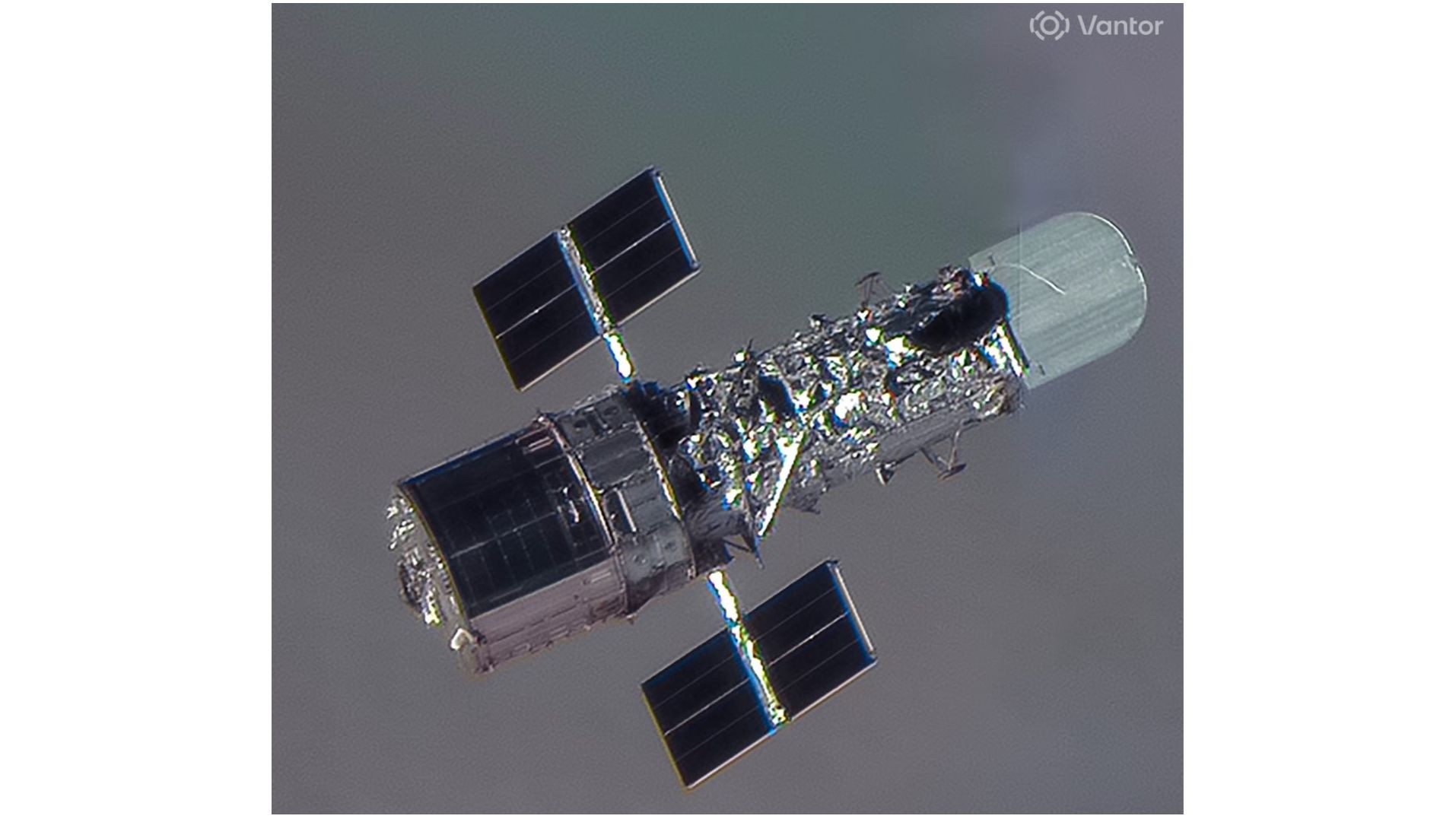
The stunning close-up was captured not by a deep-space probe, but by one of Earth’s own observing satellites. The Colorado-based spatial intelligence company Vantor (formerly Maxar Intelligence) released the image via X, revealing a detailed view of Hubble taken by its WorldView Legion 4 satellite.
The photograph provides an unprecedented level of detail, showcasing:
* Hubble’s signature cylindrical body.
* The gleaming thermal shielding designed to protect sensitive instruments.
* The extended solar arrays that power the telescope.
* The open aperture door at the front of the instrument.
The shot was taken from a distance of just 34.8 miles (61.8 kilometers), providing a level of clarity that highlights the telescope’s physical engineering as much as its scientific output.
The Technology Behind the Shot
The ability to capture such a sharp image is a testament to the advancing capabilities of Earth-observation technology. The image was captured by the WorldView Legion constellation, a group of six satellites orbiting approximately 322 miles (518 km) above the planet.
These satellites are designed for extreme precision, capable of resolving features on Earth as small as 11.8 inches (30 cm). In this instance, the WorldView Legion 4—which launched in August 2024 aboard a SpaceX Falcon 9—used that same high-resolution capability to turn its lens toward one of humanity’s most important scientific tools.
A Legacy of Resilience and Discovery
Since its launch into Low Earth Orbit (LEO) aboard the Space Shuttle Discovery on April 24, 1990, Hubble has become a symbol of scientific perseverance.
The telescope’s journey has not been without setbacks. Shortly after deployment, it was discovered that Hubble possessed a flawed primary mirror, which initially resulted in blurry images. However, a landmark servicing mission by astronauts in 1993 corrected the defect, transforming Hubble from a scientific disappointment into a revolutionary engine of discovery.
For over three decades, Hubble has fundamentally changed our understanding of the cosmos, providing the data necessary to study the expansion of the universe, the life cycles of stars, and the existence of distant galaxies.
“For over three decades, Hubble has expanded our understanding of the universe — delivering breathtaking imagery and groundbreaking science that continue to inspire.”
Conclusion
This rare photographic tribute highlights the intersection of two different eras of space technology: the legendary deep-space observatory and the modern, high-precision satellites that monitor our own planet. It serves as a reminder of Hubble’s enduring legacy and its continued relevance in the age of modern space exploration.