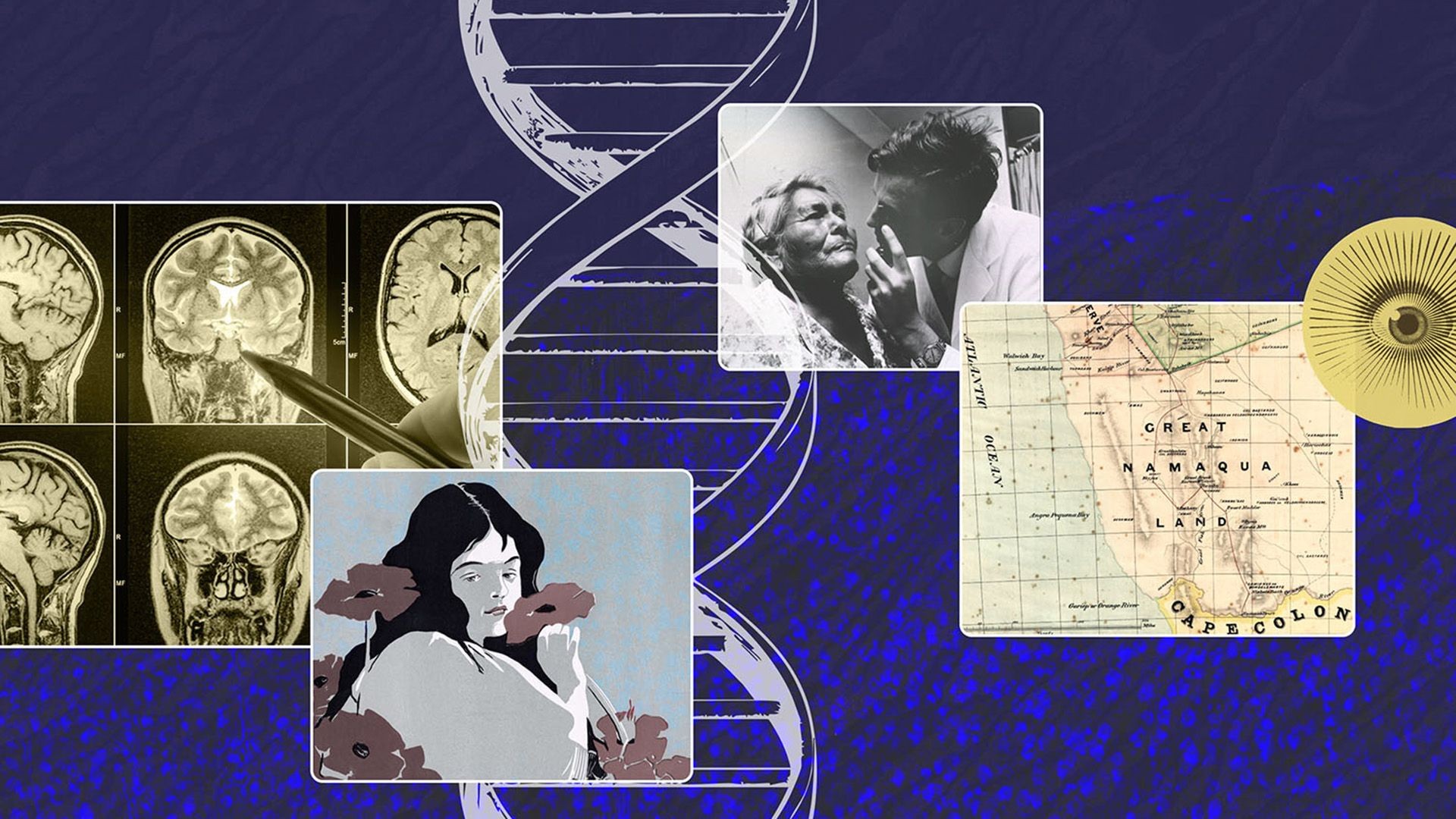
Wind kicks up dust in Lambert’s Bay. Jack van Honk drives down an unpaved road, turning into a neighborhood that looks like it held onto the last century a little tighter than the rest. A woman in a red sundress steps out. Sea-green house, ochre yard, medicinal pots cluttering the ground. She smiles, wrinkles deepening around her eyes. Forty-seven years old but careworn beyond measure. “Doctor! I missed you.” Her voice is barely a whisper. Husky. Scarred.
Maria carries a mutation that hardly exists outside this corner of the world.
The genetic defect calcifies her basolateral amygdala. It thickens and scars her vocal cords. But functionally? She’s fine. Holds a job. Runs a household. Raises two teenagers. “You talk to her,” says van Honk, a neuroscientist, “and you don’t see anything wrong.” She’s sweet. Kind. She struggles to remember even a fleeting moment of unhappiness, except for kicking out her drunk partner years ago.
Yet when tested on moral choices and risk, Maria breaks in ways that shouldn’t make sense.
The Fear Center Myth
For decades the amygdala was the brain’s “fear center.” An almond-shaped structure. The switch. You flip it and the mouse freezes. Early experiments in rats made this look undeniable. Show them a tone. Shock them. They freeze at the tone alone. Destroy the amygdala? The fear response vanishes. Simple. Elegant. Almost mythical.
But simplicity is a trap.
Elizabeth Phelps at Harvard says the amygdala isn’t a switch. It’s a hub. A “Grand Central Station.” It helps detect what matters. It connects social signals to decision making. The people with Urbach-Wiethe disease—like Maria—offer a unique look into this circuitry because their condition hits specific parts of the amygdala while leaving others intact. It’s surgical damage from inside.
Van Honk thinks the basolateral amygdula works like a social compass. It weighs who matters. It calculates social stakes. Phelps is skeptical but intrigued. The data is piling up.
There was a patient named S.M. in the 90s. Famous in the field. Her amygdala had mostly calcified. Antonio Damasio tested her. She couldn’t recognize fear on other people’s faces. She claimed to hate snakes. Yet he took her to an exotic pet store. She held a snake. For three minutes. “This is so cool!” she said. She wanted to touch bigger snakes. Horror films? Nothing. Haunted houses? Boring. Damasio called it a “profound impairment in fear.”
Van Honk was hooked by S.M. Then he went to South Africa.
The Southern Exception
Urbach-Wiethe disease is rare. Known as lipoid proteinosis. It causes papery skin and throat issues. But the brains? Some develop calcification. In South Africa specifically a cluster exists. It traces back to two immigrants from Cologne, Germany in the 1600s. A brother and sister who married into the Dutch settler colony. Their descendant passed a defective gene into the mixed-race populations of Namaqualand in the Northern Cape.
Recessive. Needs two copies of the gene.
Clinical psychologist Helena Thornton started tracking them down. She found dozens of people. An entire community with the disorder. A neuroscientist’s gold mine. In 2000 Van Honk arrived with a colleague named David Terburg. They expected S.M.-style results. Fearless people.
They found the opposite.
These women were anxious. Hyper-vigilant. Prone to fear. Terburg spent five years trying to get these results published because the peers hated it. It contradicted the icon of S.M. How could a damaged fear center create more fear?
Then the MRI tech arrived. High resolution scans in 2007. They saw exactly what was broken. Not the whole amygdala. Just the basolateral part. The central-medial part remained intact. The central part handles fast defensive reflexes like freezing. The basolateral part handles weighing consequences. It handles social calculus.
The damage created a glitch. A disconnect.
Money And Morality
Van Honk moved to Cape Town permanently in 2008. He narrowed the study group. Cut out the alcoholics. Kept the women whose voices rasped but whose minds were sharp. They turned to game theory. Economics experiments. Things like the “trust game.” You get money. You decide how much to give to a stranger with no promise they will return it. Most people are cautious.
The women with the mutation threw caution out the window.
They invested heavily. Recklessly. They didn’t adjust their spending based on the risk of a stranger stealing or losing it. Something in the calculation was broken. They couldn’t weigh the unknown against the self-interest properly.
Then there were the trolleys.
You know the trolley problem. One person dies or five? Standard moral dilemma. Utilitarian math says push the guy off the bridge. The women refused. Every time. Even when the stakes grew extreme. They understood the logic. They knew five people were worse than one. But the act of killing? It hurt too much. Not emotionally in a volatile way but structurally. Their brains couldn’t compute the trade-off. The basolateral amygdala seems to help us process that social cost.
Tobias Kalenscher came to visit in 2023. He studies rats. Lesion the rats’ basolateral amygdalae and they stop caring if their peers eat. They only want treats for themselves. Van Honk tested this on the human women. He asked them to imagine sharing money with people at varying distances. Family first. Friends second. Strangers last.
In normal brains generosity drops gradually with distance.
In the mutated brains it drops like a stone. Sharp drop off.
But wait. Maybe they’re just stingy with money. Maybe they just don’t like parting with cash. So in November 202 they removed money from the equation. They gave Maria and the others a hand dynamometer. Squeeze it. The harder you squeeze the more benefit someone gets. No resource division. Just effort for love versus effort for a stranger.
Normal women press hard for their spouses. Press lightly for strangers.
The women with the disease press just as hard for a stranger as for their husband.
They can’t adjust. The social dial is stuck. The basolateral amydgala helps us tune our behavior to the person in front of us. When it calcifies the tuning stops. They aren’t fearless. They are socially tone-deaf in ways that mimic extreme anxiety. Because they don’t know who is safe and who isn’t they assume the threat level is maxed out all the time.
Maria sits in her kitchen. The plants outside. The scarred voice. She doesn’t know about dynamometers. She doesn’t care about rat experiments. She just wants to be alone sometimes but also knows she’s not. The science says her brain is wired for a social calculus she can no longer run. But looking at her the data feels incomplete. Cold. There’s a quiet there. A steadiness. It isn’t bravery. It’s something else entirely.