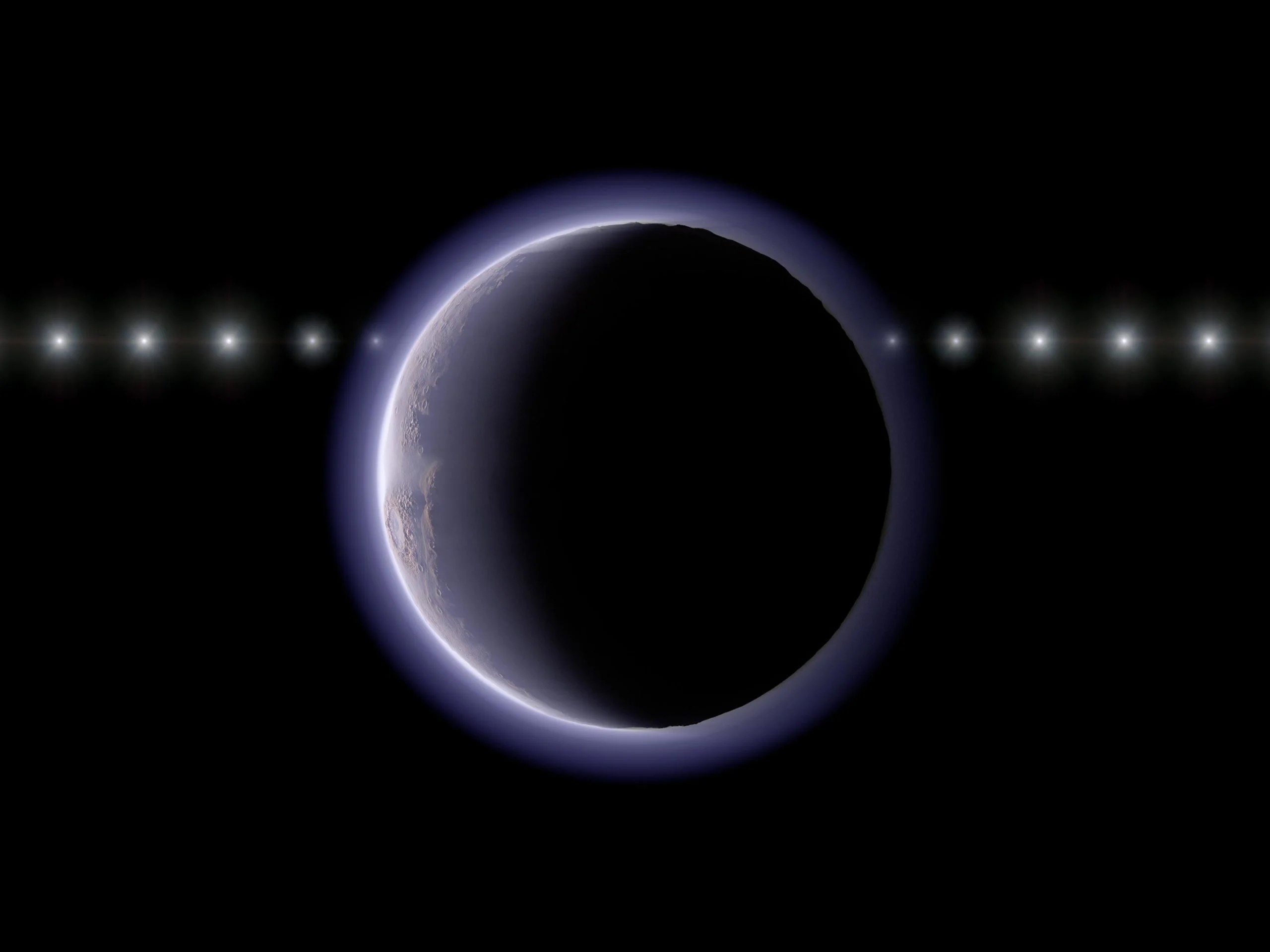
A small, icy body in the outer reaches of our Solar System is defying expectations by holding onto a thin atmosphere. This discovery challenges long-held assumptions about how small celestial bodies behave in the cold vacuum of space and suggests that a recent, dramatic event may have altered its surface.
The object, known as (612533) 2002 XV93, orbits the Sun far beyond Neptune. Despite being roughly 500 kilometers in diameter—less than a quarter the size of Pluto—astronomers have detected signs of a gaseous envelope surrounding it. This finding is significant because objects of this size typically lack the gravity necessary to retain an atmosphere against the relentless pull of solar wind and thermal escape.
The Mystery of the Airless Outer Solar System
To understand why this discovery is so unusual, one must consider the harsh environment of the Trans-Neptunian Region (TNR). This distant zone is populated by icy remnants from the formation of the Solar System. Most objects here are essentially airless rocks and ice.
The physics are straightforward:
* Weak Gravity: Small bodies have insufficient gravitational pull to hold onto gas molecules.
* Extreme Cold: While low temperatures usually help preserve volatiles, the vacuum of space allows any released gas to rapidly dissipate.
* Solar Wind: Charged particles from the Sun strip away any lingering atmosphere.
Pluto is the notable exception, possessing a substantial atmosphere due to its larger mass and specific orbital dynamics. For an object as small as 2002 XV93 to retain gas, there must be a continuous or recent source replenishing it, otherwise, the atmosphere would vanish in a geological blink of an eye.
A “Natural Experiment” Reveals the Hidden Gas
Detecting an atmosphere around such a faint, distant object is nearly impossible with direct imaging. Instead, astronomers relied on a rare astronomical alignment known as an occultation.
On January 10, 2024, 2002 XV93 passed directly in front of a distant star from the perspective of Earth. This event provided a natural laboratory for observation:
* No Atmosphere: If the object were bare rock, the star’s light would disappear instantly, like a switch being flipped.
* With Atmosphere: If gas surrounded the object, the starlight would dim gradually as it passed through the varying densities of the atmosphere, creating a smooth fade-out.
A team led by Ko Arimatsu from the National Astronomical Observatory of Japan (NAOJ) coordinated observations from multiple sites across Japan. Their data showed a gradual fading of the starlight, consistent with the presence of a thin, tenuous atmosphere. This subtle signal confirmed that 2002 XV93 is not the barren rock scientists previously assumed.
Why This Atmosphere Is a Temporary Phenomenon
The most intriguing aspect of this discovery is the atmosphere’s instability. Calculations indicate that the gas surrounding 2002 XV93 cannot persist for long. Without a constant supply of new material, the atmosphere would dissipate in less than 1,000 years.
This short lifespan raises critical questions:
1. When did it form? The atmosphere must have been created or refreshed very recently in astronomical terms.
2. What is the source? Where is the gas coming from?
Data from the James Webb Space Telescope (JWST) complicates the picture. Observations show no clear evidence of surface ice that could sublimate (turn directly from solid to gas) to maintain the atmosphere. This rules out the most common explanation for such phenomena: slow outgassing from frozen volatiles like nitrogen or methane.
Possible Explanations for the Anomaly
With the standard model of slow sublimation unlikely, scientists are exploring more dynamic scenarios:
- Internal Outgassing: Material from deep within the object’s interior may have breached the surface, releasing trapped gases. This could indicate internal geological activity, which is rare for bodies of this size.
- Recent Impact: A collision with a comet or another small body could have excavated subsurface ices or directly delivered volatile material, creating a temporary atmospheric burst.
“The detection of an atmosphere on such a small object suggests that the outer Solar System is more dynamic than previously thought,” the research implies.
Conclusion
The discovery of an atmosphere on (612533) 2002 XV93 serves as a reminder that our understanding of the Solar System’s distant frontier is still evolving. It highlights that even tiny, cold worlds can undergo rapid changes driven by internal processes or external impacts. Further observations will be crucial to determine the exact source of this fleeting atmosphere and to understand how such small bodies can briefly defy the harsh conditions of deep space.