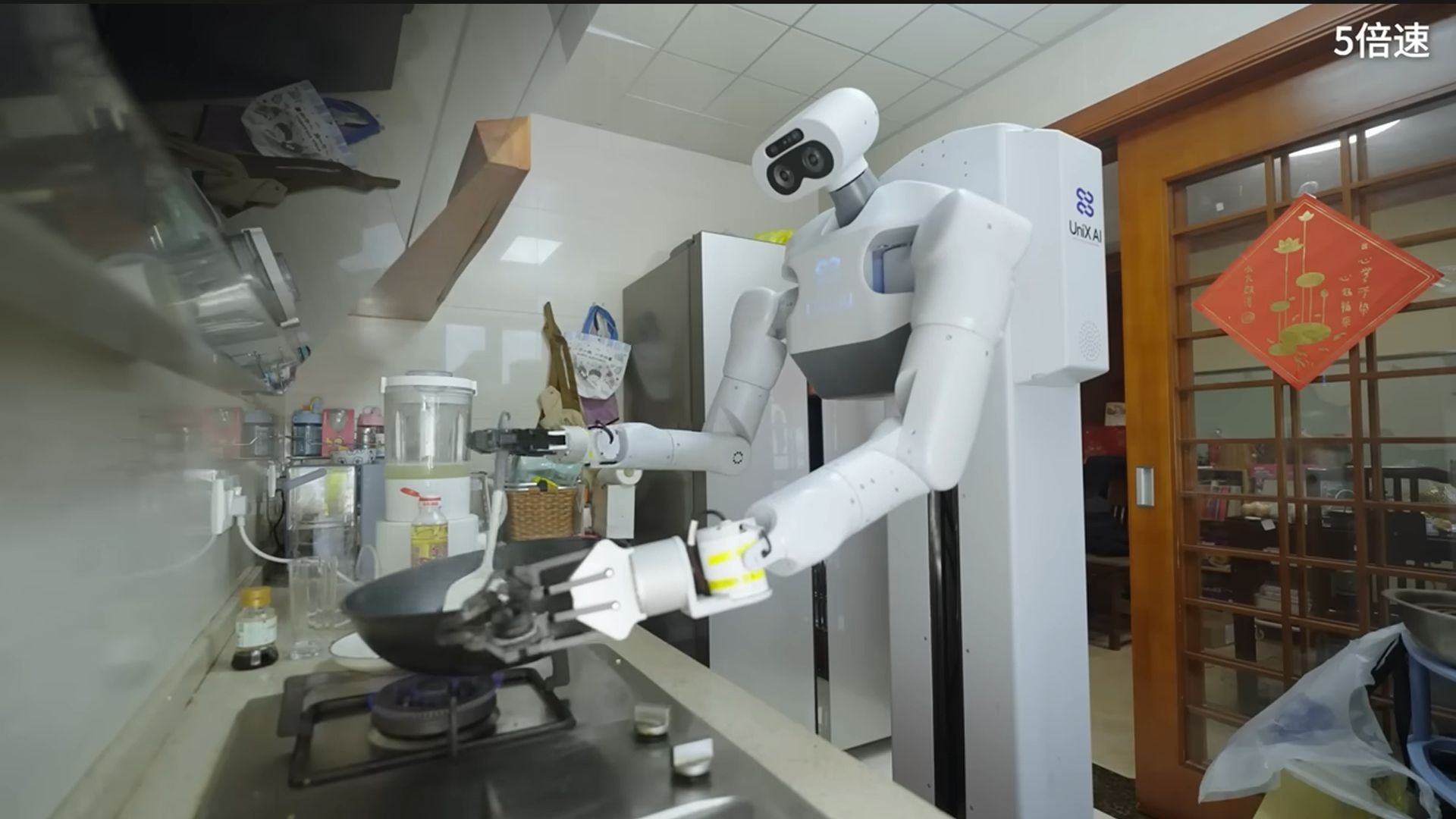
The dream of having a robotic assistant to handle the drudgery of daily life is moving from science fiction toward commercial reality. Chinese robotics firm UniX AI has officially announced the release of Panther, a humanoid service robot specifically designed to navigate and assist within domestic and professional environments.
Unlike many experimental humanoid projects that remain confined to research labs, UniX AI has already begun commercial deliveries of the Panther model, signaling a significant shift from prototype to a market-ready product.
Designed for Utility Over Aesthetics
While many developers focus on making robots look and move exactly like humans, UniX AI has taken a more pragmatic approach. The engineers have prioritized stability and task efficiency over human-like locomotion.
Key technical specifications include:
– Physical Build: Standing 5’3″ (1.6m) tall and weighing 176 lbs (80kg), the robot features a body capable of vertical extension by 31 inches (80cm) to reach both high shelves and floor-level tasks.
– Mobility: Instead of walking on legs—which can be prone to instability and falling—Panther utilizes an omnidirectional four-wheel drive (4WS+4WD) chassis. This allows it to maneuver smoothly through indoor spaces at a brisk walking pace of roughly 6 feet per second.
– Sensory Awareness: The robot employs binocular vision, webcams, Lidar, and ultrasonic sensors to map its surroundings and maintain spatial awareness.
Advanced Dexterity and Task Management
To perform complex chores like cooking or cleaning, a robot requires more than just movement; it needs fine motor skills. Panther addresses this through its specialized hardware and software:
1. Bionic Manipulation
The robot is equipped with two mass-produced 8-Degree-of-Freedom (8-DoF) bionic arms. These arms provide a total of 34 degrees of freedom, allowing for highly fluid, human-like movements. Its “intelligent grippers” are designed to adapt to various shapes, enabling the robot to switch seamlessly between delicate tasks (like holding a spatula) and heavy-duty cleaning (like using a toilet brush).
2. Intelligent Task Planning
Panther operates on an integrated technology stack that utilizes imitation learning and long-term task planning. This allows the robot to break down complex, multi-step instructions—such as “make tea” or “clean the kitchen”—into a sequence of logical actions.
Beyond the Home: A Multi-Sector Tool
While the promotional demonstrations highlight domestic tasks like making the bed, cooking breakfast, and cleaning countertops, UniX AI envisions a much broader application for Panther. The company views the robot as a “reliable productivity tool” for several sectors:
- Hospitality & Retail: Assisting in hotels, reception desks, and guided tours.
- Healthcare: Providing elderly care and companionship.
- Professional Services: Supporting research, education, and security operations.
“We are not only building advanced technology… we are bringing robots into homes, hotels, public spaces, and security operations,” stated Fred Yang, founder and CEO of UniX AI.
Why This Matters
The arrival of Panther highlights a growing trend in robotics: the move away from “humanoid mimicry” toward “functional utility.” By choosing wheels over legs and focusing on specialized grippers, developers are solving the immediate problem of reliability. If robots can successfully navigate a cluttered living room without falling, they become viable tools rather than expensive novelties.
However, the widespread adoption of such machines will likely raise new questions regarding domestic privacy, the integration of AI in private spaces, and the long-term economic impact on service-based labor.
As of now, UniX AI has not disclosed the retail price for the Panther model.
Conclusion: Panther represents a practical leap in robotics by prioritizing stable, wheeled movement and advanced dexterity over human-like walking, positioning it as a versatile tool for both home and commercial service industries.