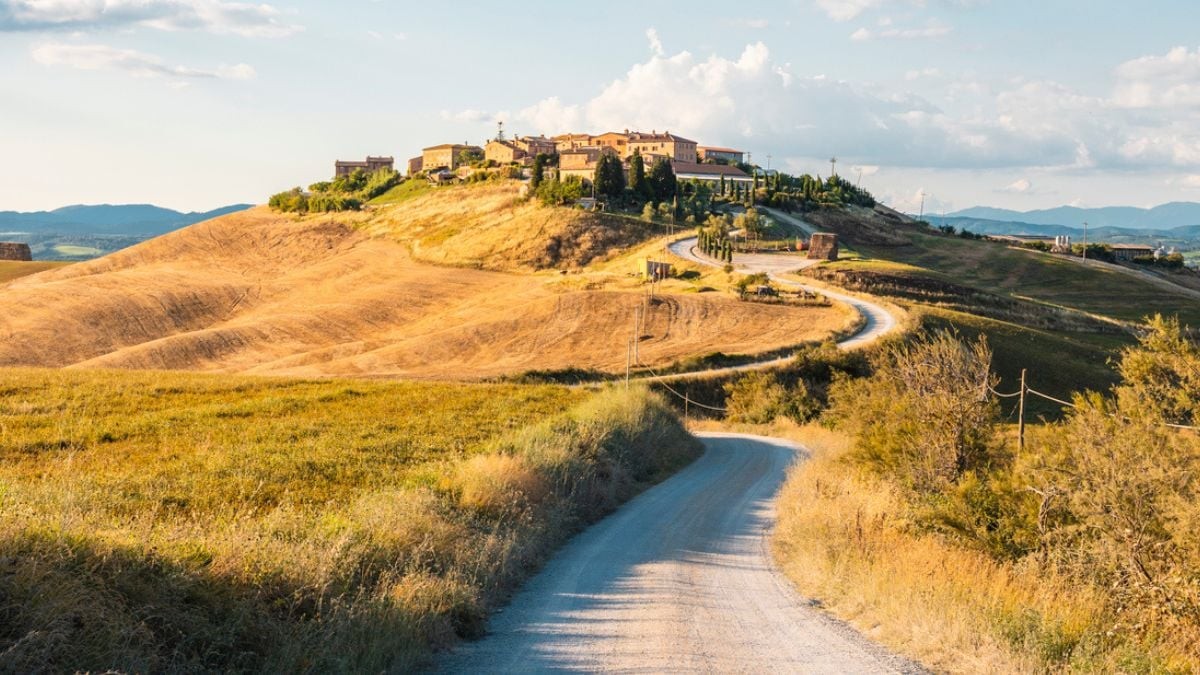
Scientists have uncovered a massive, hidden reservoir of magma churning deep beneath the Tuscan landscape. Despite the region’s lack of active volcanoes or visible surface indicators, researchers have identified a colossal system of molten rock and supercritical fluids that rivals some of the world’s most powerful volcanic systems.
A “Sleeping Beast” Without a Surface Signature
While volcanic regions like Iceland or the American West are often marked by sulfurous plumes, steaming springs, or visible craters, Tuscany remains deceptively quiet. However, deep beneath the surface—at depths of 8 to 15 kilometers (5–9 miles) —a vast volume of magma is estimated to be moving.
The scale of this discovery is staggering. Researchers estimate the reservoir contains more than 5,000 km³ of magma and partial melt. To put this in perspective, this volume is comparable to the upper magma chambers of the Yellowstone supervolcano, one of the most powerful volcanic systems on Earth.
The central mystery remains: why has a system this large never produced a major eruption? Unlike the supervolcanoes of North America or the Taupō zone in New Zealand, Tuscany shows no historical record of explosive volcanic activity, leaving geologists to debate why this “magmatic beast” remains dormant.
How the Discovery Was Made
The discovery was led by an international team of geoscientists, including researchers from the University of Geneva (UNIGE), Italy’s Institute of Geosciences and Earth Resources, and the Italian National Institute of Geophysics and Volcanology.
Rather than drilling, the team used a sophisticated network of seismometers to “see” into the Earth. This process, known as seismic tomography, works similarly to a medical X-ray, using seismic waves to map the composition of the subsurface. By analyzing how these waves moved through the crust, the team was able to model the upper 15 kilometers of Tuscany’s continental crust and identify the presence of the massive melt.
Beyond Volcanology: Implications for the Green Transition
While the discovery is a landmark for fundamental geological research, it also holds significant practical value for the future of energy and technology. The presence of such intense heat and fluid movement offers several opportunities:
- Geothermal Energy: The extreme temperatures—potentially exceeding 500 °C (932 °F) —could be harnessed to provide stable, renewable geothermal power.
- Critical Minerals: These deep, high-heat systems are often associated with deposits of lithium and rare earth elements, both of which are essential for manufacturing electric vehicle batteries and other green technologies.
- Cost-Effective Exploration: The study demonstrates that seismic tomography is a fast, low-cost method for mapping the subsoil, making it a vital tool for the global energy transition.
Why This Matters
This finding challenges our understanding of how volcanic systems evolve. It raises a critical question for geologists: What prevents a massive reservoir of magma from erupting? By studying why Tuscany has remained stable despite its immense internal heat, scientists can better predict the long-term behavior of other volcanic systems around the world that may be quietly building toward a future eruption.
The discovery of this reservoir provides a unique window into the “enigmatic” processes that govern large-scale volcanic systems, offering clues into both the risks of super-eruptions and the potential for sustainable energy.
In summary, the discovery of a Yellowstone-sized magma reservoir beneath Tuscany reveals a massive, hidden energy source that could either redefine our understanding of volcanic evolution or provide a crucial boost to the renewable energy sector.