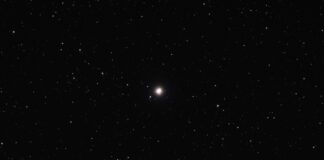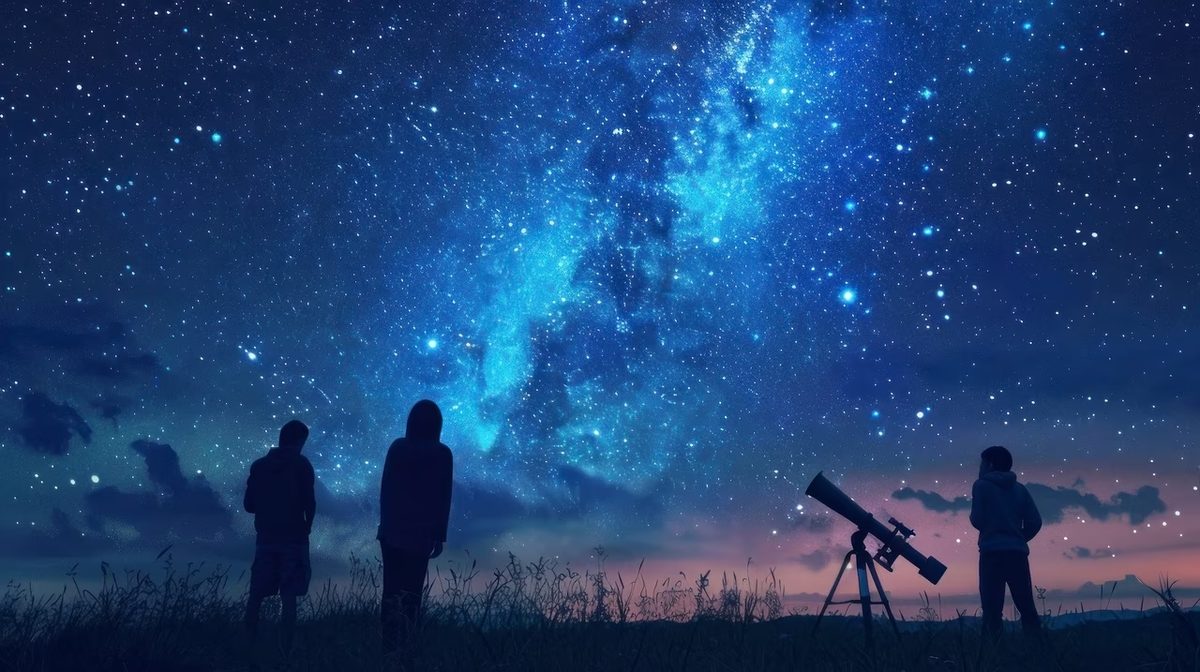
They haven’t shared the sky like this in years. Mars, the Red Planet, and Jupiter, the Gas Giant, are finally getting close again. If you look up during the nights of mid-August, you will see them sitting side-by-side. The alignment peaks on August 14 and 15.
You do not need a telescope. You do not even need binoculars. This is a naked-eye event. The two planets will be bright enough to spot with just your own eyes, provided you have a clear view of the horizon away from city lights.
“Nul besoin de lunettes astronomiques pour les observer, les deux planètes seront observables à l’œil nu.”
But if you happen to have a telescope pointed at the sky, the view changes entirely. You can go beyond simple dots of light. You can see details. Specifically, you can spot Jupiter’s four Galilean moons.
These are the big ones. The ones Galileo first observed centuries ago. They are Io, Europa, Ganymede, and Callisto. Looking through a telescope, they appear as tiny stars lined up near the planet. It is a different experience than just glancing up. It feels scientific.
The proximity of Mars and Jupiter creates a striking contrast. One is reddish-orange. The other is a steady, bright white. They hang there together, a reminder that the solar system is still dynamic. Still moving. Still putting on a show for anyone willing to look up.
Why wait for August? Because this kind of conjunction doesn’t happen often. When it does, the planets are often visible during twilight or early night hours. You don’t need to stay up until dawn. Catch them while they are still up. The window is short. The opportunity is real.
So, step outside. Find a spot with minimal light pollution. Look toward the sky. You are seeing two worlds in one frame of reference. It is simple astronomy. But it is also profound.
The moons of Jupiter might be too small to see with the naked eye. But their existence proves that Jupiter is not just a planet. It is a system. A mini-solar system in its own right. Seeing them adds context to the beauty of the planet itself.
Mars is distant. Jupiter is immense. But together, in the same patch of sky, they create a moment of cosmic coincidence. It is worth noting how easily we can miss these things if we are distracted by screens or streetlights.
The planets are there. They have been there for eons. They will be there long after we are gone. But right now, in August 2023, they are neighbors again. And for a few nights, they are ours to watch.
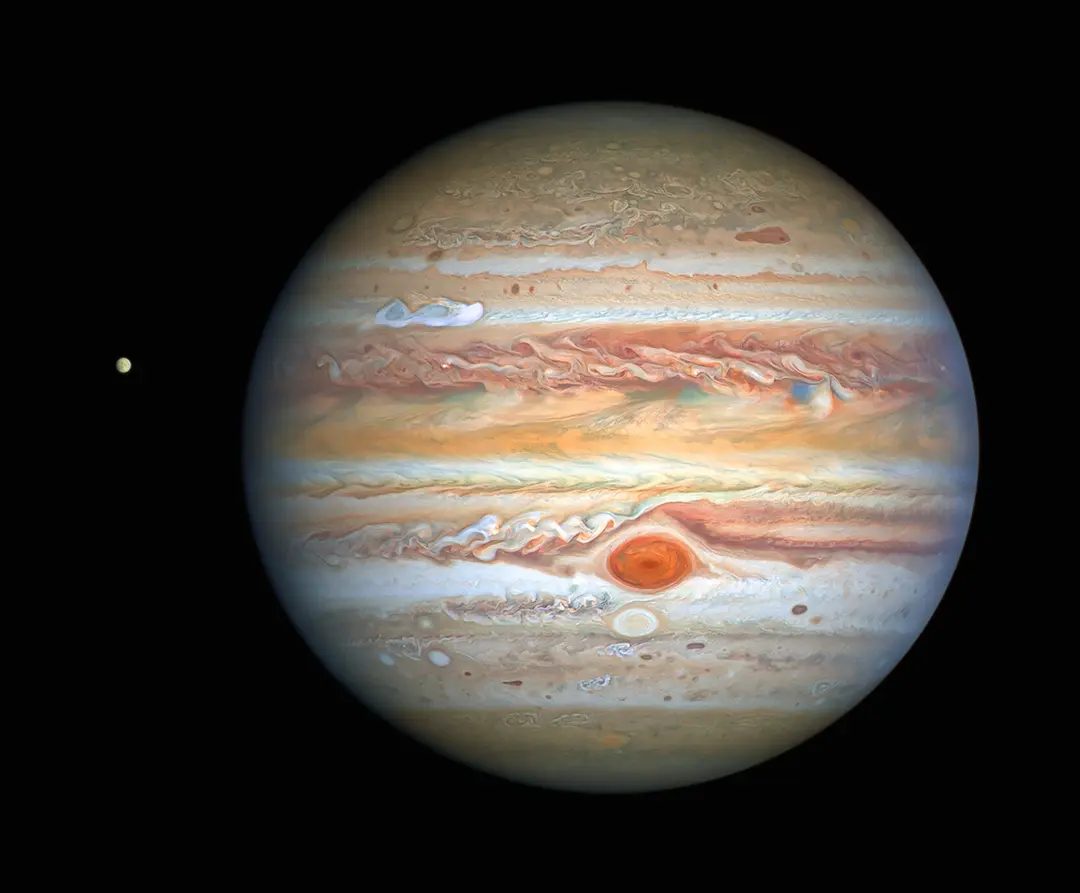

The 2020 Jupiter-Mars Alignment Explained
You might have looked up on December 21 and seen two bright points of light sitting shoulder-to-shoulder in the night sky. It looked intimate. It looked like a cosmic hug. But here is the catch: it was an optical illusion. Jupiter and Mars conjunction events like this are rare, but the planets were nowhere near each other. In reality, they were separated by roughly 575 million kilometers. That is a staggering distance. One planet is a gas giant. The other is a red, rocky world. They were just lined up from our perspective on Earth.
This specific alignment hadn’t happened since 2018. The visual closeness made it feel special. It wasn’t just another random star match. People took photos. They shared them online. They wondered if it meant something bigger. It didn’t. It just meant we were in the right spot at the right time to see two distant worlds overlap in our field of view.
Why the Distance Doesn’t Matter for the View
The scale of space is hard to wrap your head around. When you see Jupiter and Mars appear close together, your brain tries to compress that depth. It treats the sky like a flat canvas. But space is three-dimensional. Deeply so.
Jupiter sits about 4.3 AU from the sun. Mars is closer, around 1.5 AU. During this conjunction, they were on opposite sides of their orbits relative to Earth. Or at least, far enough apart that their physical separation was massive. 575 million kilometers is not a typo. It is nearly four times the distance from the Earth to the sun. If you could fly there at commercial jet speeds, you would die of old age before you arrived.
So why does it matter? Because it reminds us that our view of the universe is a projection. We are seeing light that traveled for minutes and hours to hit our eyes. The timing of that arrival creates the illusion of proximity. The planets themselves? They are strangers passing in the night.
How to Spot the Difference
If you are looking for other alignments, remember this rule: brightness does not equal closeness. Jupiter is massive. It reflects a lot of sunlight. It shines bright white-yellow. Mars is smaller. It reflects light differently, often appearing reddish. In this conjunction, they were close enough to confuse the naked eye. But with a small telescope or even binoculars, you could see they were distinct objects.
This isn’t the first time we’ve seen this. It won’t be the last. Conjunctions happen when planets line up from Earth’s vantage point. They are predictable. Astronomers calculate them years in advance. But they still carry a sense of wonder. That sense doesn’t come from the planets touching. It comes from realizing how small we are in the middle of all this movement.
“The universe is under no obligation to make sense to you.”
That quote often gets thrown around. It fits here. We want the sky to be simple. We want points of light to mean something personal. But the sky is just physics. Gravity. Orbit. Light. The beauty is in the mechanics. Not the romance.
What Comes Next
The next time two bright objects appear close in the sky, check the ephemeris.
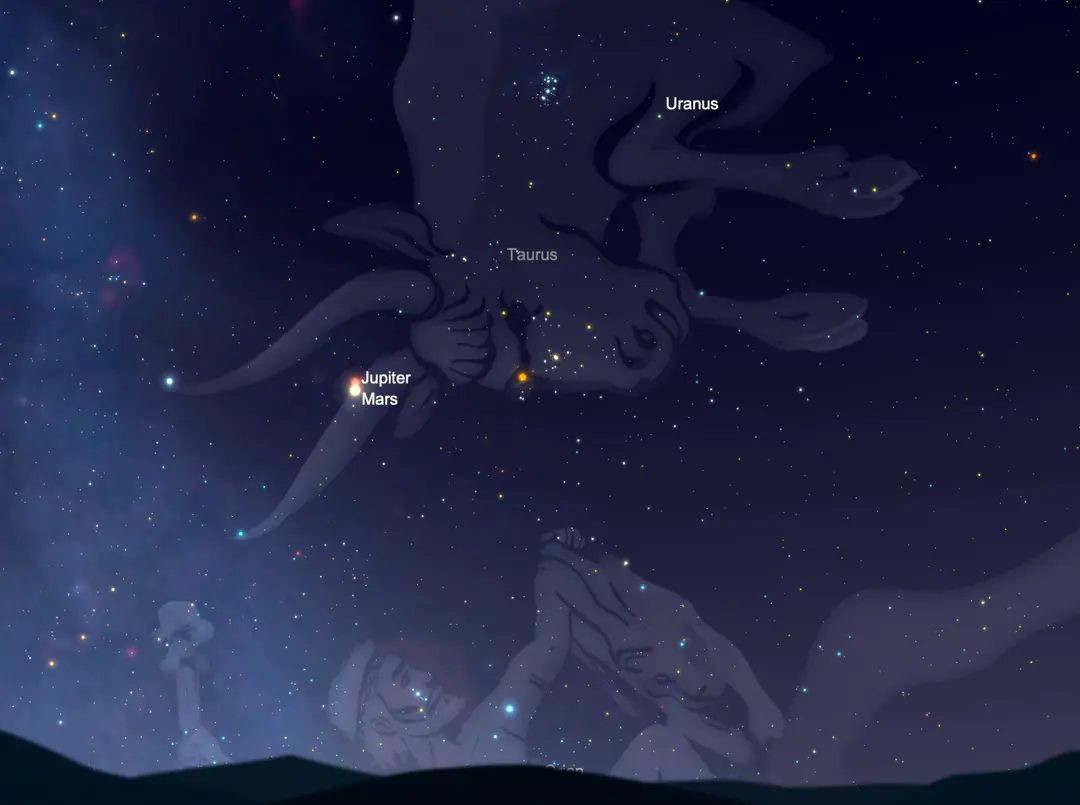

The sky is about to put on a light show. Mars and Jupiter will hit their closest point in the evening sky this Wednesday, August 14. They aren’t just near each other. They are hanging out together in Taurus, right next to the Pleiades star cluster. You might know the Pleiades as the Seven Sisters.
This is not a subtle alignment. Both planets are bright. Really bright. Jupiter brings a steady, non-twinkling white light. Mars adds a distinct reddish hue. Together, they dominate the horizon. Observers are calling this the most impressive planetary conjunction of the year. The contrast between the red planet and the gas giant is stark. It creates a visual anchor in the night sky that is hard to miss.
Why this specific date matters
If you missed the window last year, don’t panic. But you might have to wait a long time for another chance like this. The geometry of the solar system is tricky. Mars and Jupiter are on different orbits with different speeds. They line up often enough in astronomical terms, but a close, bright conjunction like this is rare.
The next time Mars and Jupiter will share the sky in such a striking way is 2033. That is nine years away. Most people will not get to see another event of this magnitude in their lifetime. It makes this Wednesday worth staying up for. Or looking out the window if you are in the right time zone.
Where to look
Find the Pleiades first. They are easy to spot with the naked eye or binoculars. They look like a tiny dipper or a fuzzy star. Once you have them, look nearby. You will see two bright objects. One is blue-white. The other is orange-red.
The conjunction happens as they approach their closest apparent distance. This is called superior conjunction for outer planets relative to Earth, but here we are talking about visual proximity from our viewpoint. The planets are actually millions of miles apart in space. But from Earth, they appear to touch.
How to plan your viewing
Check your local sunset time. Look west-northwest shortly after twilight fades. The planets will be low on the horizon initially. They rise higher as the night progresses.
Clear skies are essential. Cloud cover can ruin the view instantly. Light pollution helps reduce the contrast. If you can get away from city lights, the view is significantly better. Binoculars will show you the moons of Jupiter. You might see a line of them. Mars will appear as a disk rather than a point of light, assuming you have a decent telescope. But binoculars are enough to appreciate the separation and the color difference.
“The next conjunction of this type between Mars and Jupiter won’t happen until 2033.”
What makes this conjunction different
Other years have had Mars and Jupiter near each other. But the brightness matters. Some conjunctions happen when the planets are dimmer or further apart. This one hits peak visibility. The Pleiades cluster acts as a natural frame. It gives context. It shows you just how close these two giants are in our visual field.
It is a reminder of scale. The distance between Mars and Jupiter is vast. The distance from Earth to them is even vaster. Yet here they sit, side by side. It is a


The hype machine has been spinning for years. We are told that quantum computers will revolutionize medicine, crack encryption in seconds, and solve climate change models that currently crash supercomputers. But there is a catch. A massive one. The hardware is fragile. Unimaginably fragile.
Most people don’t realize that building a quantum bit is easy compared to keeping it alive. Decoherence is the enemy. Any stray photon, any slight change in temperature, any magnetic whisper can collapse the state. This is why quantum error correction isn’t just an optional upgrade. It is the single most important hurdle standing between a lab curiosity and a practical machine.
Why qubits are nightmares to manage
Classical bits are robust. One or zero. Push them around, store them for decades, and they stay put. Quantum bits are different. They exist in superposition until measured. This property gives them power but destroys their stability.
To build a useful quantum computer, you cannot rely on a single physical qubit. You need logical qubits. These are groups of physical qubits working together to correct errors on the fly. Think of it like a choir. One singer might hit a wrong note. The rest adjust. The song remains intact. Without this redundancy, the calculation fails instantly.
The ratio is staggering. Estimates suggest you might need a thousand physical qubits to create just one stable logical qubit. If we want a computer with 1,000 logical qubits capable of running Shor’s algorithm or complex molecular simulations, we are looking at a million physical qubits. And that is before we even talk about scaling the wiring or the cooling systems.
The race for fault tolerance
So, how do we get there? The industry is split on approaches. Superconducting circuits, like those used by Google and IBM, are good at speed but struggle with connectivity. Trapped ions offer high fidelity but are slow to operate. Photonic systems are fast and room-temperature friendly but hard to manufacture at scale.
The common denominator is error correction codes. The surface code is the current frontrunner. It arranges qubits in a 2D grid, constantly checking for parity errors. If an error is detected, the system corrects it without measuring the actual state. This preserves the quantum information while fixing the glitches.
But implementing a surface code requires more than just qubits. It requires fast, low-latency control electronics. You need to read the error syndromes and apply corrections in real-time. If the control system is too slow, the error propagates faster than you can fix it. The result is not just a bad calculation. It is a total system collapse.
Real-world implications of scaling up
Why does this matter to you? It matters because the applications are not theoretical anymore. Drug discovery is the first big target. Simulating protein folding or molecular interactions requires quantum precision. Classical approximations are getting better, but they hit a wall when complexity grows. A fault-tolerant quantum computer could simulate a new drug candidate in hours instead of years.
Cybersecurity is the other side of the coin. RSA encryption relies on the difficulty of factoring large numbers. A sufficiently large quantum computer can do this trivially. This is why post-quantum cryptography is already being standardized.