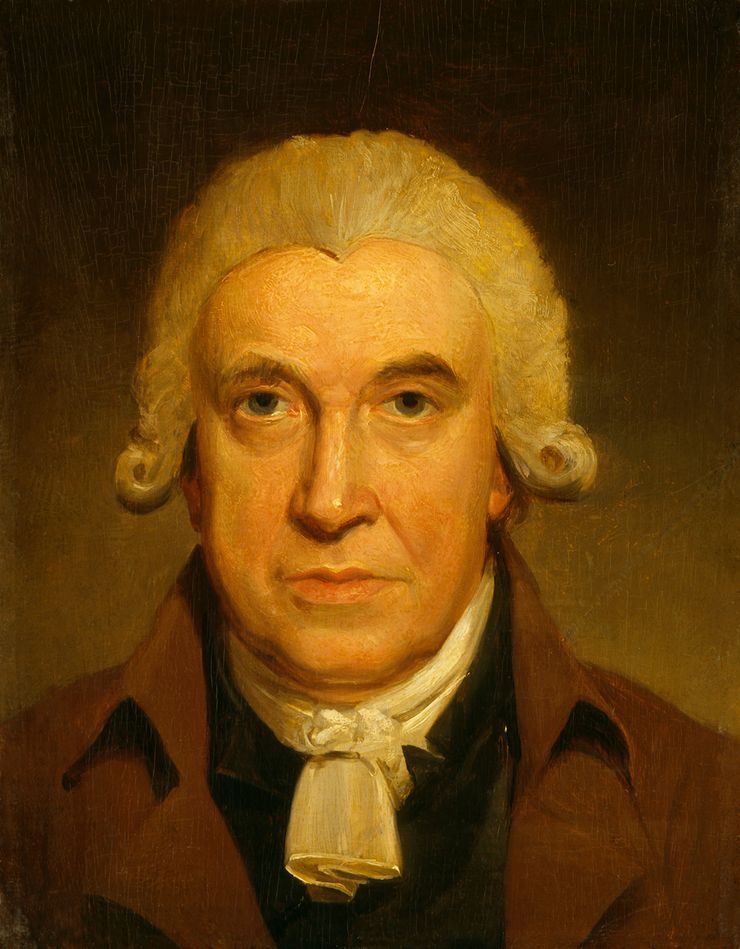
James Watt didn’t just invent the steam engine. He fixed it.
Born in Greenock, Scotland, in 1736, Watt was largely self-taught. He started as an instrument maker. Later, he worked on the Forth and Clyde Canal. He knew how things worked. He knew how they broke.
Thomas Newcomen had built the first practical steam engine decades earlier. It pumped water out of mines. It was clumsy. It wasted fuel. It was inefficient.
Watt saw the problem. The engine cooled down every time it reset. Energy was lost as heat. He figured out how to stop that.
The Separate Condenser That Changed Everything
In 1769, Watt patented a separate condenser.
This was the breakthrough. Instead of cooling the whole cylinder, he cooled a separate chamber. The main cylinder stayed hot. The steam condensed elsewhere. This small change boosted efficiency drastically.
He didn’t build them alone. Matthew Boulton provided the money and factory space. Together, they started manufacturing the new engine in 1775.
Boulton and Watt became partners. The business grew. The demand for efficient power was rising.
From Push to Pull: The Rotary Revolution
The original engines only moved up and down. That’s linear motion. Most machines needed to turn.
In 1781, Watt added rotary motion. He used a “sun-and-planet” gear to convert the up-and-down action into rotation. Now the engine could drive factory machinery. It could turn wheels. It could replace horses.
But it still had limits.
The Double-Acting Engine and Industrial Scale
By 1782, Watt introduced the double-acting steam engine.
Before, steam pushed the piston one way. Now, it pushed and pulled. The power doubled. The efficiency improved again.
This required a new way to connect the piston to the beam. The rod had to move in a straight line. It couldn’t wobble.
Watt solved this in 1784. He designed an arrangement of connected rods. The piston rod was guided perpendicularly. The mechanics were rigid. The engine was stable.
Control, Safety, and Legacy
An engine that runs away is dangerous. Watt cared about control.
In 1788, he applied the centrifugal governor. This device automatically regulated the engine’s speed. It responded to changes in load. If the engine spun too fast, the governor slowed it down. If it slowed, the governor sped it up. Automatic control. Decades ahead of its time.
He also invented a pressure gauge in 1790. Safety mattered. Monitoring pressure mattered.
These additions virtually completed the Watt engine.
Why It Matters Today
Watt’s engine had immense consequences. It powered the Industrial Revolution. Factories didn’t need to be near rivers. They could be anywhere. Production scaled. Cities grew.
Watt introduced the concept of horsepower to market his engines. He needed a way for farmers and manufacturers to understand how much power they were buying.
He died in 1819 at Heathfield Hall, near Birmingham.
But his name remains.
The watt is the unit of power.